p.13 抽出テキスト
3 Definitions and clinical impact

3.1 Definition and classification of AF

Atrial fibrillation is one of the most common heart rhythm disorders. A supraventricular arrhythmia with uncoordinated atrial activation, AF results in a loss of effective atrial contraction (see Supplementary data online for pathophysiology). AF is reflected on the surface electrocardiogram (ECG) by the absence of discernible and regular P waves, and irregular activation of the ventricles. This results in no specific pattern to RR intervals, in the absence of an atrioventricular block. The definition of AF by temporal pattern is presented in Table 5. It should be noted that these categories reflect observed episodes of AF and do not suggest the underlying pathophysiological process. Some patients may progress consecutively through these categories, while others may need periodic reclassification due to their individual clinical status. Over time, some patients with AF develop atrial and ventricular damage, which can make attempts at rhythm control futile. For this reason, or when patients and physicians make a joint decision for rate control, AF is classified as permanent (the most common ‘type’ of AF in historical registries).1

Despite many limitations, this task force have retained this temporal approach because most trials in patients with AF have used these definitions. Classifying AF by underlying drivers could inform management, but the evidence in support of the clinical use of such classification is currently lacking. Several other classifications have been applied to patients with AF, many of which have limited evidence to support them. The definition of AF is a developing field and ongoing research may allow for pathology-based strategies that could facilitate personalized management in the future. Table 6 presents some commonly used concepts in current clinical practice. Due to the lack of supporting evidence (particularly for the time periods stated), this task force have edited and updated these definitions by consensus.

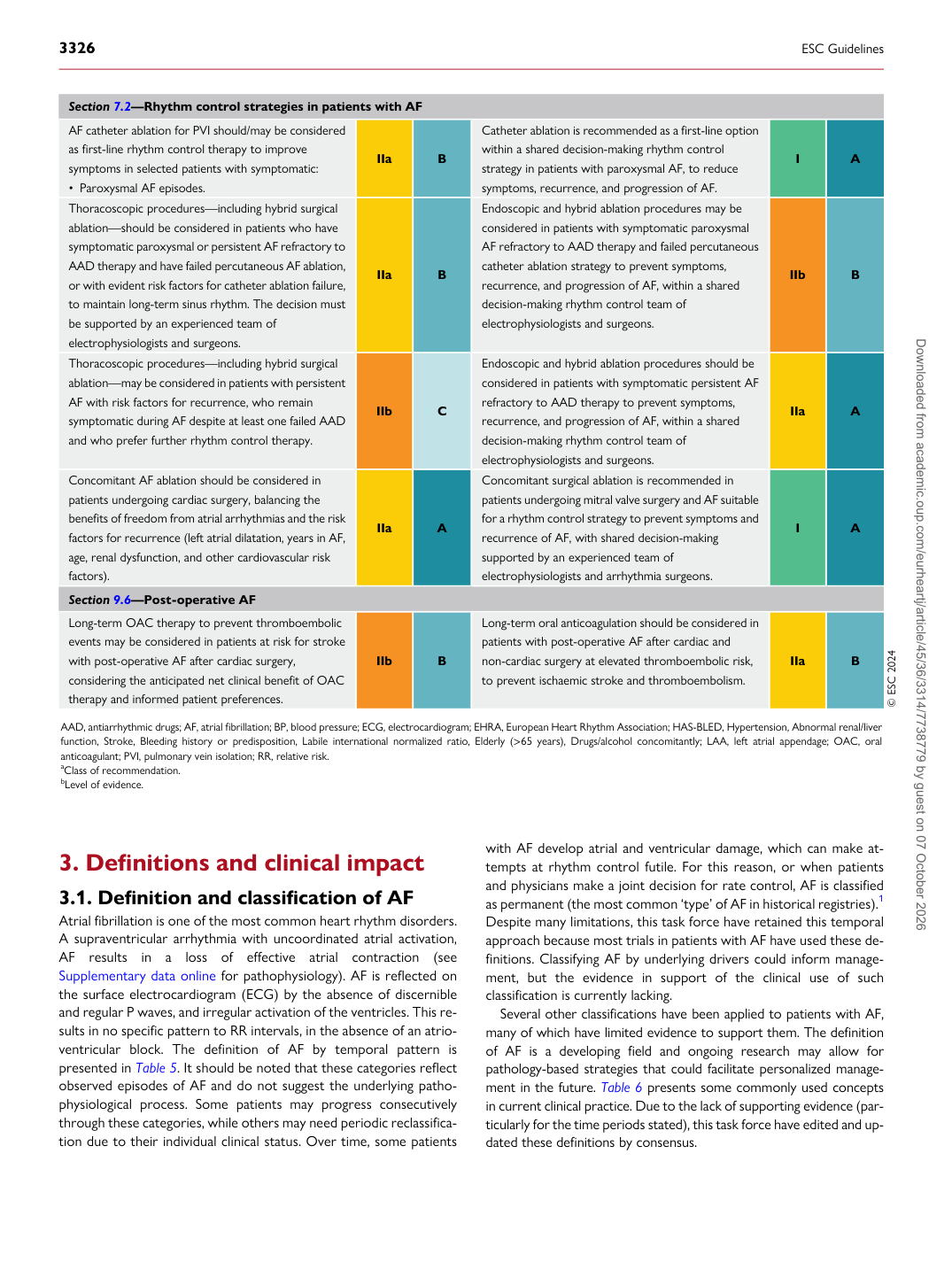
Section 7.2—Rhythm control strategies in patients with AF AF catheter ablation for PVI should/may be considered as first-line rhythm control therapy to improve symptoms in selected patients with symptomatic: • Paroxysmal AF episodes. IIa B Catheter ablation is recommended as a first-line option within a shared decision-making rhythm control

strategy in patients with paroxysmal AF, to reduce symptoms, recurrence, and progression of AF. I A

Thoracoscopic procedures—including hybrid surgical ablation—should be considered in patients who have symptomatic paroxysmal or persistent AF refractory to AAD therapy and have failed percutaneous AF ablation, or with evident risk factors for catheter ablation failure, to maintain long-term sinus rhythm. The decision must be supported by an experienced team of electrophysiologists and surgeons. IIa B Endoscopic and hybrid ablation procedures may be

considered in patients with symptomatic paroxysmal AF refractory to AAD therapy and failed percutaneous catheter ablation strategy to prevent symptoms, recurrence, and progression of AF, within a shared decision-making rhythm control team of electrophysiologists and surgeons. IIb B

Thoracoscopic procedures—including hybrid surgical ablation—may be considered in patients with persistent AF with risk factors for recurrence, who remain symptomatic during AF despite at least one failed AAD and who prefer further rhythm control therapy. IIb C Endoscopic and hybrid ablation procedures should be

considered in patients with symptomatic persistent AF refractory to AAD therapy to prevent symptoms, recurrence, and progression of AF, within a shared decision-making rhythm control team of electrophysiologists and surgeons. IIa A

Concomitant AF ablation should be considered in patients undergoing cardiac surgery, balancing the benefits of freedom from atrial arrhythmias and the risk factors for recurrence (left atrial dilatation, years in AF, age, renal dysfunction, and other cardiovascular risk factors). IIa A Concomitant surgical ablation is recommended in patients undergoing mitral valve surgery and AF suitable

for a rhythm control strategy to prevent symptoms and recurrence of AF, with shared decision-making supported by an experienced team of electrophysiologists and arrhythmia surgeons. I A

Section 9.6—Post-operative AF Long-term OAC therapy to prevent thromboembolic events may be considered in patients at risk for stroke with post-operative AF after cardiac surgery, considering the anticipated net clinical benefit of OAC therapy and informed patient preferences. IIb B Long-term oral anticoagulation should be considered in

patients with post-operative AF after cardiac and non-cardiac surgery at elevated thromboembolic risk, to prevent ischaemic stroke and thromboembolism. IIa B © ESC 2024

AAD, antiarrhythmic drugs; AF, atrial fibrillation; BP, blood pressure; ECG, electrocardiogram; EHRA, European Heart Rhythm Association; HAS-BLED, Hypertension, Abnormal renal/liver function, Stroke, Bleeding history or predisposition, Labile international normalized ratio, Elderly (>65 years), Drugs/alcohol concomitantly; LAA, left atrial appendage; OAC, oral anticoagulant; PVI, pulmonary vein isolation; RR, relative risk. aClass of recommendation. bLevel of evidence. Downloaded from academic.oup.com/eurheartj/article/45/36/3314/7738779 by guest on 07 October 2026