p.12 抽出テキスト
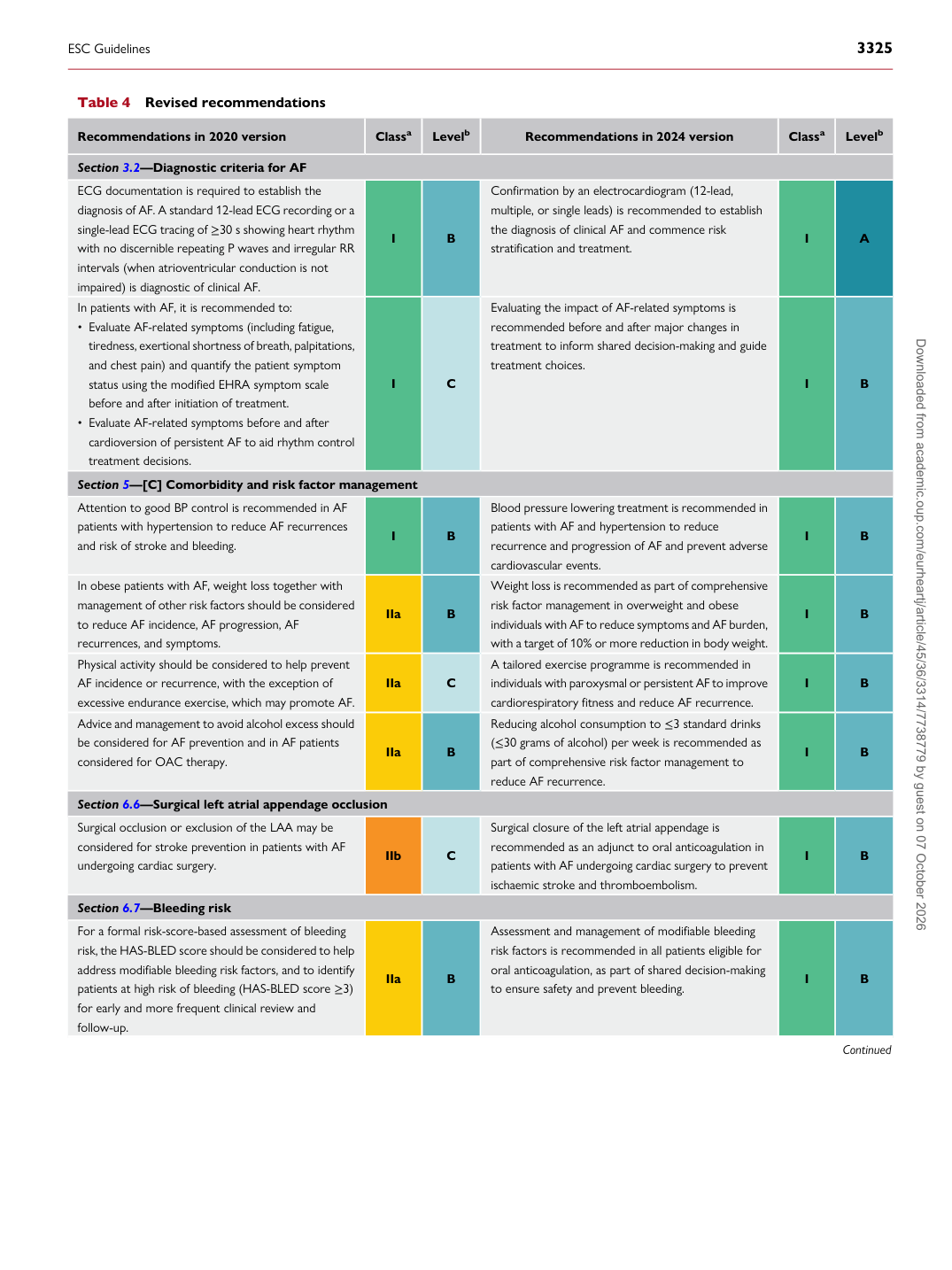
Table 4 Revised recommendations

Recommendations in 2020 version Classa Levelb Recommendations in 2024 version Classa Levelb

Section 3.2—Diagnostic criteria for AF ECG documentation is required to establish the diagnosis of AF. A standard 12-lead ECG recording or a single-lead ECG tracing of ≥30 s showing heart rhythm with no discernible repeating P waves and irregular RR intervals (when atrioventricular conduction is not impaired) is diagnostic of clinical AF. I B Confirmation by an electrocardiogram (12-lead,

multiple, or single leads) is recommended to establish the diagnosis of clinical AF and commence risk stratification and treatment. I A

In patients with AF, it is recommended to: • Evaluate AF-related symptoms (including fatigue,

tiredness, exertional shortness of breath, palpitations, and chest pain) and quantify the patient symptom status using the modified EHRA symptom scale before and after initiation of treatment. • Evaluate AF-related symptoms before and after cardioversion of persistent AF to aid rhythm control

treatment decisions. I C Evaluating the impact of AF-related symptoms is recommended before and after major changes in

treatment to inform shared decision-making and guide treatment choices.

I B

Section 5—[C] Comorbidity and risk factor management Attention to good BP control is recommended in AF patients with hypertension to reduce AF recurrences and risk of stroke and bleeding. I B Blood pressure lowering treatment is recommended in

patients with AF and hypertension to reduce recurrence and progression of AF and prevent adverse cardiovascular events. I B

In obese patients with AF, weight loss together with management of other risk factors should be considered to reduce AF incidence, AF progression, AF recurrences, and symptoms. IIa B Weight loss is recommended as part of comprehensive risk factor management in overweight and obese

individuals with AF to reduce symptoms and AF burden, with a target of 10% or more reduction in body weight. I B

Physical activity should be considered to help prevent AF incidence or recurrence, with the exception of excessive endurance exercise, which may promote AF. IIa C A tailored exercise programme is recommended in

individuals with paroxysmal or persistent AF to improve cardiorespiratory fitness and reduce AF recurrence. I B

Advice and management to avoid alcohol excess should be considered for AF prevention and in AF patients considered for OAC therapy. IIa B Reducing alcohol consumption to ≤3 standard drinks (≤30 grams of alcohol) per week is recommended as

part of comprehensive risk factor management to reduce AF recurrence. I B

Section 6.6—Surgical left atrial appendage occlusion Surgical occlusion or exclusion of the LAA may be considered for stroke prevention in patients with AF undergoing cardiac surgery. IIb C Surgical closure of the left atrial appendage is

recommended as an adjunct to oral anticoagulation in patients with AF undergoing cardiac surgery to prevent ischaemic stroke and thromboembolism. I B

Section 6.7—Bleeding risk For a formal risk-score-based assessment of bleeding risk, the HAS-BLED score should be considered to help address modifiable bleeding risk factors, and to identify patients at high risk of bleeding (HAS-BLED score ≥3) for early and more frequent clinical review and follow-up. IIa B Assessment and management of modifiable bleeding risk factors is recommended in all patients eligible for

oral anticoagulation, as part of shared decision-making to ensure safety and prevent bleeding. I B

Continued

ESC Guidelines                                                                                                                                                                                          3325

Downloaded from academic.oup.com/eurheartj/article/45/36/3314/7738779 by guest on 07 October 2026