p.11 抽出テキスト
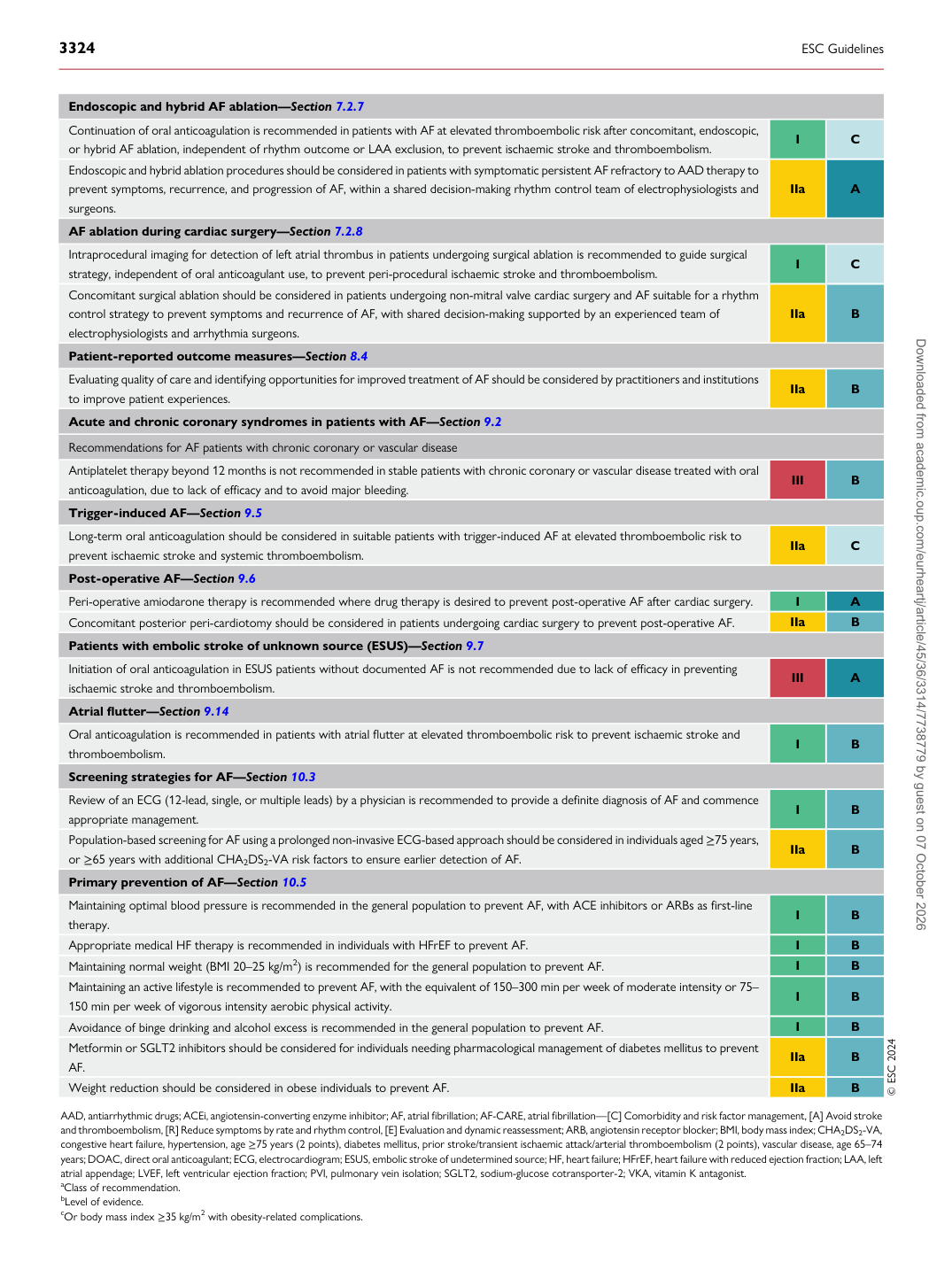
Endoscopic and hybrid AF ablation—Section 7.2.7 Continuation of oral anticoagulation is recommended in patients with AF at elevated thromboembolic risk after concomitant, endoscopic, or hybrid AF ablation, independent of rhythm outcome or LAA exclusion, to prevent ischaemic stroke and thromboembolism. I C Endoscopic and hybrid ablation procedures should be considered in patients with symptomatic persistent AF refractory to AAD therapy to prevent symptoms, recurrence, and progression of AF, within a shared decision-making rhythm control team of electrophysiologists and surgeons. IIa A AF ablation during cardiac surgery—Section 7.2.8 Intraprocedural imaging for detection of left atrial thrombus in patients undergoing surgical ablation is recommended to guide surgical strategy, independent of oral anticoagulant use, to prevent peri-procedural ischaemic stroke and thromboembolism. I C Concomitant surgical ablation should be considered in patients undergoing non-mitral valve cardiac surgery and AF suitable for a rhythm control strategy to prevent symptoms and recurrence of AF, with shared decision-making supported by an experienced team of electrophysiologists and arrhythmia surgeons. IIa B Patient-reported outcome measures—Section 8.4 Evaluating quality of care and identifying opportunities for improved treatment of AF should be considered by practitioners and institutions to improve patient experiences. IIa B Acute and chronic coronary syndromes in patients with AF—Section 9.2 Recommendations for AF patients with chronic coronary or vascular disease Antiplatelet therapy beyond 12 months is not recommended in stable patients with chronic coronary or vascular disease treated with oral anticoagulation, due to lack of efficacy and to avoid major bleeding. III B Trigger-induced AF—Section 9.5 Long-term oral anticoagulation should be considered in suitable patients with trigger-induced AF at elevated thromboembolic risk to prevent ischaemic stroke and systemic thromboembolism. IIa C Post-operative AF—Section 9.6 Peri-operative amiodarone therapy is recommended where drug therapy is desired to prevent post-operative AF after cardiac surgery. I A Concomitant posterior peri-cardiotomy should be considered in patients undergoing cardiac surgery to prevent post-operative AF. IIa B Patients with embolic stroke of unknown source (ESUS)—Section 9.7 Initiation of oral anticoagulation in ESUS patients without documented AF is not recommended due to lack of efficacy in preventing ischaemic stroke and thromboembolism. III A Atrial flutter—Section 9.14 Oral anticoagulation is recommended in patients with atrial flutter at elevated thromboembolic risk to prevent ischaemic stroke and thromboembolism. I B Screening strategies for AF—Section 10.3 Review of an ECG (12-lead, single, or multiple leads) by a physician is recommended to provide a definite diagnosis of AF and commence appropriate management. I B Population-based screening for AF using a prolonged non-invasive ECG-based approach should be considered in individuals aged ≥75 years, or ≥65 years with additional CHA2DS2-VA risk factors to ensure earlier detection of AF. IIa B Primary prevention of AF—Section 10.5 Maintaining optimal blood pressure is recommended in the general population to prevent AF, with ACE inhibitors or ARBs as first-line therapy. I B Appropriate medical HF therapy is recommended in individuals with HFrEF to prevent AF. I B Maintaining normal weight (BMI 20–25 kg/m2) is recommended for the general population to prevent AF. I B Maintaining an active lifestyle is recommended to prevent AF, with the equivalent of 150–300 min per week of moderate intensity or 75– 150 min per week of vigorous intensity aerobic physical activity. I B Avoidance of binge drinking and alcohol excess is recommended in the general population to prevent AF. I B Metformin or SGLT2 inhibitors should be considered for individuals needing pharmacological management of diabetes mellitus to prevent AF. IIa B Weight reduction should be considered in obese individuals to prevent AF. IIa B © ESC 2024

AAD, antiarrhythmic drugs; ACEi, angiotensin-converting enzyme inhibitor; AF, atrial fibrillation; AF-CARE, atrial fibrillation—[C] Comorbidity and risk factor management, [A] Avoid stroke and thromboembolism, [R] Reduce symptoms by rate and rhythm control, [E] Evaluation and dynamic reassessment; ARB, angiotensin receptor blocker; BMI, body mass index; CHA2DS2-VA, congestive heart failure, hypertension, age ≥75 years (2 points), diabetes mellitus, prior stroke/transient ischaemic attack/arterial thromboembolism (2 points), vascular disease, age 65–74 years; DOAC, direct oral anticoagulant; ECG, electrocardiogram; ESUS, embolic stroke of undetermined source; HF, heart failure; HFrEF, heart failure with reduced ejection fraction; LAA, left atrial appendage; LVEF, left ventricular ejection fraction; PVI, pulmonary vein isolation; SGLT2, sodium-glucose cotransporter-2; VKA, vitamin K antagonist. aClass of recommendation. bLevel of evidence. cOr body mass index ≥35 kg/m2 with obesity-related complications. Downloaded from academic.oup.com/eurheartj/article/45/36/3314/7738779 by guest on 07 October 2026