p.10 抽出テキスト
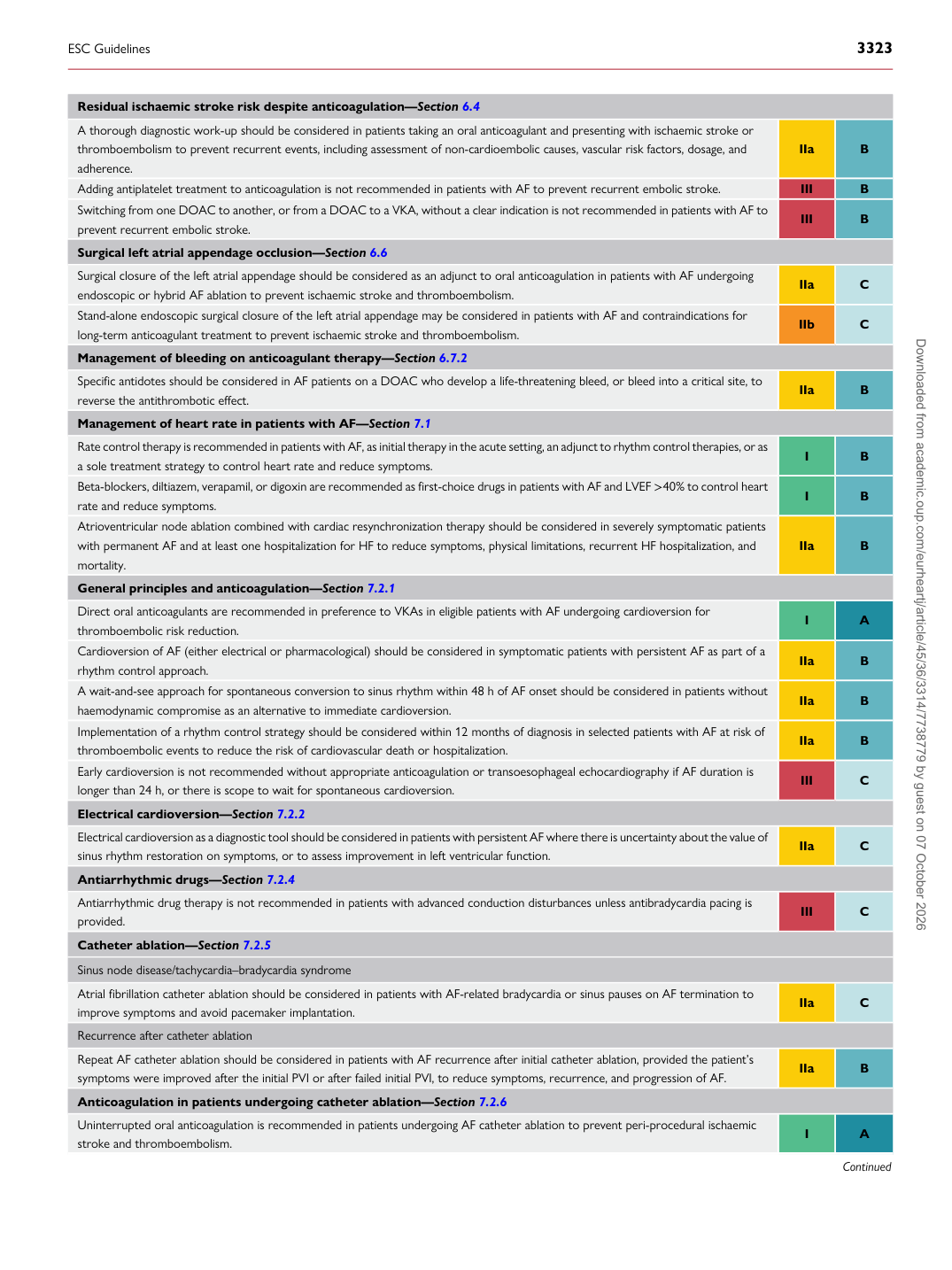
Residual ischaemic stroke risk despite anticoagulation—Section 6.4 A thorough diagnostic work-up should be considered in patients taking an oral anticoagulant and presenting with ischaemic stroke or thromboembolism to prevent recurrent events, including assessment of non-cardioembolic causes, vascular risk factors, dosage, and adherence. IIa B Adding antiplatelet treatment to anticoagulation is not recommended in patients with AF to prevent recurrent embolic stroke. III B Switching from one DOAC to another, or from a DOAC to a VKA, without a clear indication is not recommended in patients with AF to prevent recurrent embolic stroke. III B Surgical left atrial appendage occlusion—Section 6.6 Surgical closure of the left atrial appendage should be considered as an adjunct to oral anticoagulation in patients with AF undergoing endoscopic or hybrid AF ablation to prevent ischaemic stroke and thromboembolism. IIa C Stand-alone endoscopic surgical closure of the left atrial appendage may be considered in patients with AF and contraindications for long-term anticoagulant treatment to prevent ischaemic stroke and thromboembolism. IIb C Management of bleeding on anticoagulant therapy—Section 6.7.2 Specific antidotes should be considered in AF patients on a DOAC who develop a life-threatening bleed, or bleed into a critical site, to reverse the antithrombotic effect. IIa B Management of heart rate in patients with AF—Section 7.1 Rate control therapy is recommended in patients with AF, as initial therapy in the acute setting, an adjunct to rhythm control therapies, or as a sole treatment strategy to control heart rate and reduce symptoms. I B Beta-blockers, diltiazem, verapamil, or digoxin are recommended as first-choice drugs in patients with AF and LVEF >40% to control heart rate and reduce symptoms. I B Atrioventricular node ablation combined with cardiac resynchronization therapy should be considered in severely symptomatic patients with permanent AF and at least one hospitalization for HF to reduce symptoms, physical limitations, recurrent HF hospitalization, and mortality. IIa B General principles and anticoagulation—Section 7.2.1 Direct oral anticoagulants are recommended in preference to VKAs in eligible patients with AF undergoing cardioversion for thromboembolic risk reduction. I A Cardioversion of AF (either electrical or pharmacological) should be considered in symptomatic patients with persistent AF as part of a rhythm control approach. IIa B A wait-and-see approach for spontaneous conversion to sinus rhythm within 48 h of AF onset should be considered in patients without haemodynamic compromise as an alternative to immediate cardioversion. IIa B Implementation of a rhythm control strategy should be considered within 12 months of diagnosis in selected patients with AF at risk of thromboembolic events to reduce the risk of cardiovascular death or hospitalization. IIa B Early cardioversion is not recommended without appropriate anticoagulation or transoesophageal echocardiography if AF duration is longer than 24 h, or there is scope to wait for spontaneous cardioversion. III C Electrical cardioversion—Section 7.2.2 Electrical cardioversion as a diagnostic tool should be considered in patients with persistent AF where there is uncertainty about the value of sinus rhythm restoration on symptoms, or to assess improvement in left ventricular function. IIa C Antiarrhythmic drugs—Section 7.2.4 Antiarrhythmic drug therapy is not recommended in patients with advanced conduction disturbances unless antibradycardia pacing is provided. III C Catheter ablation—Section 7.2.5 Sinus node disease/tachycardia–bradycardia syndrome Atrial fibrillation catheter ablation should be considered in patients with AF-related bradycardia or sinus pauses on AF termination to improve symptoms and avoid pacemaker implantation. IIa C Recurrence after catheter ablation Repeat AF catheter ablation should be considered in patients with AF recurrence after initial catheter ablation, provided the patient’s symptoms were improved after the initial PVI or after failed initial PVI, to reduce symptoms, recurrence, and progression of AF. IIa B Anticoagulation in patients undergoing catheter ablation—Section 7.2.6 Uninterrupted oral anticoagulation is recommended in patients undergoing AF catheter ablation to prevent peri-procedural ischaemic stroke and thromboembolism. I A

Continued

ESC Guidelines                                                                                                                                                                                          3323

Downloaded from academic.oup.com/eurheartj/article/45/36/3314/7738779 by guest on 07 October 2026