p.9 抽出テキスト
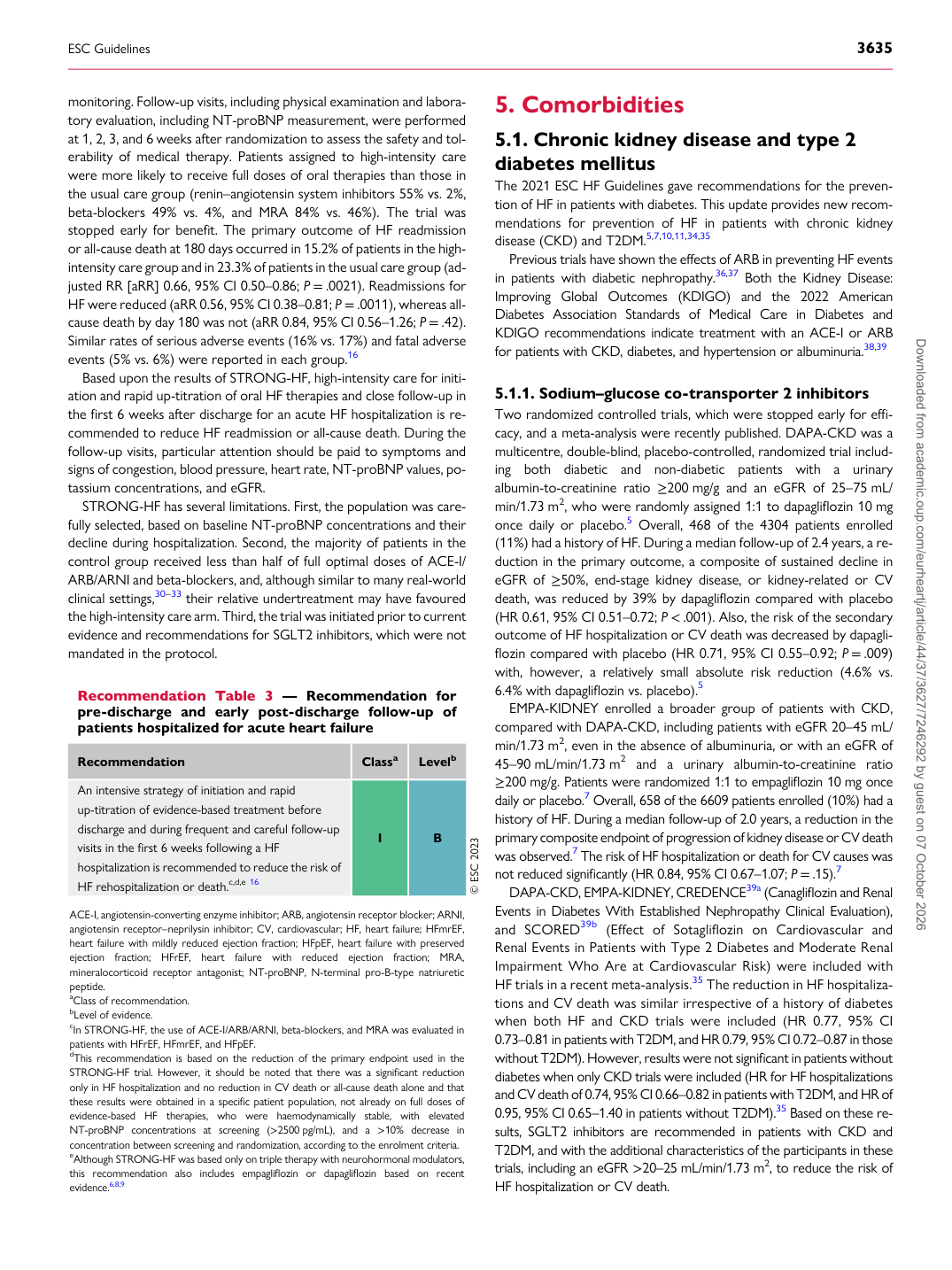
monitoring. Follow-up visits, including physical examination and laboratory evaluation, including NT-proBNP measurement, were performed at 1, 2, 3, and 6 weeks after randomization to assess the safety and tolerability of medical therapy. Patients assigned to high-intensity care were more likely to receive full doses of oral therapies than those in the usual care group (renin–angiotensin system inhibitors 55% vs. 2%, beta-blockers 49% vs. 4%, and MRA 84% vs. 46%). The trial was stopped early for benefit. The primary outcome of HF readmission or all-cause death at 180 days occurred in 15.2% of patients in the highintensity care group and in 23.3% of patients in the usual care group (adjusted RR [aRR] 0.66, 95% CI 0.50–0.86; P = .0021). Readmissions for HF were reduced (aRR 0.56, 95% CI 0.38–0.81; P = .0011), whereas allcause death by day 180 was not (aRR 0.84, 95% CI 0.56–1.26; P = .42). Similar rates of serious adverse events (16% vs. 17%) and fatal adverse events (5% vs. 6%) were reported in each group.16 Based upon the results of STRONG-HF, high-intensity care for initiation and rapid up-titration of oral HF therapies and close follow-up in the first 6 weeks after discharge for an acute HF hospitalization is recommended to reduce HF readmission or all-cause death. During the follow-up visits, particular attention should be paid to symptoms and signs of congestion, blood pressure, heart rate, NT-proBNP values, potassium concentrations, and eGFR. STRONG-HF has several limitations. First, the population was carefully selected, based on baseline NT-proBNP concentrations and their decline during hospitalization. Second, the majority of patients in the control group received less than half of full optimal doses of ACE-I/ ARB/ARNI and beta-blockers, and, although similar to many real-world clinical settings,30–33 their relative undertreatment may have favoured the high-intensity care arm. Third, the trial was initiated prior to current evidence and recommendations for SGLT2 inhibitors, which were not mandated in the protocol. 5 Comorbidities

5.1. Chronic kidney disease and type 2 diabetes mellitus The 2021 ESC HF Guidelines gave recommendations for the prevention of HF in patients with diabetes. This update provides new recommendations for prevention of HF in patients with chronic kidney disease (CKD) and T2DM.5,7,10,11,34,35 Previous trials have shown the effects of ARB in preventing HF events in patients with diabetic nephropathy.36,37 Both the Kidney Disease: Improving Global Outcomes (KDIGO) and the 2022 American Diabetes Association Standards of Medical Care in Diabetes and KDIGO recommendations indicate treatment with an ACE-I or ARB for patients with CKD, diabetes, and hypertension or albuminuria.38,39

5.1.1 Sodium–glucose co-transporter 2 inhibitors

Two randomized controlled trials, which were stopped early for efficacy, and a meta-analysis were recently published. DAPA-CKD was a multicentre, double-blind, placebo-controlled, randomized trial including both diabetic and non-diabetic patients with a urinary albumin-to-creatinine ratio ≥200 mg/g and an eGFR of 25–75 mL/ min/1.73 m2, who were randomly assigned 1:1 to dapagliflozin 10 mg once daily or placebo.5 Overall, 468 of the 4304 patients enrolled (11%) had a history of HF. During a median follow-up of 2.4 years, a reduction in the primary outcome, a composite of sustained decline in eGFR of ≥50%, end-stage kidney disease, or kidney-related or CV death, was reduced by 39% by dapagliflozin compared with placebo (HR 0.61, 95% CI 0.51–0.72; P < .001). Also, the risk of the secondary outcome of HF hospitalization or CV death was decreased by dapagliflozin compared with placebo (HR 0.71, 95% CI 0.55–0.92; P = .009) with, however, a relatively small absolute risk reduction (4.6% vs. 6.4% with dapagliflozin vs. placebo).5 EMPA-KIDNEY enrolled a broader group of patients with CKD, compared with DAPA-CKD, including patients with eGFR 20–45 mL/ min/1.73 m2, even in the absence of albuminuria, or with an eGFR of 45–90 mL/min/1.73 m2 and a urinary albumin-to-creatinine ratio ≥200 mg/g. Patients were randomized 1:1 to empagliflozin 10 mg once daily or placebo.7 Overall, 658 of the 6609 patients enrolled (10%) had a history of HF. During a median follow-up of 2.0 years, a reduction in the primary composite endpoint of progression of kidney disease or CV death was observed.7 The risk of HF hospitalization or death for CV causes was not reduced significantly (HR 0.84, 95% CI 0.67–1.07; P = .15).7 DAPA-CKD, EMPA-KIDNEY, CREDENCE39a (Canagliflozin and Renal Events in Diabetes With Established Nephropathy Clinical Evaluation), and SCORED39b (Effect of Sotagliflozin on Cardiovascular and Renal Events in Patients with Type 2 Diabetes and Moderate Renal Impairment Who Are at Cardiovascular Risk) were included with HF trials in a recent meta-analysis.35 The reduction in HF hospitalizations and CV death was similar irrespective of a history of diabetes when both HF and CKD trials were included (HR 0.77, 95% CI 0.73–0.81 in patients with T2DM, and HR 0.79, 95% CI 0.72–0.87 in those without T2DM). However, results were not significant in patients without diabetes when only CKD trials were included (HR for HF hospitalizations and CV death of 0.74, 95% CI 0.66–0.82 in patients with T2DM, and HR of 0.95, 95% CI 0.65–1.40 in patients without T2DM).35 Based on these results, SGLT2 inhibitors are recommended in patients with CKD and T2DM, and with the additional characteristics of the participants in these trials, including an eGFR >20–25 mL/min/1.73 m2, to reduce the risk of HF hospitalization or CV death.

Recommendation Table 3 — Recommendation for pre-discharge and early post-discharge follow-up of patients hospitalized for acute heart failure

Recommendation Classa Levelb

An intensive strategy of initiation and rapid up-titration of evidence-based treatment before discharge and during frequent and careful follow-up visits in the first 6 weeks following a HF hospitalization is recommended to reduce the risk of HF rehospitalization or death.c,d,e 16 I B © ESC 2023

ACE-I, angiotensin-converting enzyme inhibitor; ARB, angiotensin receptor blocker; ARNI, angiotensin receptor–neprilysin inhibitor; CV, cardiovascular; HF, heart failure; HFmrEF, heart failure with mildly reduced ejection fraction; HFpEF, heart failure with preserved ejection fraction; HFrEF, heart failure with reduced ejection fraction; MRA, mineralocorticoid receptor antagonist; NT-proBNP, N-terminal pro-B-type natriuretic peptide. aClass of recommendation. bLevel of evidence. cIn STRONG-HF, the use of ACE-I/ARB/ARNI, beta-blockers, and MRA was evaluated in patients with HFrEF, HFmrEF, and HFpEF. dThis recommendation is based on the reduction of the primary endpoint used in the STRONG-HF trial. However, it should be noted that there was a significant reduction only in HF hospitalization and no reduction in CV death or all-cause death alone and that these results were obtained in a specific patient population, not already on full doses of evidence-based HF therapies, who were haemodynamically stable, with elevated NT-proBNP concentrations at screening (>2500 pg/mL), and a >10% decrease in concentration between screening and randomization, according to the enrolment criteria. eAlthough STRONG-HF was based only on triple therapy with neurohormonal modulators, this recommendation also includes empagliflozin or dapagliflozin based on recent evidence.6,8,9

ESC Guidelines                                                                                                                                                                                          3635

Downloaded from academic.oup.com/eurheartj/article/44/37/3627/7246292 by guest on 07 October 2026