p.4 抽出テキスト
regulations applicable in each country to drugs and devices at the time of prescription and, where appropriate, to respect the ethical rules of their profession. ESC Guidelines represent the official position of the ESC on a given topic and are regularly updated. ESC Policies and Procedures for formulating and issuing ESC Guidelines can be found on the ESC website (https://www.escardio.org/Guidelines). Interim Focused Updates are created when the publication of new evidence could influence clinical practice before the next full update of a guideline is published. This Focused Update provides new and revised recommendations for the 2021 ESC Guidelines for the diagnosis and treatment of acute and chronic heart failure. View the full 2021 ESC Guidelines here: https://www.escardio.org/Guidelines/Clinical-Practice- Guidelines/Acute-and-Chronic-Heart-Failure.

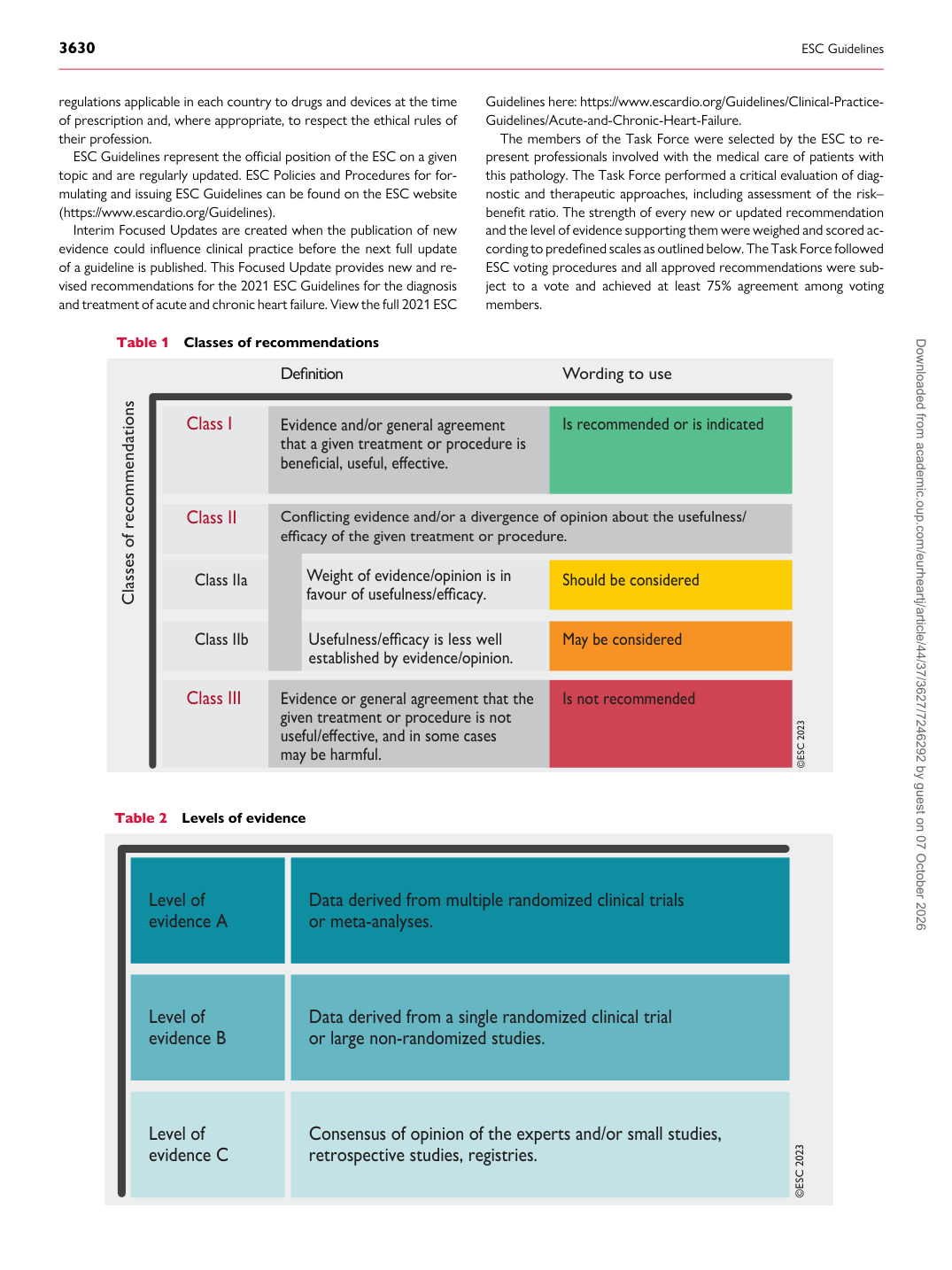
The members of the Task Force were selected by the ESC to represent professionals involved with the medical care of patients with this pathology. The Task Force performed a critical evaluation of diagnostic and therapeutic approaches, including assessment of the risk– benefit ratio. The strength of every new or updated recommendation and the level of evidence supporting them were weighed and scored according to predefined scales as outlined below. The Task Force followed ESC voting procedures and all approved recommendations were subject to a vote and achieved at least 75% agreement among voting members.

Table 1 Classes of recommendations

©ESC 2023

Classes of recommendations Class I Evidence and/or general agreement that a given treatment or procedure is beneficial, useful, effective.

Conflicting evidence and/or a divergence of opinion about the usefulness/ efficacy of the given treatment or procedure.

Is recommended or is indicated

Wording to use Definition

Class III Evidence or general agreement that the given treatment or procedure is not useful/effective, and in some cases may be harmful. Is not recommended

Class IIb Usefulness/efficacy is less well established by evidence/opinion. May be considered

Class IIa Weight of evidence/opinion is in favour of usefulness/efficacy. Should be considered

Class II

© ESC 2023

Table 2 Levels of evidence

Level of evidence A

Level of evidence B

Level of evidence C Data derived from multiple randomized clinical trials or meta-analyses.

Data derived from a single randomized clinical trial or large non-randomized studies.

Consensus of opinion of the experts and/or small studies, retrospective studies, registries. ©ESC 2023 © ESC 2023 Downloaded from academic.oup.com/eurheartj/article/44/37/3627/7246292 by guest on 07 October 2026