p.11 抽出テキスト
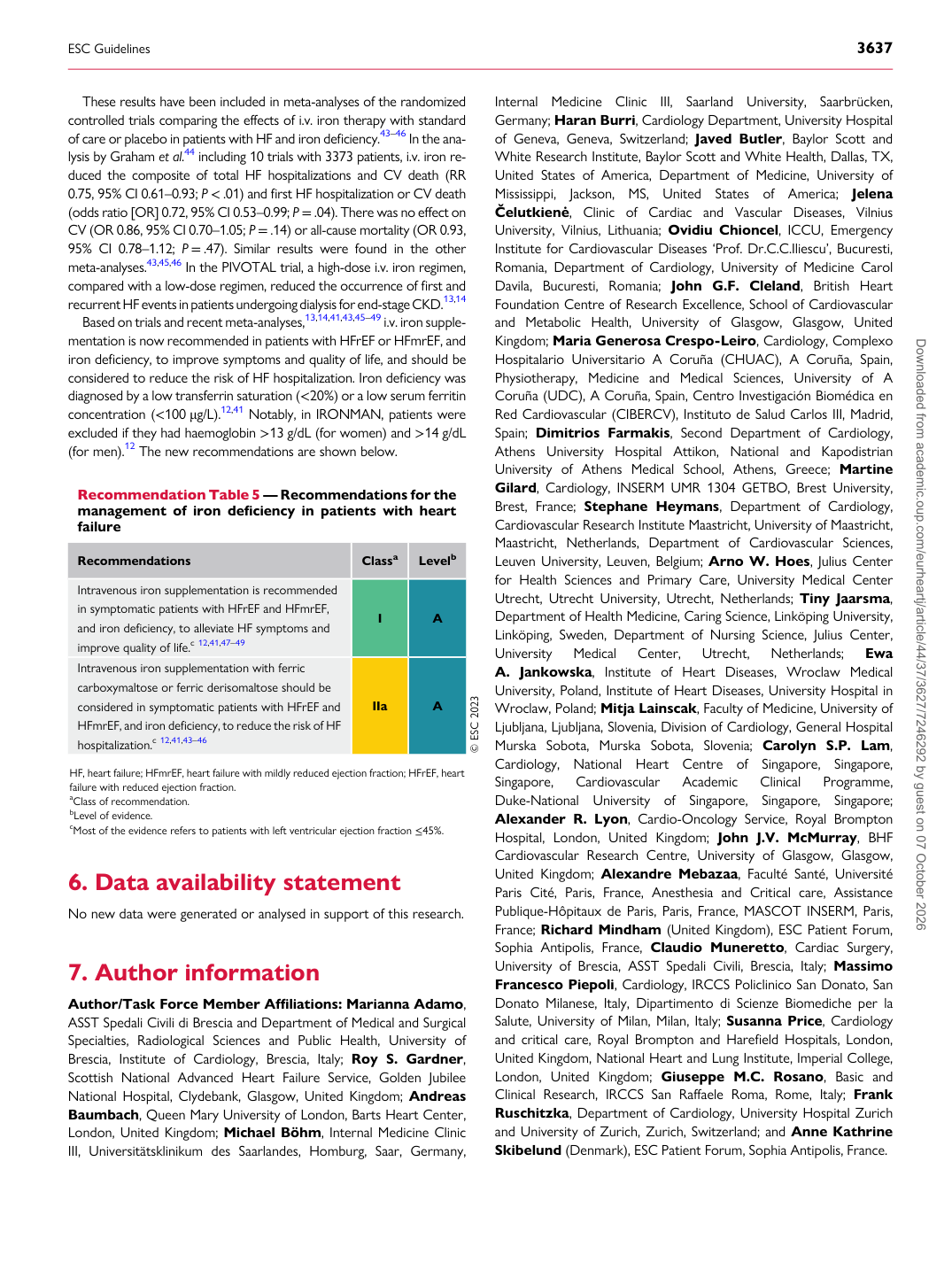
These results have been included in meta-analyses of the randomized controlled trials comparing the effects of i.v. iron therapy with standard of care or placebo in patients with HF and iron deficiency.43–46 In the analysis by Graham et al.44 including 10 trials with 3373 patients, i.v. iron reduced the composite of total HF hospitalizations and CV death (RR 0.75, 95% CI 0.61–0.93; P < .01) and first HF hospitalization or CV death (odds ratio [OR] 0.72, 95% CI 0.53–0.99; P = .04). There was no effect on CV (OR 0.86, 95% CI 0.70–1.05; P = .14) or all-cause mortality (OR 0.93, 95% CI 0.78–1.12; P = .47). Similar results were found in the other meta-analyses.43,45,46 In the PIVOTAL trial, a high-dose i.v. iron regimen, compared with a low-dose regimen, reduced the occurrence of first and recurrent HF events in patients undergoing dialysis for end-stage CKD.13,14 Based on trials and recent meta-analyses,13,14,41,43,45–49 i.v. iron supplementation is now recommended in patients with HFrEF or HFmrEF, and iron deficiency, to improve symptoms and quality of life, and should be considered to reduce the risk of HF hospitalization. Iron deficiency was diagnosed by a low transferrin saturation (<20%) or a low serum ferritin concentration (<100 μg/L).12,41 Notably, in IRONMAN, patients were excluded if they had haemoglobin >13 g/dL (for women) and >14 g/dL (for men).12 The new recommendations are shown below.

6 Data availability statement

No new data were generated or analysed in support of this research.

7 Author information

Author/Task Force Member Affiliations: Marianna Adamo, ASST Spedali Civili di Brescia and Department of Medical and Surgical Specialties, Radiological Sciences and Public Health, University of Brescia, Institute of Cardiology, Brescia, Italy; Roy S. Gardner, Scottish National Advanced Heart Failure Service, Golden Jubilee National Hospital, Clydebank, Glasgow, United Kingdom; Andreas Baumbach, Queen Mary University of London, Barts Heart Center, London, United Kingdom; Michael Böhm, Internal Medicine Clinic III, Universitätsklinikum des Saarlandes, Homburg, Saar, Germany, Internal Medicine Clinic III, Saarland University, Saarbrücken, Germany; Haran Burri, Cardiology Department, University Hospital of Geneva, Geneva, Switzerland; Javed Butler, Baylor Scott and White Research Institute, Baylor Scott and White Health, Dallas, TX, United States of America, Department of Medicine, University of Mississippi, Jackson, MS, United States of America; Jelena Čelutkienė, Clinic of Cardiac and Vascular Diseases, Vilnius University, Vilnius, Lithuania; Ovidiu Chioncel, ICCU, Emergency Institute for Cardiovascular Diseases ‘Prof. Dr.C.C.Iliescu’, Bucuresti, Romania, Department of Cardiology, University of Medicine Carol Davila, Bucuresti, Romania; John G.F. Cleland, British Heart Foundation Centre of Research Excellence, School of Cardiovascular and Metabolic Health, University of Glasgow, Glasgow, United Kingdom; Maria Generosa Crespo-Leiro, Cardiology, Complexo Hospitalario Universitario A Coruña (CHUAC), A Coruña, Spain, Physiotherapy, Medicine and Medical Sciences, University of A Coruña (UDC), A Coruña, Spain, Centro Investigación Biomédica en Red Cardiovascular (CIBERCV), Instituto de Salud Carlos III, Madrid, Spain; Dimitrios Farmakis, Second Department of Cardiology, Athens University Hospital Attikon, National and Kapodistrian University of Athens Medical School, Athens, Greece; Martine Gilard, Cardiology, INSERM UMR 1304 GETBO, Brest University, Brest, France; Stephane Heymans, Department of Cardiology, Cardiovascular Research Institute Maastricht, University of Maastricht, Maastricht, Netherlands, Department of Cardiovascular Sciences, Leuven University, Leuven, Belgium; Arno W. Hoes, Julius Center for Health Sciences and Primary Care, University Medical Center Utrecht, Utrecht University, Utrecht, Netherlands; Tiny Jaarsma, Department of Health Medicine, Caring Science, Linköping University, Linköping, Sweden, Department of Nursing Science, Julius Center, University Medical Center, Utrecht, Netherlands; Ewa A. Jankowska, Institute of Heart Diseases, Wroclaw Medical University, Poland, Institute of Heart Diseases, University Hospital in Wroclaw, Poland; Mitja Lainscak, Faculty of Medicine, University of Ljubljana, Ljubljana, Slovenia, Division of Cardiology, General Hospital Murska Sobota, Murska Sobota, Slovenia; Carolyn S.P. Lam, Cardiology, National Heart Centre of Singapore, Singapore, Singapore, Cardiovascular Academic Clinical Programme, Duke-National University of Singapore, Singapore, Singapore; Alexander R. Lyon, Cardio-Oncology Service, Royal Brompton Hospital, London, United Kingdom; John J.V. McMurray, BHF Cardiovascular Research Centre, University of Glasgow, Glasgow, United Kingdom; Alexandre Mebazaa, Faculté Santé, Université Paris Cité, Paris, France, Anesthesia and Critical care, Assistance Publique-Hôpitaux de Paris, Paris, France, MASCOT INSERM, Paris, France; Richard Mindham (United Kingdom), ESC Patient Forum, Sophia Antipolis, France, Claudio Muneretto, Cardiac Surgery, University of Brescia, ASST Spedali Civili, Brescia, Italy; Massimo Francesco Piepoli, Cardiology, IRCCS Policlinico San Donato, San Donato Milanese, Italy, Dipartimento di Scienze Biomediche per la Salute, University of Milan, Milan, Italy; Susanna Price, Cardiology and critical care, Royal Brompton and Harefield Hospitals, London, United Kingdom, National Heart and Lung Institute, Imperial College, London, United Kingdom; Giuseppe M.C. Rosano, Basic and Clinical Research, IRCCS San Raffaele Roma, Rome, Italy; Frank Ruschitzka, Department of Cardiology, University Hospital Zurich and University of Zurich, Zurich, Switzerland; and Anne Kathrine Skibelund (Denmark), ESC Patient Forum, Sophia Antipolis, France.

Recommendation Table 5 — Recommendations for the management of iron deficiency in patients with heart failure

Recommendations Classa Levelb

Intravenous iron supplementation is recommended in symptomatic patients with HFrEF and HFmrEF, and iron deficiency, to alleviate HF symptoms and improve quality of life.c 12,41,47–49 I A Intravenous iron supplementation with ferric carboxymaltose or ferric derisomaltose should be considered in symptomatic patients with HFrEF and HFmrEF, and iron deficiency, to reduce the risk of HF hospitalization.c 12,41,43–46 IIa A © ESC 2023

HF, heart failure; HFmrEF, heart failure with mildly reduced ejection fraction; HFrEF, heart failure with reduced ejection fraction. aClass of recommendation. bLevel of evidence. cMost of the evidence refers to patients with left ventricular ejection fraction ≤45%.

ESC Guidelines                                                                                                                                                                                          3637

Downloaded from academic.oup.com/eurheartj/article/44/37/3627/7246292 by guest on 07 October 2026