p.10 抽出テキスト
5.1.2 Finerenone

The selective, non-steroidal, MRA finerenone was tested in two trials in patients with diabetic kidney disease. The FIDELIO-DKD trial enrolled 5734 patients with a urinary albumin-to-creatinine ratio 30–300 mg/g, an eGFR 25–60 mL/min/1.73 m2, and diabetic retinopathy, or a urinary albumin-to-creatinine ratio 300–5000 mg/g and an eGFR 25–75 mL/ min/1.73 m2.10 The primary outcome of the trial, assessed in a time-to-event analysis, was a composite of kidney failure, a sustained decrease of ≥40% in the eGFR from baseline over a period of ≥4 weeks, or death from renal causes. Kidney failure was defined as endstage kidney disease or an eGFR <15 mL/min/1.73 m2; end-stage kidney disease was defined as the initiation of long-term dialysis (for ≥90 days) or kidney transplantation. The primary endpoint of the trial was reduced by finerenone compared with placebo by 18% (HR 0.82, 95% CI 0.73–0.93; P = .001), during a median follow-up of 2.6 years.10 There was no evidence of a reduction in HF hospitalizations with finerenone vs. placebo (HR 0.86, 95% CI 0.68–1.08), although finerenone was associated with a lower occurrence of the key secondary endpoint, a composite of CV death, non-fatal myocardial infarction, non-fatal stroke, and hospitalization for HF (HR 0.86, 95% CI 0.75–0.99; P = .03).10 Patients with HFrEF and NYHA class II–IV were excluded from the trial. However, patients with asymptomatic or NYHA class I HFrEF, or with HFmrEF or HFpEF, could be enrolled, so that 7.7% of the patients included had a history of HF. The effects of finerenone on the composite of CV and renal outcomes, including HF hospitalizations, were independent of a previous history of HF.34 In the more recent FIGARO-DKD trial, the primary outcome, assessed in a time-to-event analysis, was a composite of death from CV causes, non-fatal myocardial infarction, non-fatal stroke, or hospitalization for HF.11 The trial enrolled adult patients with T2DM and CKD treated with a renin–angiotensin system inhibitor at the maximum tolerated dose. CKD was defined according to one of two sets of criteria: persistent, moderately elevated albuminuria (urinary albumin-to-creatinine ratio 30 to <300 mg/g) and an eGFR 25–90 mL/min/1.73 m2 (i.e. stage 2 to 4 CKD); or persistent, severely elevated albuminuria (urinary albumin-to-creatinine ratio 300–5000 mg/g) and an eGFR >60 mL/min/1.73 m2 (i.e. stage 1 or 2 CKD). Patients were required to have a serum potassium level of ≤4.8 mmol/L at the time of screening.11 The trial included 7437 patients randomly assigned to finerenone or placebo.11 At a median follow-up of 3.4 years, the rate of the primary outcome, CV death, non-fatal myocardial infarction, non-fatal stroke, or HF hospitalization, was lower in the treatment arm compared with placebo (HR 0.87, 95% CI 0.76–0.98; P = .03). The benefit was driven by a numerically small, but statistically significant, lower incidence of HF hospitalization with finerenone vs. placebo (3.2% vs. 4.4%; HR 0.71, 95% CI 0.56–0.90), with no differences in CV death.11 In both FIDELIO-DKD and FIGARO-DKD the occurrence of hyperkalaemia was higher in the finerenone group compared with the placebo group. However, the rate of adverse events was similar between the two arms. A pre-specified individual patient-level, pooled analysis, including 13 026 patients with diabetic kidney disease followed for a median of 3.0 years from both the FIDELIO-DKD and FIGARO-DKD trials, showed a reduction in the composite CV outcome, including CV death, non-fatal stroke, non-fatal myocardial infarction, and HF hospitalizations, as well as in HF hospitalizations alone with finerenone vs. placebo (HR 0.86, 95% CI 0.78–0.95; P = .0018; and HR 0.78, 95% CI 0.66–0.92; P = .0030, respectively).40 Thus, finerenone is recommended for the prevention of HF hospitalization in patients with CKD and T2DM. 5.2 Iron deficiency

Recommendations for the diagnosis and treatment of iron deficiency were given in the 2021 ESC HF Guidelines: COR I, LOE C for the diagnosis of iron deficiency, COR IIa, LOE A to improve HF symptoms, exercise capacity, and quality of life, and COR IIa, LOE B to reduce HF hospitalizations, for treatment with ferric carboxymaltose.1 A new trial, IRONMAN, has now been published.12 This was a prospective, randomized, open-label, blinded-endpoint trial including patients with HF, LVEF ≤45%, and transferrin saturation <20% or serum ferritin <100 μg/L who were randomly allocated 1:1 to i.v. ferric derisomaltose or usual care. The patients included were mainly ambulatory, although 14% were enrolled during an HF hospitalization and 18% had an HF hospitalization in the previous 6 months. After a median follow-up of 2.7 years, the rate ratio for the primary endpoint, a composite of total (first and recurrent) HF hospitalizations and CV death, was 0.82 (95% CI 0.66–1.02; P = .070). Total hospital admissions for HF were not reduced significantly with ferric derisomaltose vs. usual care (16.7 vs. 20.9 per 100 patient-years; RR 0.80, 95% CI 0.62–1.03; P = .085). As in AFFIRM-AHF (A Randomized Double-blind Placebo Controlled Trial Comparing the Effects of Intravenous Ferric Carboxymaltose on Hospitalizations and Mortality in Iron Deficient Subjects Admitted for Acute Heart Failure),41 a pre-specified COVID-19 analysis, censoring follow-up on September 2020, showed a reduction in the risk of the primary endpoint with ferric derisomaltose vs. control (HR 0.76, 95% CI 0.58–1.00; P = .047). There was a statistically borderline improvement in the Minnesota Living with Heart Failure Questionnaire score with ferric derisomaltose (between treatment difference −3.33, 95% CI −6.67 to 0.00; P = .050), but no difference in EQ-5D visual analogue scale or EQ-5D index.12 Some of these findings in secondary outcomes might be explained by the lack of adjustment for multiple testing.42 Safety endpoints, i.e. death and hospitalization due to infection, did not differ between the two arms.12

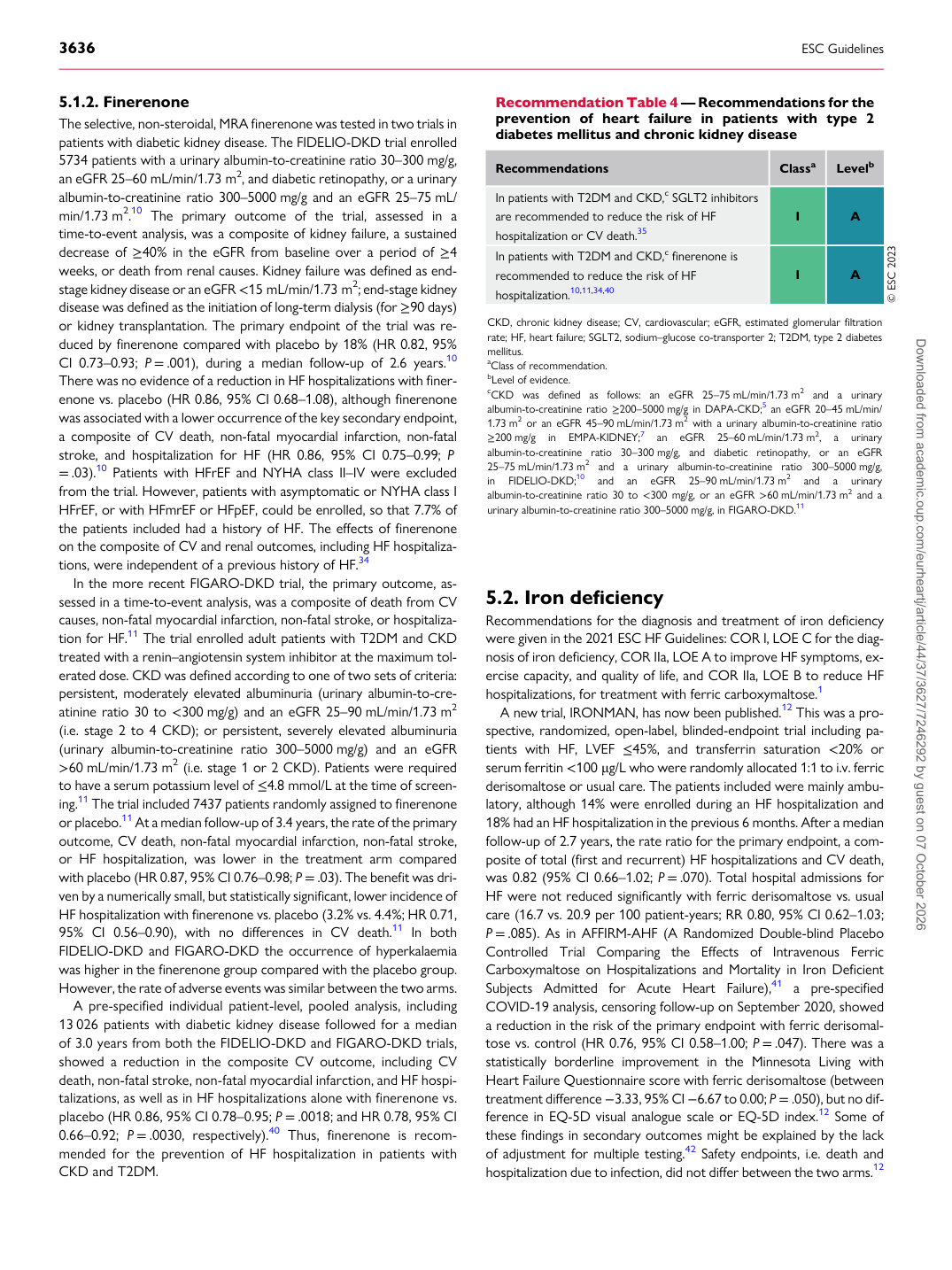
Recommendation Table 4 — Recommendations for the prevention of heart failure in patients with type 2 diabetes mellitus and chronic kidney disease

Recommendations Classa Levelb In patients with T2DM and CKD,c SGLT2 inhibitors are recommended to reduce the risk of HF hospitalization or CV death.35 I A In patients with T2DM and CKD,c finerenone is recommended to reduce the risk of HF hospitalization.10,11,34,40 I A © ESC 2023

CKD, chronic kidney disease; CV, cardiovascular; eGFR, estimated glomerular filtration rate; HF, heart failure; SGLT2, sodium–glucose co-transporter 2; T2DM, type 2 diabetes mellitus. aClass of recommendation. bLevel of evidence. cCKD was defined as follows: an eGFR 25–75 mL/min/1.73 m2 and a urinary albumin-to-creatinine ratio ≥200–5000 mg/g in DAPA-CKD;5 an eGFR 20–45 mL/min/ 1.73 m2 or an eGFR 45–90 mL/min/1.73 m2 with a urinary albumin-to-creatinine ratio ≥200 mg/g in EMPA-KIDNEY;7 an eGFR 25–60 mL/min/1.73 m2, a urinary albumin-to-creatinine ratio 30–300 mg/g, and diabetic retinopathy, or an eGFR 25–75 mL/min/1.73 m2 and a urinary albumin-to-creatinine ratio 300–5000 mg/g, in FIDELIO-DKD;10 and an eGFR 25–90 mL/min/1.73 m2 and a urinary albumin-to-creatinine ratio 30 to <300 mg/g, or an eGFR >60 mL/min/1.73 m2 and a urinary albumin-to-creatinine ratio 300–5000 mg/g, in FIGARO-DKD.11 Downloaded from academic.oup.com/eurheartj/article/44/37/3627/7246292 by guest on 07 October 2026