p.9 抽出テキスト
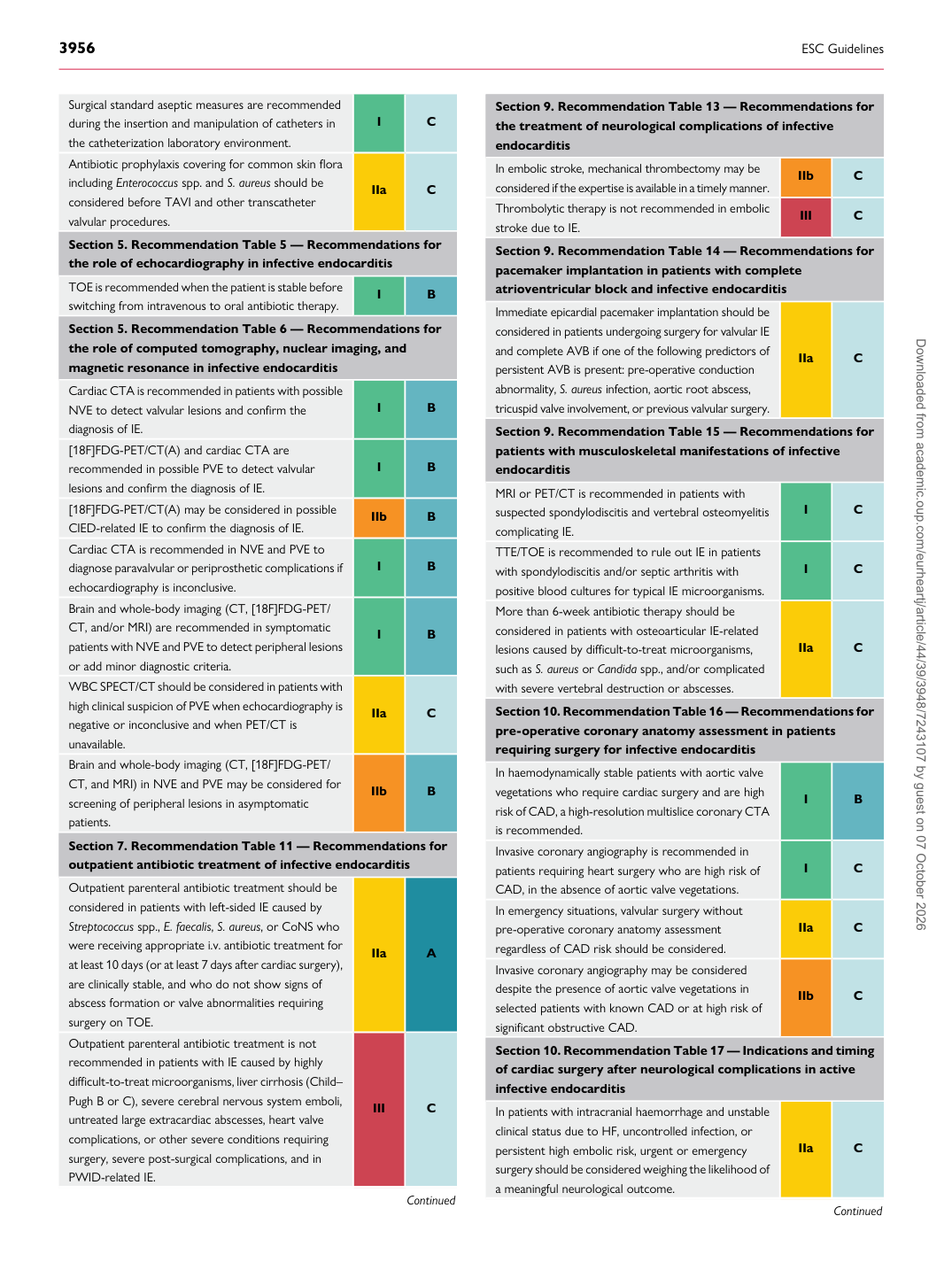
Surgical standard aseptic measures are recommended during the insertion and manipulation of catheters in the catheterization laboratory environment. I C Antibiotic prophylaxis covering for common skin flora including Enterococcus spp. and S. aureus should be considered before TAVI and other transcatheter valvular procedures. IIa C Section 5. Recommendation Table 5 — Recommendations for the role of echocardiography in infective endocarditis TOE is recommended when the patient is stable before switching from intravenous to oral antibiotic therapy. I B Section 5. Recommendation Table 6 — Recommendations for the role of computed tomography, nuclear imaging, and magnetic resonance in infective endocarditis Cardiac CTA is recommended in patients with possible NVE to detect valvular lesions and confirm the diagnosis of IE. I B [18F]FDG-PET/CT(A) and cardiac CTA are recommended in possible PVE to detect valvular lesions and confirm the diagnosis of IE. I B [18F]FDG-PET/CT(A) may be considered in possible CIED-related IE to confirm the diagnosis of IE. IIb B Cardiac CTA is recommended in NVE and PVE to diagnose paravalvular or periprosthetic complications if echocardiography is inconclusive. I B Brain and whole-body imaging (CT, [18F]FDG-PET/ CT, and/or MRI) are recommended in symptomatic patients with NVE and PVE to detect peripheral lesions or add minor diagnostic criteria. I B WBC SPECT/CT should be considered in patients with high clinical suspicion of PVE when echocardiography is negative or inconclusive and when PET/CT is unavailable. IIa C Brain and whole-body imaging (CT, [18F]FDG-PET/ CT, and MRI) in NVE and PVE may be considered for screening of peripheral lesions in asymptomatic patients. IIb B Section 7. Recommendation Table 11 — Recommendations for outpatient antibiotic treatment of infective endocarditis Outpatient parenteral antibiotic treatment should be considered in patients with left-sided IE caused by Streptococcus spp., E. faecalis, S. aureus, or CoNS who were receiving appropriate i.v. antibiotic treatment for at least 10 days (or at least 7 days after cardiac surgery), are clinically stable, and who do not show signs of abscess formation or valve abnormalities requiring surgery on TOE. IIa A Outpatient parenteral antibiotic treatment is not recommended in patients with IE caused by highly difficult-to-treat microorganisms, liver cirrhosis (Child– Pugh B or C), severe cerebral nervous system emboli, untreated large extracardiac abscesses, heart valve complications, or other severe conditions requiring surgery, severe post-surgical complications, and in PWID-related IE. III C

Continued Section 9. Recommendation Table 13 — Recommendations for

the treatment of neurological complications of infective endocarditis In embolic stroke, mechanical thrombectomy may be considered if the expertise is available in a timely manner. IIb C Thrombolytic therapy is not recommended in embolic stroke due to IE. III C Section 9. Recommendation Table 14 — Recommendations for pacemaker implantation in patients with complete atrioventricular block and infective endocarditis Immediate epicardial pacemaker implantation should be considered in patients undergoing surgery for valvular IE and complete AVB if one of the following predictors of persistent AVB is present: pre-operative conduction abnormality, S. aureus infection, aortic root abscess, tricuspid valve involvement, or previous valvular surgery. IIa C Section 9. Recommendation Table 15 — Recommendations for patients with musculoskeletal manifestations of infective endocarditis MRI or PET/CT is recommended in patients with suspected spondylodiscitis and vertebral osteomyelitis complicating IE. I C TTE/TOE is recommended to rule out IE in patients with spondylodiscitis and/or septic arthritis with positive blood cultures for typical IE microorganisms. I C More than 6-week antibiotic therapy should be considered in patients with osteoarticular IE-related lesions caused by difficult-to-treat microorganisms, such as S. aureus or Candida spp., and/or complicated with severe vertebral destruction or abscesses. IIa C Section 10. Recommendation Table 16 — Recommendations for pre-operative coronary anatomy assessment in patients requiring surgery for infective endocarditis In haemodynamically stable patients with aortic valve vegetations who require cardiac surgery and are high risk of CAD, a high-resolution multislice coronary CTA is recommended. I B Invasive coronary angiography is recommended in patients requiring heart surgery who are high risk of CAD, in the absence of aortic valve vegetations. I C In emergency situations, valvular surgery without pre-operative coronary anatomy assessment regardless of CAD risk should be considered. IIa C Invasive coronary angiography may be considered despite the presence of aortic valve vegetations in selected patients with known CAD or at high risk of significant obstructive CAD. IIb C Section 10. Recommendation Table 17 — Indications and timing of cardiac surgery after neurological complications in active infective endocarditis In patients with intracranial haemorrhage and unstable clinical status due to HF, uncontrolled infection, or persistent high embolic risk, urgent or emergency surgery should be considered weighing the likelihood of a meaningful neurological outcome. IIa C

Continued Downloaded from academic.oup.com/eurheartj/article/44/39/3948/7243107 by guest on 07 October 2026