p.8 抽出テキスト
pathology. The selection procedure aimed to include members from across the whole of the ESC region and from relevant ESC Subspecialty Communities. Consideration was given to diversity and inclusion, notably with respect to gender and country of origin. The Task Force performed a critical evaluation of diagnostic and therapeutic approaches, including assessment of the risk-benefit ratio. The strength of every recommendation and the level of evidence supporting them were weighed and scored according to predefined scales as outlined below. The Task Force followed ESC voting procedures, and all approved recommendations were subject to a vote and achieved at least 75% agreement among voting members. The experts of the writing and reviewing panels provided declaration of interest forms for all relationships that might be perceived as real or potential sources of conflicts of interest. Their declarations of interest were reviewed according to the ESC declaration of interest rules and can be found on the ESC website (http://www.escardio.org/Guidelines) and have been compiled in a report published in a supplementary document with the guidelines. The Task Force received its entire financial support from the ESC without any involvement from the healthcare industry. The ESC Clinical Practice Guidelines (CPG) Committee supervises and co-ordinates the preparation of new guidelines and is responsible for the approval process. ESC Guidelines undergo extensive review by the CPG Committee and external experts, including members from across the whole of the ESC region and from relevant ESC Subspecialty Communities and National Cardiac Societies. After appropriate revisions, the guidelines are signed off by all the experts involved in the Task Force. The finalized document is signed off by the CPG Committee for publication in the European Heart Journal. The guidelines were developed after careful consideration of the scientific and medical knowledge and the evidence available at the time of their writing. Tables of evidence summarizing the findings of studies informing development of the guidelines are included. The ESC warns readers that the technical language may be misinterpreted and declines any responsibility in this respect. Off-label use of medication may be presented in this guideline if a sufficient level of evidence shows that it can be considered medically appropriate for a given condition. However, the final decisions concerning an individual patient must be made by the responsible health professional giving special consideration to: • The specific situation of the patient. Unless otherwise provided for by national regulations, off-label use of medication should be limited to situations where it is in the patient’s interest with regard to the quality, safety, and efficacy of care, and only after the patient has been informed and has provided consent. • Country-specific health regulations, indications by governmental drug regulatory agencies, and the ethical rules to which health professionals are subject, where applicable.

2 Introduction

Infective endocarditis (IE) is a major public health challenge.1 In 2019, the estimated incidence of IE was 13.8 cases per 100 000 subjects per year, and IE accounted for 66 300 deaths worldwide.2 Due to the associated high morbidity and mortality (1723.59 disability-adjusted life years and 0.87 death cases per 100 000 population, respectively), identification of the best preventive strategies has been the focus of research.2,3 Since the publication of the 2015 ESC Guidelines for the management of infective endocarditis,4 important new data have been published mandating an update of recommendations. First, the population at risk of IE has increased and new data on IE in different clinical scenarios have arisen.5–11 Furthermore, the emerging and increasing antibiotic resistance among oral streptococci is of concern. The rate of resistance to azythromycin and clarithromycin is higher than that to penicillin.12 Whether changes in national guidelines on the use of antibiotic prophylaxis have resulted in an increase in the incidence of IE remains unclear.13–18 It is likely that the increased use of diagnostic tools to diagnose IE is an important contributor to the increase in the incidence of IE. The use of echocardiography has probably increased in patients with positive blood cultures for Enteroccus faecalis, Staphylococcus aureus, or streptococci due to the associated increased risk of IE.19 In addition, computed tomography (CT) and nuclear imaging techniques have increased the number of definite IE cases particularly among patients with prosthetic valves and implantable cardiac devices.20–22

Data on the contemporary characterization of patients with IE have been taken into consideration to update the recommendations on the diagnosis and management of patients with IE.5,19,23–41 Furthermore, the recommendations on antibiotic therapy have been updated based on the susceptibility of various microorganisms defined by the European Committee on Antimicrobial Susceptibility Testing (EUCAST) clinical breakpoints.42 Recommendations on outpatient parenteral antibiotic therapy (OPAT) or oral antibiotic treatment have been included based on the results of the Partial Oral Treatment of Endocarditis (POET) randomized trial and other trials.43–46 The main objective of the current Task Force was to provide clear and simple recommendations, assisting healthcare providers in their clinical decision-making. These recommendations were obtained by expert consensus after thorough review of the available literature (see Supplementary data, evidence tables online). An evidence-based scoring system was used, based on a classification of the strength of recommendations and the levels of evidence.

2.1 What is new

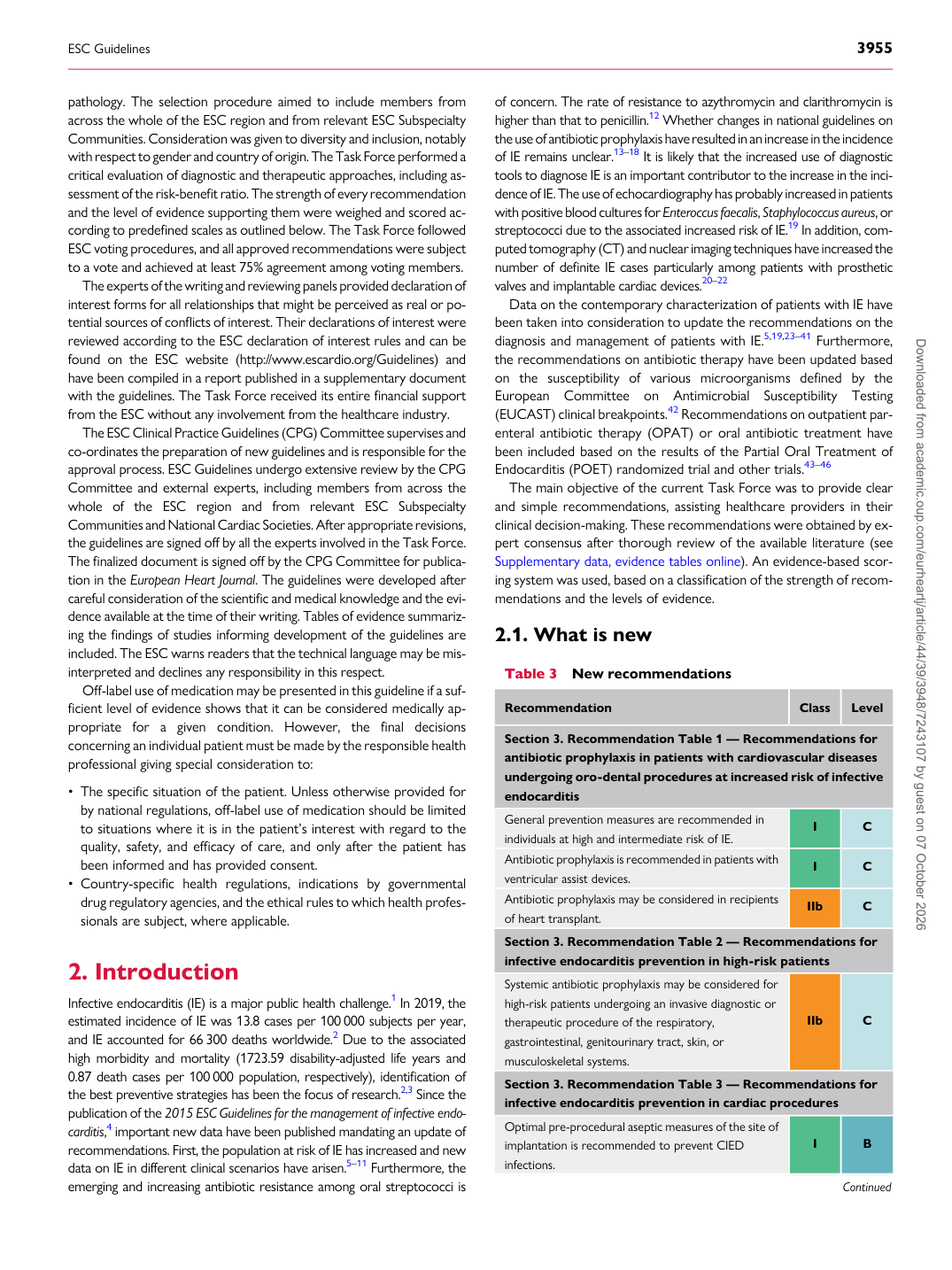
Table 3 New recommendations

Recommendation Class Level

Section 3. Recommendation Table 1 — Recommendations for antibiotic prophylaxis in patients with cardiovascular diseases undergoing oro-dental procedures at increased risk of infective endocarditis General prevention measures are recommended in individuals at high and intermediate risk of IE. I C Antibiotic prophylaxis is recommended in patients with ventricular assist devices. I C Antibiotic prophylaxis may be considered in recipients of heart transplant. IIb C Section 3. Recommendation Table 2 — Recommendations for infective endocarditis prevention in high-risk patients Systemic antibiotic prophylaxis may be considered for high-risk patients undergoing an invasive diagnostic or therapeutic procedure of the respiratory, gastrointestinal, genitourinary tract, skin, or musculoskeletal systems. IIb C Section 3. Recommendation Table 3 — Recommendations for infective endocarditis prevention in cardiac procedures Optimal pre-procedural aseptic measures of the site of implantation is recommended to prevent CIED infections. I B

Continued

ESC Guidelines                                                                                                                                                                                          3955

Downloaded from academic.oup.com/eurheartj/article/44/39/3948/7243107 by guest on 07 October 2026