p.72 抽出テキスト
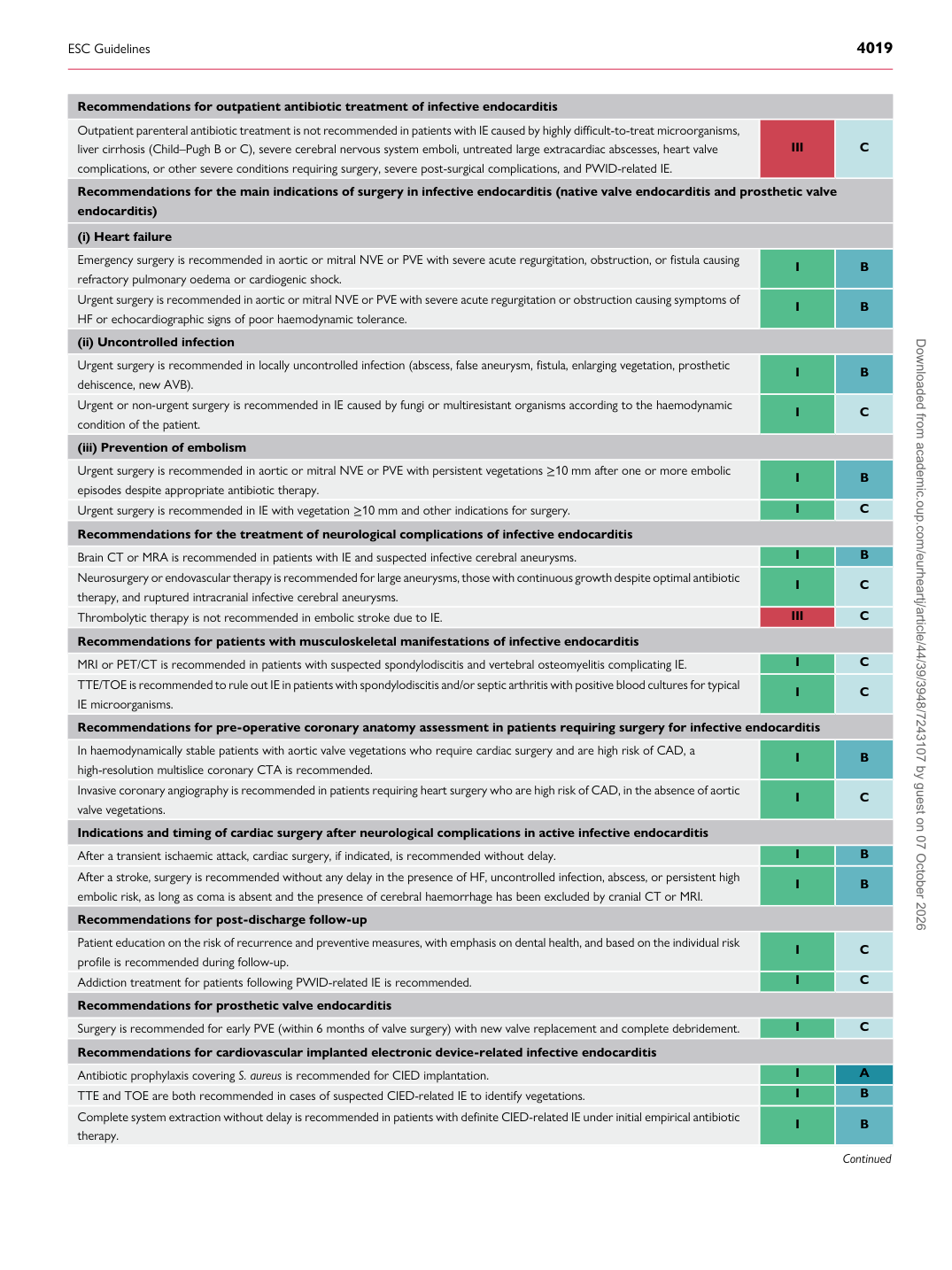
Recommendations for outpatient antibiotic treatment of infective endocarditis Outpatient parenteral antibiotic treatment is not recommended in patients with IE caused by highly difficult-to-treat microorganisms, liver cirrhosis (Child–Pugh B or C), severe cerebral nervous system emboli, untreated large extracardiac abscesses, heart valve complications, or other severe conditions requiring surgery, severe post-surgical complications, and PWID-related IE. III C Recommendations for the main indications of surgery in infective endocarditis (native valve endocarditis and prosthetic valve endocarditis) (i) Heart failure Emergency surgery is recommended in aortic or mitral NVE or PVE with severe acute regurgitation, obstruction, or fistula causing refractory pulmonary oedema or cardiogenic shock. I B Urgent surgery is recommended in aortic or mitral NVE or PVE with severe acute regurgitation or obstruction causing symptoms of HF or echocardiographic signs of poor haemodynamic tolerance. I B (ii) Uncontrolled infection Urgent surgery is recommended in locally uncontrolled infection (abscess, false aneurysm, fistula, enlarging vegetation, prosthetic dehiscence, new AVB). I B Urgent or non-urgent surgery is recommended in IE caused by fungi or multiresistant organisms according to the haemodynamic condition of the patient. I C (iii) Prevention of embolism Urgent surgery is recommended in aortic or mitral NVE or PVE with persistent vegetations ≥10 mm after one or more embolic episodes despite appropriate antibiotic therapy. I B Urgent surgery is recommended in IE with vegetation ≥10 mm and other indications for surgery. I C Recommendations for the treatment of neurological complications of infective endocarditis Brain CT or MRA is recommended in patients with IE and suspected infective cerebral aneurysms. I B Neurosurgery or endovascular therapy is recommended for large aneurysms, those with continuous growth despite optimal antibiotic therapy, and ruptured intracranial infective cerebral aneurysms. I C Thrombolytic therapy is not recommended in embolic stroke due to IE. III C Recommendations for patients with musculoskeletal manifestations of infective endocarditis MRI or PET/CT is recommended in patients with suspected spondylodiscitis and vertebral osteomyelitis complicating IE. I C TTE/TOE is recommended to rule out IE in patients with spondylodiscitis and/or septic arthritis with positive blood cultures for typical IE microorganisms. I C Recommendations for pre-operative coronary anatomy assessment in patients requiring surgery for infective endocarditis In haemodynamically stable patients with aortic valve vegetations who require cardiac surgery and are high risk of CAD, a high-resolution multislice coronary CTA is recommended. I B Invasive coronary angiography is recommended in patients requiring heart surgery who are high risk of CAD, in the absence of aortic valve vegetations. I C Indications and timing of cardiac surgery after neurological complications in active infective endocarditis After a transient ischaemic attack, cardiac surgery, if indicated, is recommended without delay. I B After a stroke, surgery is recommended without any delay in the presence of HF, uncontrolled infection, abscess, or persistent high embolic risk, as long as coma is absent and the presence of cerebral haemorrhage has been excluded by cranial CT or MRI. I B Recommendations for post-discharge follow-up Patient education on the risk of recurrence and preventive measures, with emphasis on dental health, and based on the individual risk profile is recommended during follow-up. I C Addiction treatment for patients following PWID-related IE is recommended. I C Recommendations for prosthetic valve endocarditis Surgery is recommended for early PVE (within 6 months of valve surgery) with new valve replacement and complete debridement. I C Recommendations for cardiovascular implanted electronic device-related infective endocarditis Antibiotic prophylaxis covering S. aureus is recommended for CIED implantation. I A TTE and TOE are both recommended in cases of suspected CIED-related IE to identify vegetations. I B Complete system extraction without delay is recommended in patients with definite CIED-related IE under initial empirical antibiotic therapy. I B

Continued

ESC Guidelines                                                                                                                                                                                          4019

Downloaded from academic.oup.com/eurheartj/article/44/39/3948/7243107 by guest on 07 October 2026