p.62 抽出テキスト
treatment should follow the same indications as in patients without HIV.813

12.10.3 Patients with neutropaenia

Neutropaenia is common in patients with haematological malignancies and in patients receiving chemotherapy for other malignancies, but is rare in patients presenting with IE.814 Neutrophils play an important role in the pathogenesis of IE by producing layers of extracellular traps that entrap bacteria-platelet aggregates, leading to expansion of these aggregates, vegetation growth, and the destruction of tissues.814 The diagnosis of IE can therefore be challenging in patients with neutropaenia, delaying the appropriate treatment, and worsening outcomes. Series reporting the clinical characteristics and outcomes of IE in patients with neutropaenia are anecdotal.814 As in any other immunocompromised patient with IE, antibiotic and surgical treatment are the same as in patients without neutropaenia. It is important to take into consideration the side effects of some antibiotics which may worsen the neutropaenia, such as cloxacillin and ceftaroline.815,816

12.11 Antithrombotic and anticoagulant

therapy in infective endocarditis Infective endocarditis by itself is not an indication for antithrombotics or anticoagulants, and bleeding complications or stroke may in contrast justify discontinuation or interruption of such therapies. Indications for antithrombotic therapy or anticoagulants (e.g. atrial fibrillation, valve prostheses, ischaemic heart disease, prior stroke, etc.) are prevalent in the general population and, as a result, the clinician is often faced with the challenge of these therapies in patients presenting with IE, especially in cases where surgery is part of the treatment course. For patients with IE and stroke, thrombolytic therapy is not recommended (see Section 9.1). However, thrombectomy may be considered in selected cases with large vessel occlusion. The level of evidence underlying the recommendations for antithrombotic and anticoagulant therapy in IE is low and should be discussed within the Endocarditis Team. Bridging with lowmolecular-weight heparin/unfractionated heparin instead of oral anticoagulants should be considered early on in the IE course, especially for patients in whom surgery is indicated. To date, no data support initiation of either antithrombotics nor anticoagulants for treatment or prevention of stroke in IE. 12.12 Non-bacterial thrombotic

endocarditis Non-bacterial thrombotic endocarditis (NBTE) is a rare condition with an incidence varying from 1.1% to 1.6% in patient-series from autopsy studies.818,819 Non-bacterial thrombotic endocarditis occurs in patients with a predisposing factor and/or a hypercoagulable state, such as systemic lupus erythematous (SLE), APLs (Libman–Sacks endocarditis), cancer (marantic endocarditis), disseminated intravascular coagulation (DIC), or various other chronic diseases (tuberculosis or autoimmune disease).820,821 Increased production of coagulation factors, of cytokines, and high tissue factor expression are potential mechanisms underlying NBTE in cancer patients.822 In a recent contemporary registry, 41% of NBTE patients had cancer, 33% SLE, and 36% APLs, with 21% of patients having both SLE and APLs.823 Among the patients with malignancies, the three most frequent cancers were lung adenocarcinoma, breast, and pancreatic cancer. Stroke was the most frequent clinical presentation at admission (60%), while HF was observed in 21% and acute coronary syndrome in 7% of patients. Transthoracic echocardiography was able to confirm the diagnosis in 45% of patients. The mitral valve was more often affected (62%) than the aortic valve (24%).823 The diagnosis of NBTE remains challenging and should be suspected in patients presenting with systemic embolization and a predisposing factor (i.e. cancer, APLs, SLE). Laboratory findings of a hypercoagulable state (eg. lupus anticoagulant, anti-cardiolipin antibodies, and anti-β2-glycoprotein 1 antibodies or DIC) may be present, but are nonspecific and may also be demonstrated in other IE patients with embolic events.162 Echocardiography diagnosis should attempt to differentiate non-bacterial thrombotic vegetation from IE, Lambl excrescences, or fibroelastoma, or other benign intracardiac masses/tumours.824 Libman–Sacks vegetations may present with various shapes (sessile, tubular, or coalescent), various levels of echogenicity (heterogeneously or homogeneously), could be nodular or protuberant, are generally located near the leaflet’s edge of coaptation, and frequently have extensions to the mid and basal portions of the leaflet. They are rarely associated with valve dysfunction and never with valve perforation, which is an important method of differentiating from bacterial IE.824 Compared with TOE, TTE has a lower sensitivity (63%), specificity (58%), negative predictive value (40%), and a moderate positive predictive value (78%) for the detection of NBTE.823,824 Compared with two-dimensional TOE, three-dimensional TOE provides additional information and allows a better characterization of the vegetation.823 The treatment of the underlying cause (i.e. SLE or cancer) is crucial to prevent recurrent NBTE. Anticoagulant treatment should be considered in all patients and should be balanced against the individual

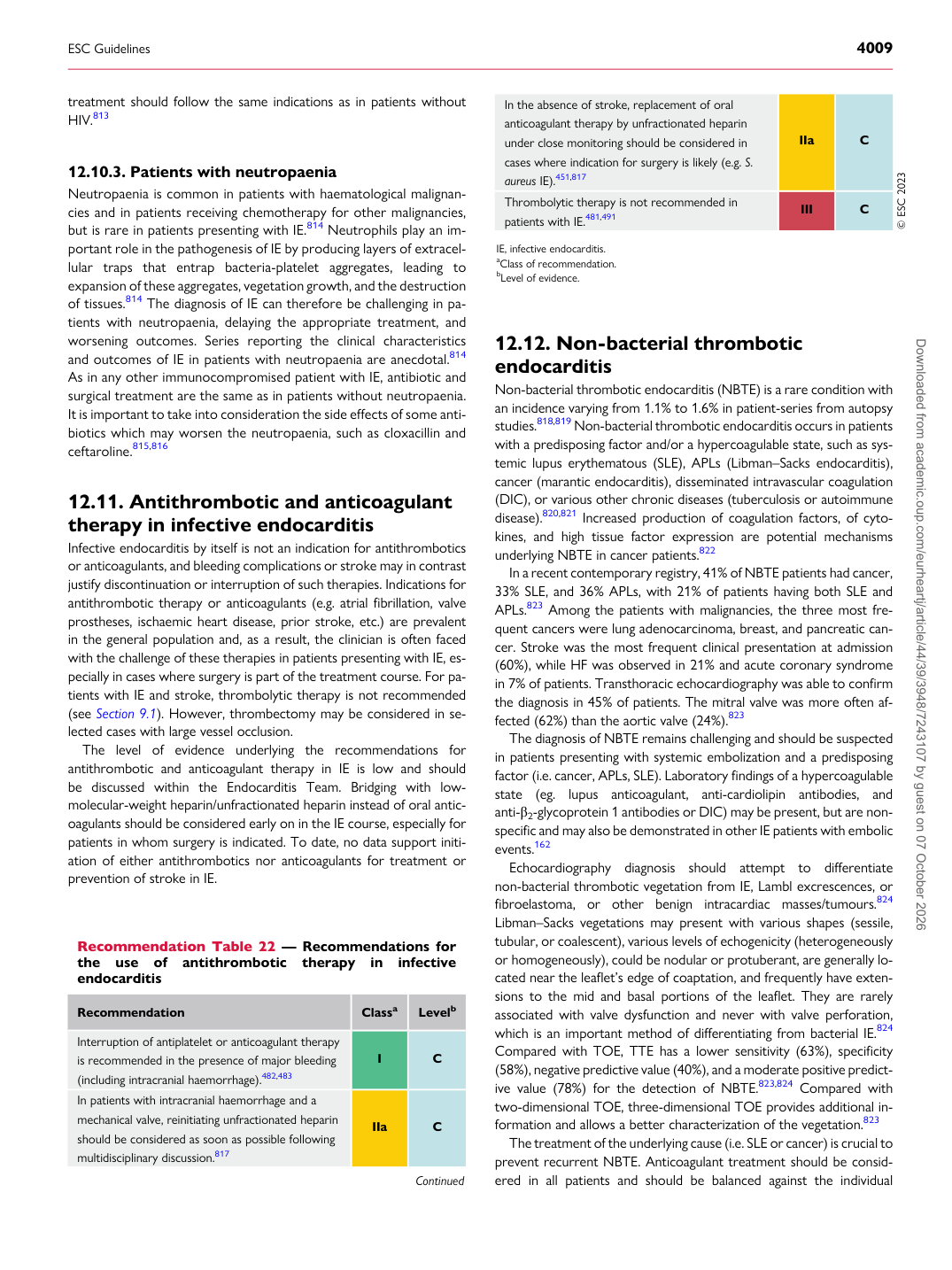
Recommendation Table 22 — Recommendations for the use of antithrombotic therapy in infective endocarditis

Recommendation Classa Levelb

Interruption of antiplatelet or anticoagulant therapy is recommended in the presence of major bleeding (including intracranial haemorrhage).482,483 I C In patients with intracranial haemorrhage and a mechanical valve, reinitiating unfractionated heparin should be considered as soon as possible following multidisciplinary discussion.817 IIa C

Continued In the absence of stroke, replacement of oral

anticoagulant therapy by unfractionated heparin under close monitoring should be considered in cases where indication for surgery is likely (e.g. S. aureus IE).451,817 IIa C Thrombolytic therapy is not recommended in patients with IE.481,491 III C © ESC 2023

IE, infective endocarditis. aClass of recommendation. bLevel of evidence.

ESC Guidelines                                                                                                                                                                                          4009

Downloaded from academic.oup.com/eurheartj/article/44/39/3948/7243107 by guest on 07 October 2026