p.60 抽出テキスト
residual large vegetations frequently present with right-heart and/or respiratory failure, as well as persistent sepsis.750 The common surgical strategies for tricuspid valve IE include valve repair, replacement and, less commonly, surgical valvectomy.751 Tricuspid valve repair is more frequently performed than valve replacement in right-sided IE, although the extent of valve destruction may make repair impossible.725,752 Tricuspid valve repair may also be associated with better short- and long-term outcomes than replacement for right-sided IE, particularly with regards to recurrent infection and need for repeat surgery.479,723 When valve replacement for right-sided IE is required, bioprostheses are frequently preferred due to concerns with the management and risks of lifelong anticoagulation, especially in PWID, and the risks of thrombo-embolism for mechanical valves in the right heart.726 Prophylactic placement of permanent epicardial leads should be performed at the time of tricuspid valve surgery for right-sided IE, particularly if heart block is present in the operating room to prevent damage of a replaced valve during subsequent transvenous lead displacement and to lower the risk of reinfection.733 Recently, interest has been generated in the extraction of large vegetations using percutaneous extracorporeal circuitry for aspiration.753 The main goals have been debulking of septic intracardiac masses, reducing the infectious load, and achieving clinical stability.754 12.7 Infective endocarditis in congenital

heart disease Although the incidence of CHD is relatively constant, the overall population with CHD is constantly increasing due to increased survival following CHD surgery in childhood and increased longevity of adults with CHD. The presence of CHD, even after repair, is recognized as a lifelong potential substrate for IE. Congenital heart disease predisposes to IE via several mechanisms including turbulent non-laminar blood flow causing shear stress and endothelial damage, the presence of intracardiac foreign material such as prosthetic valves or CIED, cyanosis, and recurrent exposure to cardiac procedures.98 There are marked variations in susceptibility to IE between CHD lesions. Some simple conditions, such as secundum atrial septal defect, patent ductus arteriosus, and pulmonary valve stenosis, carry a low risk of IE, while others, such as bicuspid aortic valve carry a somewhat increased risk.8 However, CHD often presents with multiple cardiac lesions, each adding to the total risk of IE.8,756 In general terms, IE is more common in CHD with multiple defects and in patients with more complex CHD.757 Specific high-risk conditions are prosthetic valves, including transcatheter valves, valve repair using a prosthetic ring, previous IE, any unrepaired cyanotic CHD, and any CHD repaired with prosthetic material for up to 6 months after the procedure, or lifelong if residual shunt or valvar regurgitation remains.758 Contemporary studies confirm the relatively high risk of IE in CHD patients after valve surgery.8,47,90,759 Specific awareness is needed after TPVI (see Section 12.3.2).666,759,760 The distribution of causative microorganisms does not differ from the pattern found in acquired heart disease, with Streptococcus spp. and Staphylococcus spp. being the most common strains.98,757,761,762 As in other groups, the diagnosis of IE is often made late,757 highlighting the need to consider the diagnosis of IE in any CHD patient presenting with persisting fever or other signs of ongoing infection. Multiple blood cultures are essential before starting antibiotic treatment. The principal symptoms, complications, and basis for diagnosis do not differ from IE in general. However, in CHD right-sided IE is more frequent than in non-CHD-acquired cardiac disease. Transthoracic echocardiography is sufficient in many cases to image the infectious lesions and their complications. However, complex anatomy and the presence of artificial material may reduce the rate of vegetation detection and other features of IE, thus favouring the addition of TOE, particularly in adults and larger children. Despite the improved sensitivity of TOE for the detection of IE, TOE may only perform similarly to TTE for anterior structures of the heart, such as the right ventricular outflow tract, or infected sites at distal structures, such as stents or other prosthetic material within branch pulmonary arteries. Hence, a negative study does not exclude the diagnosis of IE. In patients with prosthetic material advanced imaging such as [18F]FDG-PET/CT and PET/CTA, can increase the diagnostic accuracy.223 In addition to the usual Endocarditis Team (see Section 4), multidisciplinary care of CHD patients with IE from diagnosis to treatment should be provided in specialized CHD centres with expertise in CHD cardiac imaging, CHD surgery, infectious disease, and intensive care. Surgical indications do not differ from those of acquired heart disease IE. Mortality rates in CHD vary from 6% to 15%.757,761–764 This better prognosis compared with acquired heart disease IE may reflect the higher proportion of right-heart IE, younger overall patient age, or the comprehensive care in CHD centres. Primary prevention of IE in CHD patients and corresponding patient education is essential (see Section 3).765

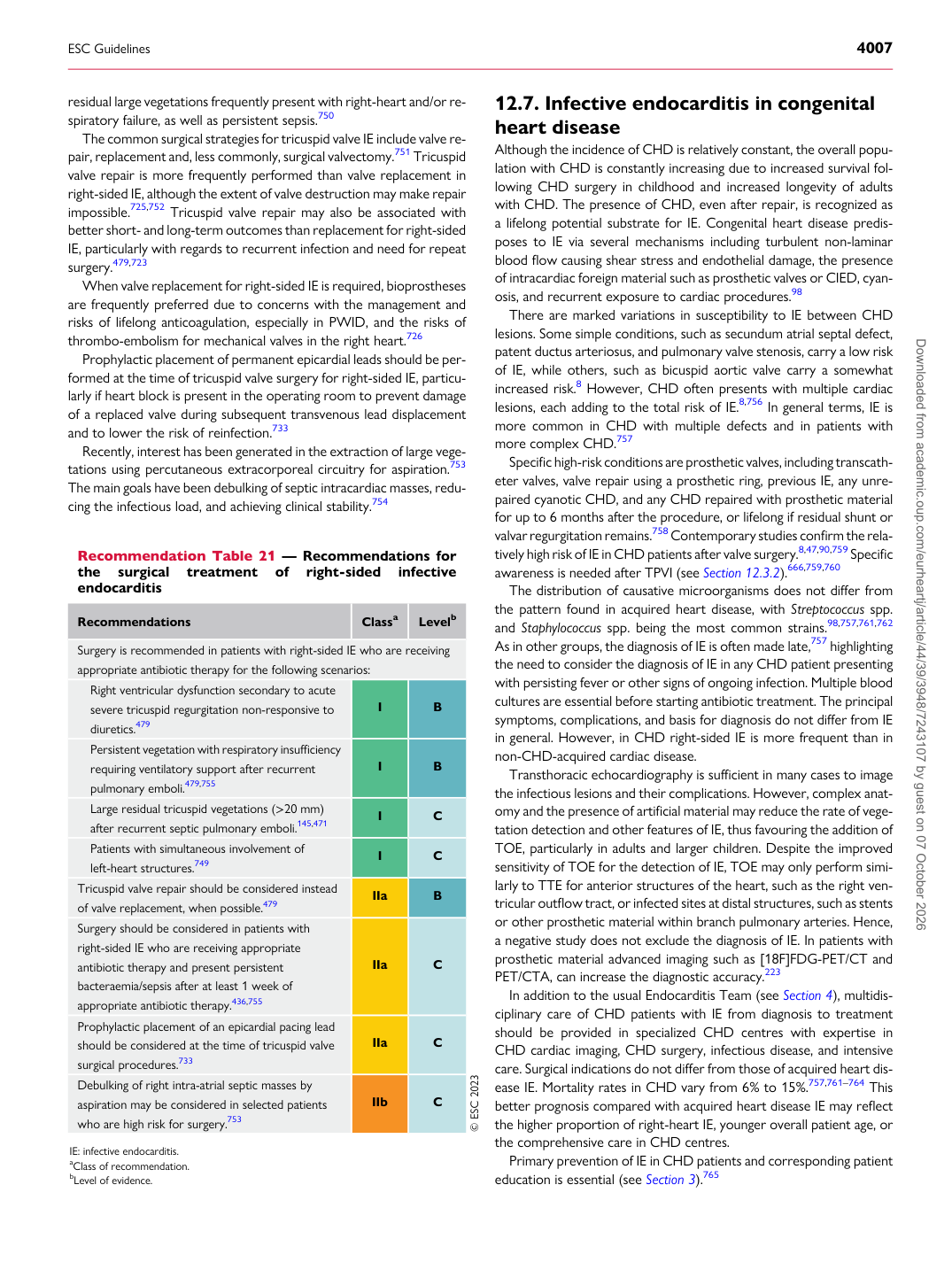
Recommendation Table 21 — Recommendations for the surgical treatment of right-sided infective endocarditis

Recommendations Classa Levelb

Surgery is recommended in patients with right-sided IE who are receiving appropriate antibiotic therapy for the following scenarios:

Right ventricular dysfunction secondary to acute severe tricuspid regurgitation non-responsive to diuretics.479 I B Persistent vegetation with respiratory insufficiency requiring ventilatory support after recurrent pulmonary emboli.479,755 I B Large residual tricuspid vegetations (>20 mm) after recurrent septic pulmonary emboli.145,471 I C Patients with simultaneous involvement of left-heart structures.749 I C Tricuspid valve repair should be considered instead of valve replacement, when possible.479 IIa B Surgery should be considered in patients with right-sided IE who are receiving appropriate antibiotic therapy and present persistent bacteraemia/sepsis after at least 1 week of appropriate antibiotic therapy.436,755 IIa C Prophylactic placement of an epicardial pacing lead should be considered at the time of tricuspid valve surgical procedures.733 IIa C Debulking of right intra-atrial septic masses by aspiration may be considered in selected patients who are high risk for surgery.753 IIb C © ESC 2023

IE: infective endocarditis. aClass of recommendation. bLevel of evidence.

ESC Guidelines                                                                                                                                                                                          4007

Downloaded from academic.oup.com/eurheartj/article/44/39/3948/7243107 by guest on 07 October 2026