p.6 抽出テキスト
1 Preamble

Guidelines evaluate and summarize available evidence, with the aim of assisting health professionals in proposing the best diagnostic or therapeutic approach for an individual patient with a given condition. Guidelines are intended for use by health professionals and the European Society of Cardiology (ESC) makes its Guidelines freely available. ESC Guidelines do not override the individual responsibility of health professionals to make appropriate and accurate decisions in consideration of each patient’s health condition and in consultation with that patient or the patient’s caregiver where appropriate and/or necessary. It is also the health professional’s responsibility to verify the rules and regulations applicable in each country to drugs and devices at the time of prescription, and, where appropriate, to respect the ethical rules of their profession.

ESC Guidelines represent the official position of the ESC on a given topic and are regularly updated. ESC Policies and Procedures for formulating and issuing ESC Guidelines can be found on the ESC website (https://www.escardio.org/Guidelines). The Members of this Task Force were selected by the ESC to represent professionals involved with the medical care of patients with this

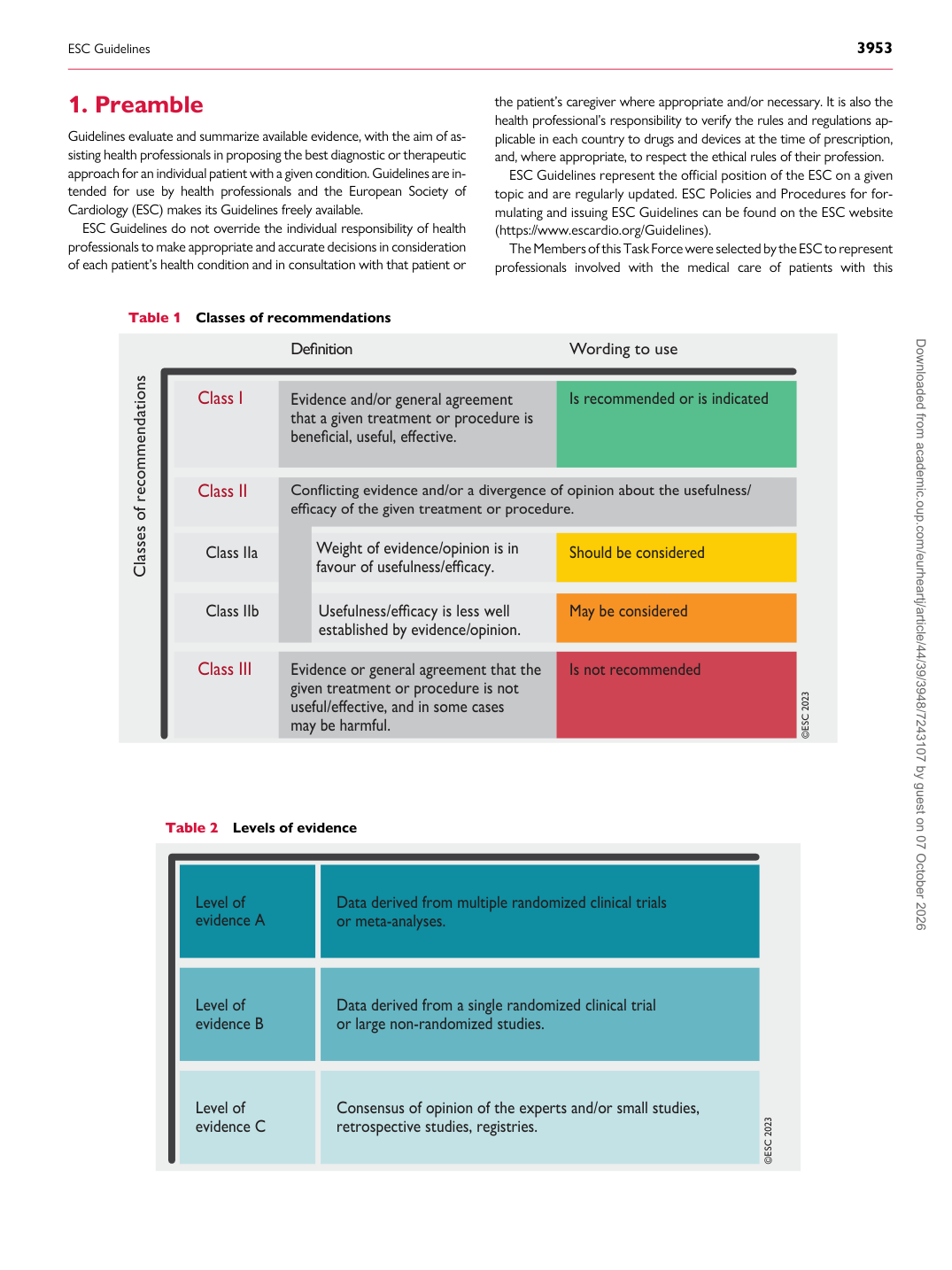
Table 1 Classes of recommendations

©ESC 2023

Classes of recommendations Class I Evidence and/or general agreement that a given treatment or procedure is beneficial, useful, effective.

Conflicting evidence and/or a divergence of opinion about the usefulness/ efficacy of the given treatment or procedure.

Is recommended or is indicated

Wording to use Definition

Class III Evidence or general agreement that the given treatment or procedure is not useful/effective, and in some cases may be harmful. Is not recommended

Class IIb Usefulness/efficacy is less well established by evidence/opinion. May be considered

Class IIa Weight of evidence/opinion is in favour of usefulness/efficacy. Should be considered

Class II

© ESC 2023

Table 2 Levels of evidence

Level of evidence A

Level of evidence B

Level of evidence C Data derived from multiple randomized clinical trials or meta-analyses.

Data derived from a single randomized clinical trial or large non-randomized studies.

Consensus of opinion of the experts and/or small studies, retrospective studies, registries. ©ESC 2023 © ESC 2023

ESC Guidelines                                                                                                                                                                                          3953

Downloaded from academic.oup.com/eurheartj/article/44/39/3948/7243107 by guest on 07 October 2026