p.58 抽出テキスト
12.5 Infective endocarditis in patients

admitted to intensive care units Infective endocarditis is frequently associated with severe life-threatening cardiac and/or systemic complications and the number of patients requiring intensive care unit (ICU) admission has steadily been growing in recent years, as shown in a large retrospective study.716 The need for ICU admission, advanced monitoring, vasoactive treatment, and organ support is most commonly prompted by the occurrence of septic shock, acute HF, and cardiogenic shock leading to multiorgan failure. Moreover, in recent years, an increase in healthcare-associated IE, usually of staphylococcal origin, predominantly in older patients with an increased number of comorbidities, and more likely to lead to critical illness, has also been reported.29,717–719 Any IE patient requiring ICU admission should be urgently discussed within the Endocarditis Team. In the largest multicentre retrospective series, focusing on critically ill IE patients with organ failure requiring ICU admission in France over an 18-year period, overall in-hospital mortality was 32%.716 Multivariate analysis showed age, Simplified Acute Physiology Score (SAPS) II score, organ failure, stroke, and Staphylococcus spp. to be associated with an increased risk of death. In contrast, cardiac surgery, CIED, male gender, and Streptococcus spp. as the causative microorganism of IE, were associated with a better survival.716 In another study that reported an even higher mortality (42%), four independent prognostic factors were identified: high SAPS II (>35 points) and Sequential Organ Failure Assessment (>8 points) scores, MRSA infection, and native valve IE.718

Right-sided IE, which is more commonly associated with PWID, accounts for <10% of IE cases but is associated with high mortality in patients needing ICU admission.717

12.5.1 Causative microorganisms

The majority of retrospective series in the ICU setting point to Staphylococcus spp. as the main causative agent of IE episodes. Indeed, S. aureus has emerged as the most feared aetiological agent with the highest rates of complications and mortality, being responsible for up to 56% of IE cases in one observational study.719 Streptococcus spp., Enterococcus spp., Gram-negative bacilli, and Candida spp. are less frequently reported.718,719 Identification of the infecting microorganism remains the mainstay of effective therapy in complicated IE cases. Hence, in patients with negative blood cultures, serological or molecular testing by PCR should be considered (see Section 5.3).

12.5.2 Diagnosis

The diverse nature, epidemiological profile, and presentation phenotype of IE in the ICU setting may hinder early diagnosis. In particular, pyrexial episodes suggestive of an alternative infective source and neurological manifestations, such as confusion, delirium, or focal symptoms may initially mislead the clinician from a diagnosis of IE. The diagnosis of IE in ICUs follows the same modified criteria as in non-ICU patients (see Section 5). Transoesophageal echocardiography has a prominent role as a tool for diagnosis of IE and its complications in the ICU.720

12.5.3 Management

Antimicrobial therapy and indications for surgery in patients with IE are described in Sections 7 and 10, respectively. Surgical therapy has been associated with an improved early and late outcome both in the general population and in patients admitted to ICUs. Although surgery is the treatment of choice in about one-half of patients, surgical therapy in ICU patients is characterized by more complex procedures with increased peri-operative mortality, as well as difficult post-operative care due to higher requirements of circulatory and pulmonary support. Five independent predictors of post-operative need for advanced circulatory support were found in one study of patients with IE: male sex, increased surgery duration, renal dysfunction (pre-operative estimated glomerular filtration <60 mL/min/m2), HF prior to surgery, and lower pre-operative platelet count.721 Extracorporeal membrane oxygenation is occasionally required in patients post-surgery but is associated with poor outcomes.722 Decision-making in ICU patients with IE should always be a product of consensus of the Endocarditis Team to determine the best management strategy. Pre-operative haemodynamic optimization and goal-directed therapy protocols including vasoactive drugs and mechanical circulatory support may be considered in these complex high-risk patients.721

12.6 Right-sided infective endocarditis

Right-sided IE accounts for ∼5–10% of patients with IE,723 but its frequency may be increasing as its risk factors are increasing in some countries.133,724 Risk factors for right-sided IE include patients with CHD, indwelling catheters, and CIED, as well as immunocompromised and PWID patients. Of these, PWID is an increasingly common risk

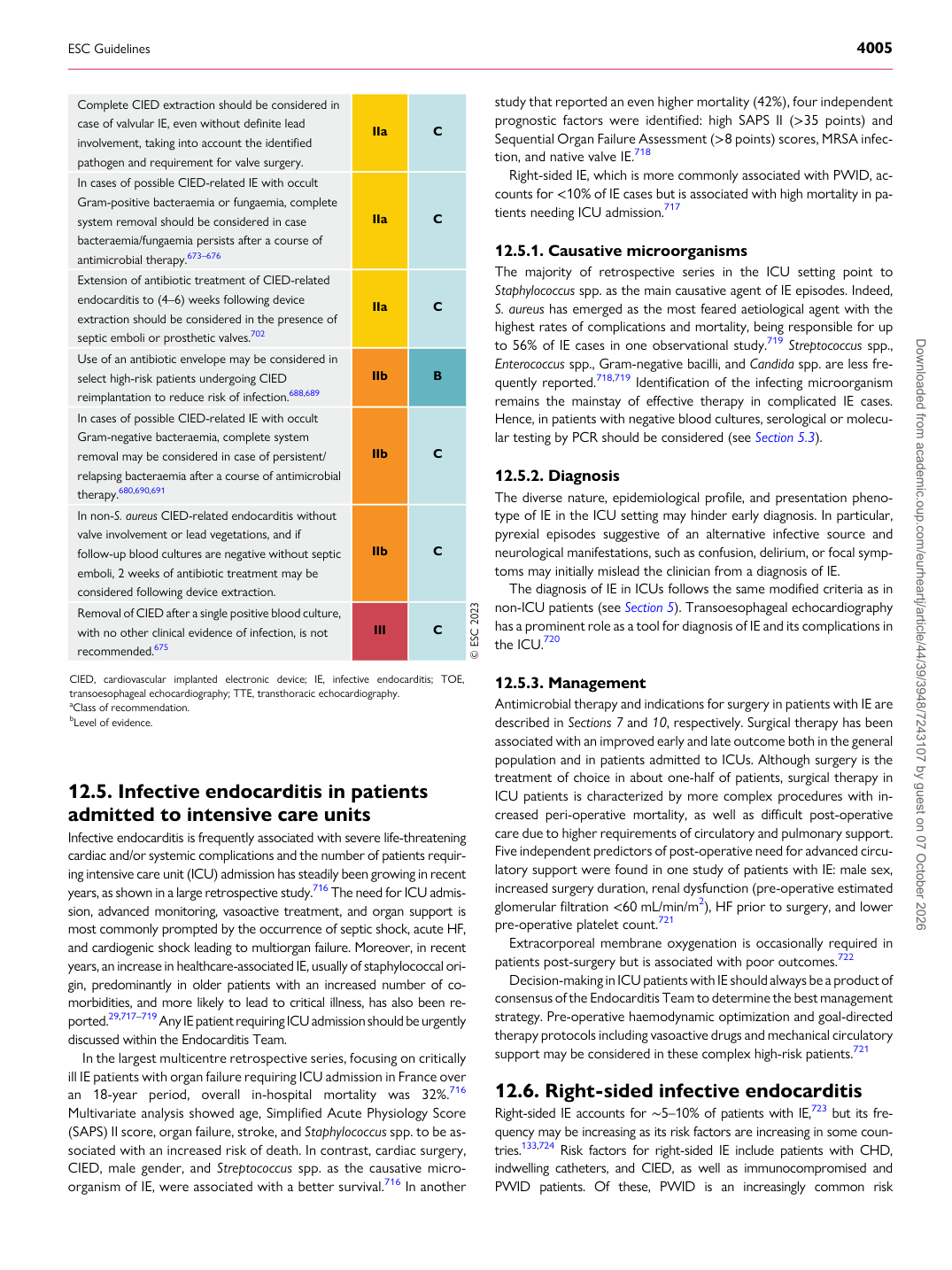
Complete CIED extraction should be considered in case of valvular IE, even without definite lead involvement, taking into account the identified pathogen and requirement for valve surgery. IIa C In cases of possible CIED-related IE with occult Gram-positive bacteraemia or fungaemia, complete system removal should be considered in case bacteraemia/fungaemia persists after a course of antimicrobial therapy.673–676 IIa C Extension of antibiotic treatment of CIED-related endocarditis to (4–6) weeks following device extraction should be considered in the presence of septic emboli or prosthetic valves.702 IIa C Use of an antibiotic envelope may be considered in select high-risk patients undergoing CIED reimplantation to reduce risk of infection.688,689 IIb B In cases of possible CIED-related IE with occult Gram-negative bacteraemia, complete system removal may be considered in case of persistent/ relapsing bacteraemia after a course of antimicrobial therapy.680,690,691 IIb C In non-S. aureus CIED-related endocarditis without valve involvement or lead vegetations, and if follow-up blood cultures are negative without septic emboli, 2 weeks of antibiotic treatment may be considered following device extraction. IIb C Removal of CIED after a single positive blood culture, with no other clinical evidence of infection, is not recommended.675 III C © ESC 2023

CIED, cardiovascular implanted electronic device; IE, infective endocarditis; TOE, transoesophageal echocardiography; TTE, transthoracic echocardiography. aClass of recommendation. bLevel of evidence.

ESC Guidelines                                                                                                                                                                                          4005

Downloaded from academic.oup.com/eurheartj/article/44/39/3948/7243107 by guest on 07 October 2026