p.57 抽出テキスト
Transthoracic echocardiography and TOE are both recommended in the case of suspected CIED-related IE.692–694 Intracardiac echocardiography may also be used to visualize vegetations,695 and may be useful in patients in whom TOE is not possible. However, the absence of vegetations does not rule out IE, as these may be present on extracardiac segments of the lead which cannot be visualized. Repeating TTE and/or TOE within 5–7 days is recommended in case of initially negative examination when clinical suspicion of CIED-related IE remains high. It is important to note that fibrinous lead masses may be observed in asymptomatic CIED patients, and do not predict CIED-related IE over long-term follow-up.696 Diagnosis of CIED-related endocarditis by [18]FDG-PET/CT has good sensitivity and specificity,129 and is particularly useful in the setting of possible CIED-related IE without signs of pocket infection.238 Results should be interpreted with caution, however, if the CIED is recently implanted (<6 weeks).130 White blood cell SPECT/CT has also been used for diagnosing CIED infection but has limited availability.216,697 A chest X-ray or CT should be performed in all patients to evaluate the presence of pulmonary complications.

12.4.6 Antimicrobial therapy

Treatment of CIED infection involves early698,699 and complete removal of all parts of the system, combined with initial empirical antibiotic therapy directed at MRSA and Gram-negative bacteria, while awaiting identification of the pathogen.130,700,701 Antibiotic treatment follows the recommendations indicated in Section 7. In exceptional cases where complete device removal is not possible, i.v. antibiotics for 4–6 weeks may be administered followed by close follow-up after interruption of antibiotic therapy or, alternatively, individualized long-term suppressive oral therapy.

12.4.7 Device extraction

When CIED and lead extraction is required, such procedures should be performed in centres with the corresponding expertise. Complete CIED removal is recommended for all patients with confirmed infection of the lead(s), as conservative treatment is associated with increased mortality.678,699 In patients with left-sided prosthetic heart valves and CIED infection, complete CIED removal combined with prolonged (4–)6 week antibiotic therapy may prevent left-sided valve infection.130,702 Complete CIED extraction should also be considered in case of valvular IE without definite lead involvement, taking into account the identified pathogens (Staphylococcus spp. infections may be more prone to seed the CIED),673,675,676 procedural risk, and indication for valve surgery. Complete device extraction should be considered even in the absence of vegetations in the setting of persistent or relapsing Gram-positive bacteraemia or fungaemia after a course of appropriate antibiotic therapy, if there is no other identified source (see Figure 13).681 In all instances of lead extraction, procedural risk should be carefully evaluated taking into account lead dwell time, pacemaker dependency, patient frailty, and other co-morbidities within the process of shared decision-making.703 Lead extraction should be performed, without delay (i.e. within the first days of admission), as this has been shown to be associated with improved outcomes.698,699,704 Percutaneous rather than surgical extraction is the preferred procedure, but requires specialized tools and should be performed in centres with expertise in this technique and with onsite surgical backup, due to the risk of life-threatening tamponade and vein laceration. Large vegetations may be aspirated percutaneously before lead extraction to reduce risk associated with embolization.705 Surgical lead extraction should be considered in case of large vegetations (e.g. >20 mm)679 and if aspiration is not available or is unsuccessful. Surgical removal is also the preferred technique if valve surgery is indicated. Hardware retrieved from extraction, especially the lead tip, should be cultured.706 Sonication has been shown to increase diagnostic yield.707,708

12.4.8 Device reimplantation

The indication for reimplantation should always be carefully evaluated and no part of the removed CIED system should be reimplanted. Quality of evidence regarding timing of reimplantation is poor.709 Reimplantation should be performed at a site distant from that of the previous generator, and delayed until signs and symptoms of local and systemic infection have resolved and blood cultures are negative for at least 72 h after extraction in the absence of vegetations or ‘ghosts’ (fibrous remnants after lead extraction, which have been associated with death and reinfection),710 or after 2 weeks of negative blood cultures if vegetations were visualized.701,711 For patients with a high risk of sudden cardiac death, a wearable defibrillator is an option as a bridge to reimplantation. In pacemaker-dependent patients, an active-fixation lead may be introduced via the internal jugular vein and connected to an external pacemaker for up to 4–6 weeks, thereby preserving the contralateral side for definitive device reimplantation.712 As an alternative to delayed reimplantation in pacemaker-dependent patients, an epicardial pacemaker may be implanted before lead extraction, although this strategy has been associated with a higher risk of device re-intervention.713 Alternative devices such as leadless pacemakers714 or subcutaneous ICD715 may be implanted in selected patients if the risk of new infection is deemed high.

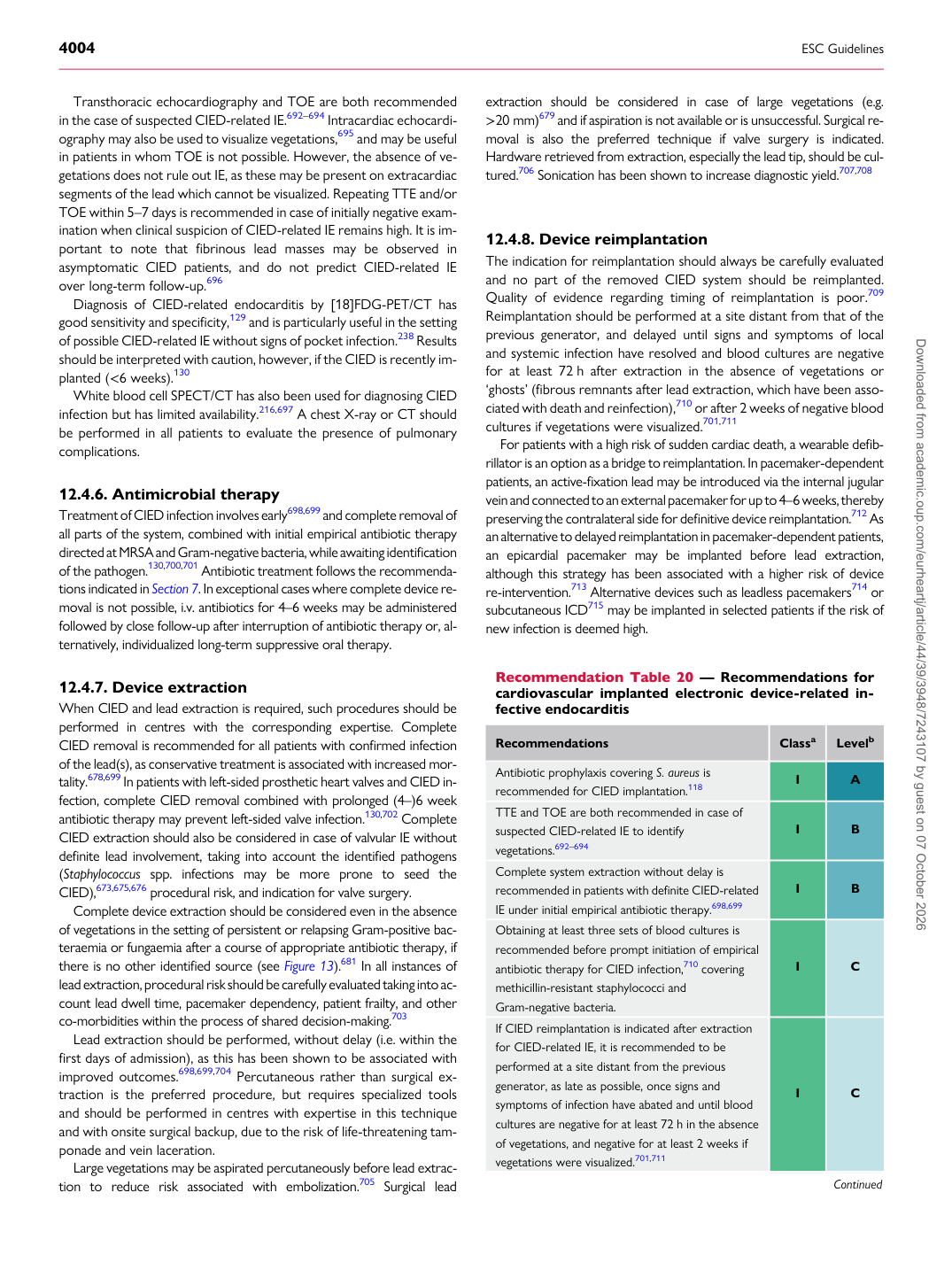
Recommendation Table 20 — Recommendations for cardiovascular implanted electronic device-related infective endocarditis

Recommendations Classa Levelb

Antibiotic prophylaxis covering S. aureus is recommended for CIED implantation.118 I A TTE and TOE are both recommended in case of suspected CIED-related IE to identify vegetations.692–694 I B Complete system extraction without delay is recommended in patients with definite CIED-related IE under initial empirical antibiotic therapy.698,699 I B Obtaining at least three sets of blood cultures is recommended before prompt initiation of empirical antibiotic therapy for CIED infection,710 covering methicillin-resistant staphylococci and Gram-negative bacteria. I C If CIED reimplantation is indicated after extraction for CIED-related IE, it is recommended to be performed at a site distant from the previous generator, as late as possible, once signs and symptoms of infection have abated and until blood cultures are negative for at least 72 h in the absence of vegetations, and negative for at least 2 weeks if vegetations were visualized.701,711 I C

Continued Downloaded from academic.oup.com/eurheartj/article/44/39/3948/7243107 by guest on 07 October 2026