p.52 抽出テキスト
11.2 First year follow-up

Patients discharged after the first episode of IE should remain under close surveillance for potential long-term complications. A partnership between cardiologists, infectious disease specialists, cardiac surgeons, general practitioners, and dentists is encouraged to improve patient care and reinforce prophylaxis measures. In medically treated patients, residual valve dysfunction may worsen, or structural valve deterioration may progress, despite bacteriological cure. To monitor the risk of development of secondary HF, an initial clinical evaluation and baseline TTE should be performed at the completion of antimicrobial therapy and repeated if a change in the clinical condition occurs. Clinical re-assessment should be performed one or more times in the first year and yearly thereafter depending on the individual risk profile. The need for late valve surgery is relatively low, ranging from 3% to 11%.27,588,592 Blood testing for inflammatory markers (i.e. WBC, C-reactive protein, procalcitonin) should be performed early after finishing antimicrobial treatment and repeated thereafter when clinically indicated.592 Due to the increased risk of relapse for virulent microorganisms, blood cultures are encouraged within the first week after finishing treatment. The early period after discharge might be challenged by slow physical and mental recovery.603,604 Patients’ and families’ concerns should be addressed during follow-up. Supporting the family may indirectly support the patient during recovery and reduce the psychological burden. Cardiac rehabilitation, including physical exercise training and patient education, may be beneficial, and has been shown to be safe and feasible in stable patients at a minimum of 2 weeks after surgery for left-sided IE.605 Physical training should start as early as possible and can be adapted post-sternotomy with isolated lower-limb training. Adherence is improved if the delay to training is minimized, and rebuilding muscle mass and reducing frailty should be a priority. Patients, and their caregivers, should be informed of their risk of IE recurrence and be educated on preventive measures and selfmonitoring. In particular, patients should be educated that new onset of fever, chills, or other signs of infection mandate immediate evaluation, including procurement of blood cultures before empirical use of antibiotics, and that contact with the Heart Valve Centre is mandatory in case of suspected recurrent IE. Good oral health maintenance, preventive dentistry, and advice about skin hygiene, including advice on tattoos and skin piercing, are mandatory. Deficiencies in dental surveillance contribute to the continuous gradual increase in the incidence of IE, which underlines the need for repeating the principles of IE prevention at each follow-up visit. In PWID patients, follow-up care should include a strategy for addiction treatment, involve relevant addiction specialists before hospital discharge, and possibly including medication for opioid-use disorder.606,607

11.3 Long-term prognosis

Contemporary long-term survival rates after the completion of IE treatment are estimated to be ∼85–90% and 70–80% at 1 and 5 years, respectively.589,592–594,610,611 Impact of referral bias, however, should be taken into consideration.612 The main predictors of long-term mortality are age, co-morbidities, PWID, double valve infection, recurrences of IE, and HF, especially when cardiac surgery cannot be performed.588,589,592,593,613 Compared with an age- and sex-matched general population, patients that survived a first episode of IE have significantly worse survival when suffering relapses or reinfections.589,614 This excess mortality is especially high within the first few years after hospital discharge and can be explained by late complications such as HF, risk of recurrences, and higher patient vulnerability.589,611 In fact, most recurrences of IE and late cardiac surgeries occurred during this period of time.589,592,611

12 Management of specific

situations

12.1 Prosthetic valve endocarditis

Prosthetic valve endocarditis is the most severe form of IE and occurs in 1–6% of patients with valve prostheses,615 with an incidence of 0.3–1.2% per patient-year.5,420,616,617 PVE accounts for 20–30% of all cases of IE,618 and may be more common after biological than after mechanical valve replacement surgery.619,620 PVE was observed in 21% of cases of IE in a French survey,618 in 26% of cases in the Euro Heart Survey,419 and in 20% of cases in the ICE-PCS.621 Real-world

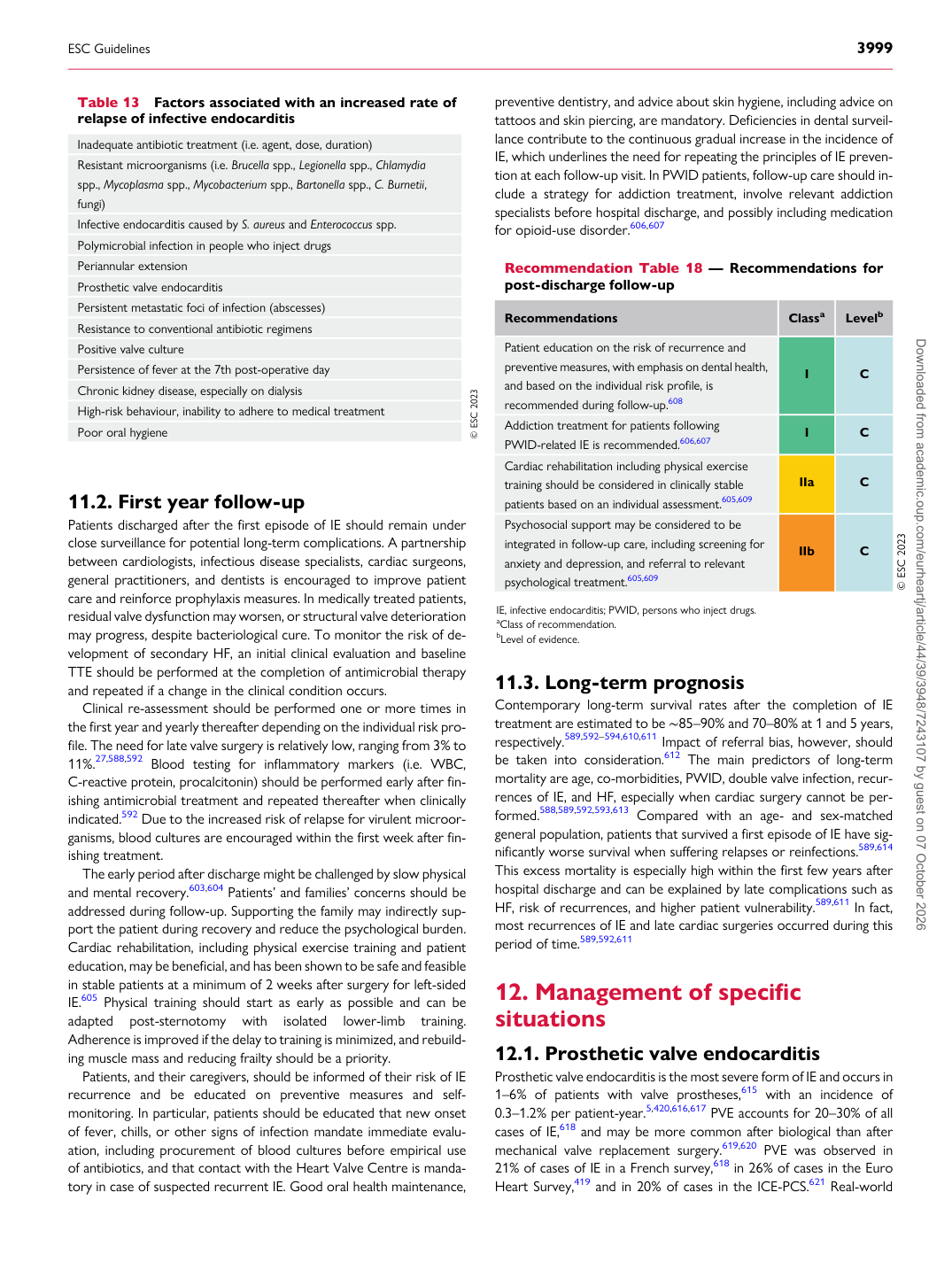
Table 13 Factors associated with an increased rate of relapse of infective endocarditis Inadequate antibiotic treatment (i.e. agent, dose, duration) Resistant microorganisms (i.e. Brucella spp., Legionella spp., Chlamydia spp., Mycoplasma spp., Mycobacterium spp., Bartonella spp., C. Burnetii, fungi) Infective endocarditis caused by S. aureus and Enterococcus spp. Polymicrobial infection in people who inject drugs Periannular extension Prosthetic valve endocarditis Persistent metastatic foci of infection (abscesses) Resistance to conventional antibiotic regimens Positive valve culture Persistence of fever at the 7th post-operative day Chronic kidney disease, especially on dialysis High-risk behaviour, inability to adhere to medical treatment Poor oral hygiene © ESC 2023 Recommendation Table 18 — Recommendations for post-discharge follow-up

Recommendations Classa Levelb

Patient education on the risk of recurrence and preventive measures, with emphasis on dental health, and based on the individual risk profile, is recommended during follow-up.608 I C Addiction treatment for patients following PWID-related IE is recommended.606,607 I C Cardiac rehabilitation including physical exercise training should be considered in clinically stable patients based on an individual assessment.605,609 IIa C Psychosocial support may be considered to be integrated in follow-up care, including screening for anxiety and depression, and referral to relevant psychological treatment.605,609 IIb C © ESC 2023

IE, infective endocarditis; PWID, persons who inject drugs. aClass of recommendation. bLevel of evidence.

ESC Guidelines                                                                                                                                                                                          3999

Downloaded from academic.oup.com/eurheartj/article/44/39/3948/7243107 by guest on 07 October 2026