p.51 抽出テキスト
10.6 Management of antithrombotic

therapy after surgery The management of antithrombotic therapy early after surgery for IE may need to be altered when compared with non-IE clinical scenarios (see also Section 12.10).128 This is mainly due to known increased risk of intracranial haemorrhage after cerebral embolism. Restrictive or tailored use of antiplatelet and antithrombotic agents after surgery are key to avoid further complications,203,587 which is more feasible in patients who received bioprosthetic valve prostheses or valve repair operations than after mechanical valve replacement surgery.

11 Outcome after discharge: follow-up and long-term prognosis

Following in-hospital treatment, patients should be followed-up for the occurrence of main post-discharge complications, including recurrence of infection, HF, need for valve surgery or additional intervention, stroke, need for renal replacement therapy, psychological complications, and death.86,588,589

11.1 Recurrences: relapses and

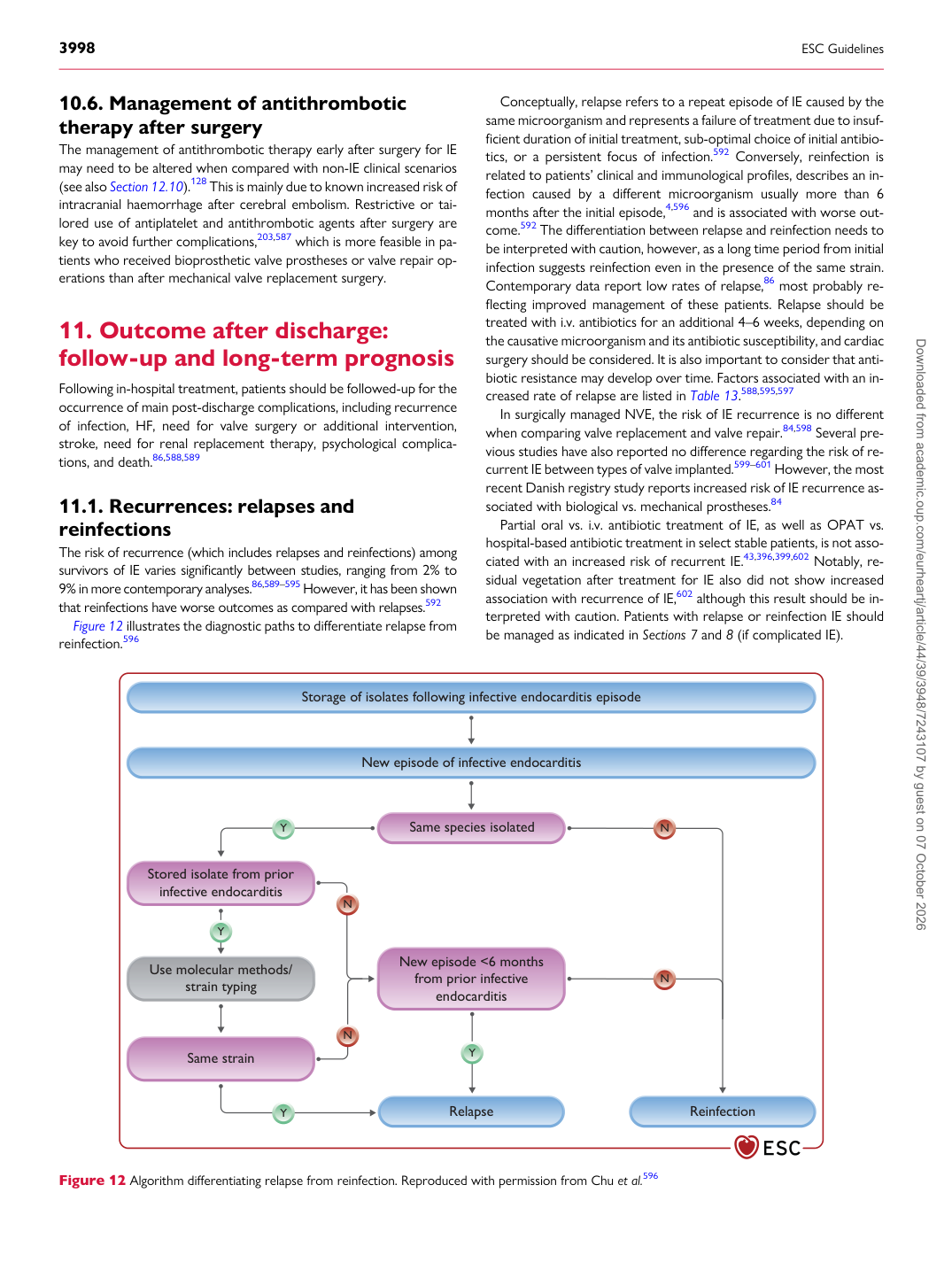
reinfections The risk of recurrence (which includes relapses and reinfections) among survivors of IE varies significantly between studies, ranging from 2% to 9% in more contemporary analyses.86,589–595 However, it has been shown that reinfections have worse outcomes as compared with relapses.592 Figure 12 illustrates the diagnostic paths to differentiate relapse from reinfection.596 Conceptually, relapse refers to a repeat episode of IE caused by the same microorganism and represents a failure of treatment due to insufficient duration of initial treatment, sub-optimal choice of initial antibiotics, or a persistent focus of infection.592 Conversely, reinfection is related to patients’ clinical and immunological profiles, describes an infection caused by a different microorganism usually more than 6 months after the initial episode,4,596 and is associated with worse outcome.592 The differentiation between relapse and reinfection needs to be interpreted with caution, however, as a long time period from initial infection suggests reinfection even in the presence of the same strain. Contemporary data report low rates of relapse,86 most probably reflecting improved management of these patients. Relapse should be treated with i.v. antibiotics for an additional 4–6 weeks, depending on the causative microorganism and its antibiotic susceptibility, and cardiac surgery should be considered. It is also important to consider that antibiotic resistance may develop over time. Factors associated with an increased rate of relapse are listed in Table 13.588,595,597

In surgically managed NVE, the risk of IE recurrence is no different when comparing valve replacement and valve repair.84,598 Several previous studies have also reported no difference regarding the risk of recurrent IE between types of valve implanted.599–601 However, the most recent Danish registry study reports increased risk of IE recurrence associated with biological vs. mechanical prostheses.84 Partial oral vs. i.v. antibiotic treatment of IE, as well as OPAT vs. hospital-based antibiotic treatment in select stable patients, is not associated with an increased risk of recurrent IE.43,396,399,602 Notably, residual vegetation after treatment for IE also did not show increased association with recurrence of IE,602 although this result should be interpreted with caution. Patients with relapse or reinfection IE should be managed as indicated in Sections 7 and 8 (if complicated IE).

Same species isolated

Reinfection Relapse

Same strain

Stored isolate from prior

infective endocarditis

Use molecular methods/

strain typing New episode <6 months

from prior infective

endocarditis N

N

N N

Storage of isolates following infective endocarditis episode

New episode of infective endocarditis

Y

Y

Y Y

Figure 12 Algorithm differentiating relapse from reinfection. Reproduced with permission from Chu et al.596 Downloaded from academic.oup.com/eurheartj/article/44/39/3948/7243107 by guest on 07 October 2026