p.50 抽出テキスト
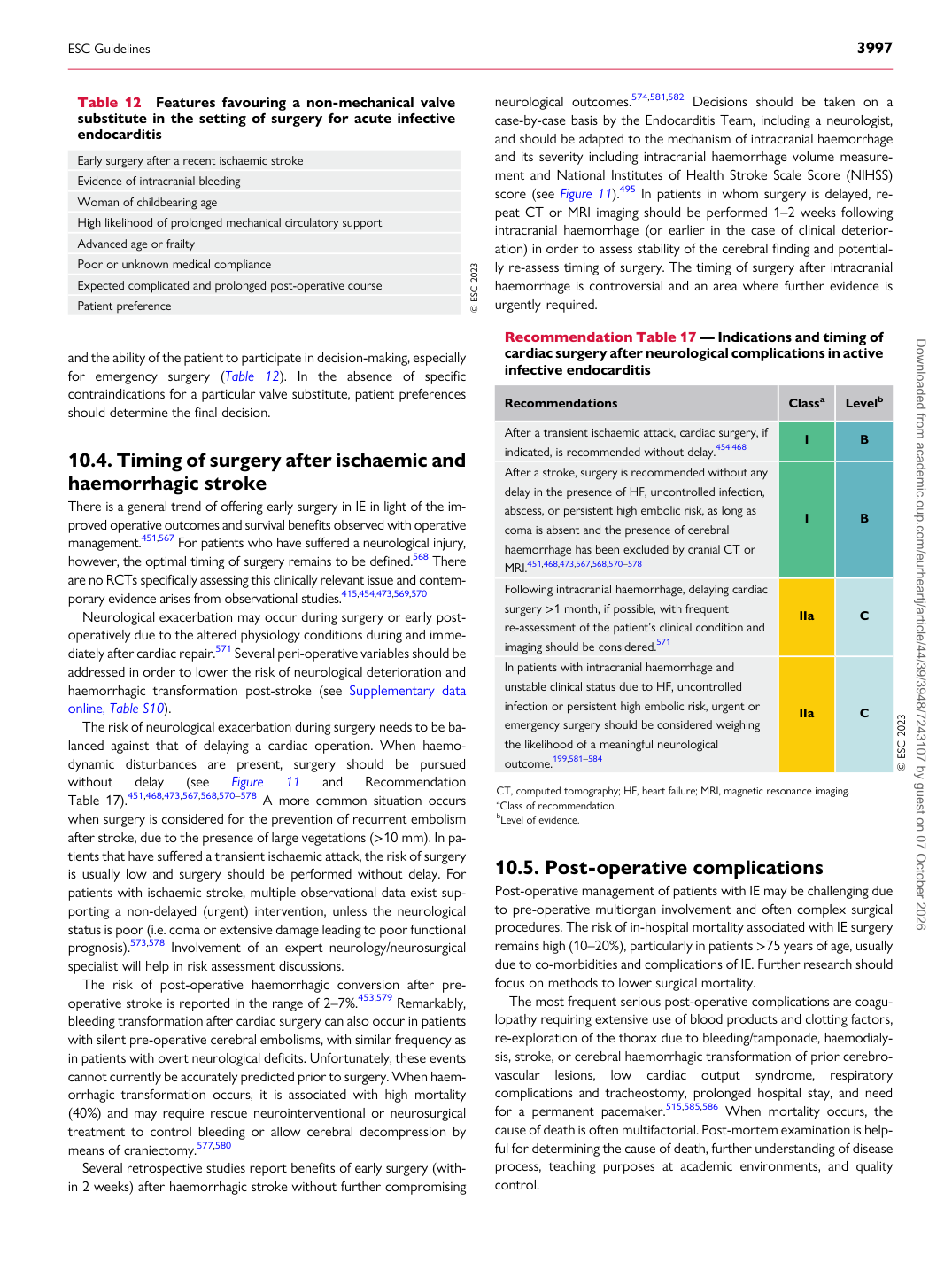
and the ability of the patient to participate in decision-making, especially for emergency surgery (Table 12). In the absence of specific contraindications for a particular valve substitute, patient preferences should determine the final decision.

10.4 Timing of surgery after ischaemic and

haemorrhagic stroke There is a general trend of offering early surgery in IE in light of the improved operative outcomes and survival benefits observed with operative management.451,567 For patients who have suffered a neurological injury, however, the optimal timing of surgery remains to be defined.568 There are no RCTs specifically assessing this clinically relevant issue and contemporary evidence arises from observational studies.415,454,473,569,570 Neurological exacerbation may occur during surgery or early postoperatively due to the altered physiology conditions during and immediately after cardiac repair.571 Several peri-operative variables should be addressed in order to lower the risk of neurological deterioration and haemorrhagic transformation post-stroke (see Supplementary data online, Table S10). The risk of neurological exacerbation during surgery needs to be balanced against that of delaying a cardiac operation. When haemodynamic disturbances are present, surgery should be pursued without delay (see Figure 11 and Recommendation Table 17).451,468,473,567,568,570–578 A more common situation occurs when surgery is considered for the prevention of recurrent embolism after stroke, due to the presence of large vegetations (>10 mm). In patients that have suffered a transient ischaemic attack, the risk of surgery is usually low and surgery should be performed without delay. For patients with ischaemic stroke, multiple observational data exist supporting a non-delayed (urgent) intervention, unless the neurological status is poor (i.e. coma or extensive damage leading to poor functional prognosis).573,578 Involvement of an expert neurology/neurosurgical specialist will help in risk assessment discussions. The risk of post-operative haemorrhagic conversion after preoperative stroke is reported in the range of 2–7%.453,579 Remarkably, bleeding transformation after cardiac surgery can also occur in patients with silent pre-operative cerebral embolisms, with similar frequency as in patients with overt neurological deficits. Unfortunately, these events cannot currently be accurately predicted prior to surgery. When haemorrhagic transformation occurs, it is associated with high mortality (40%) and may require rescue neurointerventional or neurosurgical treatment to control bleeding or allow cerebral decompression by means of craniectomy.577,580 Several retrospective studies report benefits of early surgery (within 2 weeks) after haemorrhagic stroke without further compromising neurological outcomes.574,581,582 Decisions should be taken on a case-by-case basis by the Endocarditis Team, including a neurologist, and should be adapted to the mechanism of intracranial haemorrhage and its severity including intracranial haemorrhage volume measurement and National Institutes of Health Stroke Scale Score (NIHSS) score (see Figure 11).495 In patients in whom surgery is delayed, repeat CT or MRI imaging should be performed 1–2 weeks following intracranial haemorrhage (or earlier in the case of clinical deterioration) in order to assess stability of the cerebral finding and potentially re-assess timing of surgery. The timing of surgery after intracranial haemorrhage is controversial and an area where further evidence is urgently required.

10.5 Post-operative complications

Post-operative management of patients with IE may be challenging due to pre-operative multiorgan involvement and often complex surgical procedures. The risk of in-hospital mortality associated with IE surgery remains high (10–20%), particularly in patients >75 years of age, usually due to co-morbidities and complications of IE. Further research should focus on methods to lower surgical mortality. The most frequent serious post-operative complications are coagulopathy requiring extensive use of blood products and clotting factors, re-exploration of the thorax due to bleeding/tamponade, haemodialysis, stroke, or cerebral haemorrhagic transformation of prior cerebrovascular lesions, low cardiac output syndrome, respiratory complications and tracheostomy, prolonged hospital stay, and need for a permanent pacemaker.515,585,586 When mortality occurs, the cause of death is often multifactorial. Post-mortem examination is helpful for determining the cause of death, further understanding of disease process, teaching purposes at academic environments, and quality control.

Recommendation Table 17 — Indications and timing of cardiac surgery after neurological complications in active infective endocarditis

Recommendations Classa Levelb

After a transient ischaemic attack, cardiac surgery, if indicated, is recommended without delay.454,468 I B After a stroke, surgery is recommended without any delay in the presence of HF, uncontrolled infection, abscess, or persistent high embolic risk, as long as coma is absent and the presence of cerebral haemorrhage has been excluded by cranial CT or MRI.451,468,473,567,568,570–578 I B Following intracranial haemorrhage, delaying cardiac surgery >1 month, if possible, with frequent re-assessment of the patient’s clinical condition and imaging should be considered.571 IIa C In patients with intracranial haemorrhage and unstable clinical status due to HF, uncontrolled infection or persistent high embolic risk, urgent or emergency surgery should be considered weighing the likelihood of a meaningful neurological outcome.199,581–584 IIa C © ESC 2023

CT, computed tomography; HF, heart failure; MRI, magnetic resonance imaging. aClass of recommendation. bLevel of evidence.

Table 12 Features favouring a non-mechanical valve substitute in the setting of surgery for acute infective endocarditis Early surgery after a recent ischaemic stroke Evidence of intracranial bleeding Woman of childbearing age High likelihood of prolonged mechanical circulatory support Advanced age or frailty Poor or unknown medical compliance Expected complicated and prolonged post-operative course Patient preference © ESC 2023

ESC Guidelines                                                                                                                                                                                          3997

Downloaded from academic.oup.com/eurheartj/article/44/39/3948/7243107 by guest on 07 October 2026