p.48 抽出テキスト
10.1.2 Extracardiac infection

Extracardiac foci may be treated prior to valve surgery, during the valve operation, or post-operatively, dependent on the urgency of cardiac surgery. Regardless of the timing of intervention, infective foci need to be eradicated before completion of antibiotic therapy in order to avoid cardiac valve reinfection.

10.1.3 Intra-operative echocardiography

Intra-operative TOE provides contemporaneous assessment of the extent of infection prior to valve repair/replacement. Extent of infection, stability of known vegetations, re-assessment of previously uninvolved heart valves, and biventricular function are routinely performed with intra-operative TOE. Intra-operative TOE post-surgical repair is mandatory to determine the immediate result and establish a baseline for follow-up comparisons.547

10.2 Other intra-operative considerations

Specific peri-operative management considerations are necessary in all IE patients undergoing valve surgery, particularly in those following stroke (see Section 10.3). Pre-operative antibiotic therapy must be continued intra-operatively, and doses may need to be repeated in case of prolonged operations or major bleeding. Although the pharmacokinetics of antibiotic therapy is altered during cardio-pulmonary bypass (CPB), adjustment of doses is rarely required.548 In general, ongoing IE antibiotic treatment offers appropriate surgical site infection prophylaxis. However, when the antibiotic treatment for IE does not fully cover normal surgical prophylactic treatment, conventional prophylaxis should be added. Intra-operative bleeding management is often complicated by marked coagulopathy in patients with IE, particularly those undergoing surgery during persistent sepsis. The management of hypotension and vasoplaegia is particularly challenging in patients presenting with septic shock, and accompanying vasoplaegia tends to worsen significantly during CPB. Norepinephrine is frequently used as first-line therapy for septic shock, followed by vasopressin or terlipressin in cases of resistant vasoplaegia.549 Methylene blue may be used as a rescue agent in patients who are unresponsive to these measures, but mortality rates are high for such patients.550

Retrospective studies have suggested that the use of haemoadsorbent filters during CPB may decrease the negative effects associated with cytokine cascade activation.551 A recent RCT of haemoadsorption during cardiac surgery in IE patients, however, failed to demonstrate any beneficial effects with regards to adverse events or end-organ function.552

10.3 Surgical approach and techniques

Surgery for IE aims to remove infected structures followed by reestablishment of anatomy and haemodynamic function. With regards to the involved heart valve(s), repair or replacement is carried out based on the extent of destruction, acuity of disease, and patient characteristics.553 Appropriate collection and labelling of tissue samples for pathological, microbiological, and molecular biological analyses are necessary to help guide antibiotic treatment. Aortic valve replacement is usually required for aortic IE. Aortic valve repair is very uncommon in the acute situation but may be performed for isolated aortic regurgitation after healed endocarditis. In mitral IE, leaflet perforations with preserved free margin and chordae tendinae may be treated with patch repair, particularly in the setting of subacute or healed IE. Although mitral valve repair is feasible in more complex mitral IE involving the annuli, the leaflet free edge, and/or chordae, evidence showing the feasibility and durability of such repair techniques is scarce.554,555 A large registry on mitral repair vs. replacement in IE was limited by the lack of information on severity of IE, different patient group profiles, and significantly higher incidence of staphylococcal endocarditis in the mitral valve replacement group.556 Therefore, it cannot be concluded that mitral valve repair is superior to replacement due to the high probability of selection bias. Valve preservation in acute IE should only be attempted if a durable repair is anticipated and complete eradication of infected tissue can be achieved. However, valve repair may be necessary in children, where valve replacement options are more limited. Invasion of the aortic annuli may create shallow defects (very limited abscess or small pseudoaneurysms) that are still amenable to conventional valve replacement surgery. When disease progresses into an extensive aortic root abscess or periannular destruction, aortic root replacement is usually required. In experienced centres, the use of allografts has been preferred as they have the advantage of adapting to irregular surfaces and provide haemostatic advantages with very good haemodynamic function and low thrombo-embolic risk, and can be used to repair concomitant lesions of the anterior mitral valve leaflet.557,558 Additionally, allografts and stentless bioprostheses can be beneficial in small aortic roots and are associated with low reinfection rates. However, experience is generally limited to single-centre case series and there is no clear evidence of superiority of one valve substitute over the other.559 In very selected patients and children in particular, the Ross operation (pulmonary valve autotransplantation) may be considered for aortic root IE.128 The use of patches to cover abscess cavities and prevent extensive resection and reconstruction is discouraged in aortic root IE as it may be associated with recurrences, periprosthetic leaks, and pseudoaneurysm formation. After exclusion from the circulation, abscess and pseudoaneurysm cavities are left to drain into the pericardial cavity. When periannular infection of the aortic root extends into the intervalvular fibrosa body, complex surgical reconstructions are required and are frequently the only option to achieve patient survival. The reported

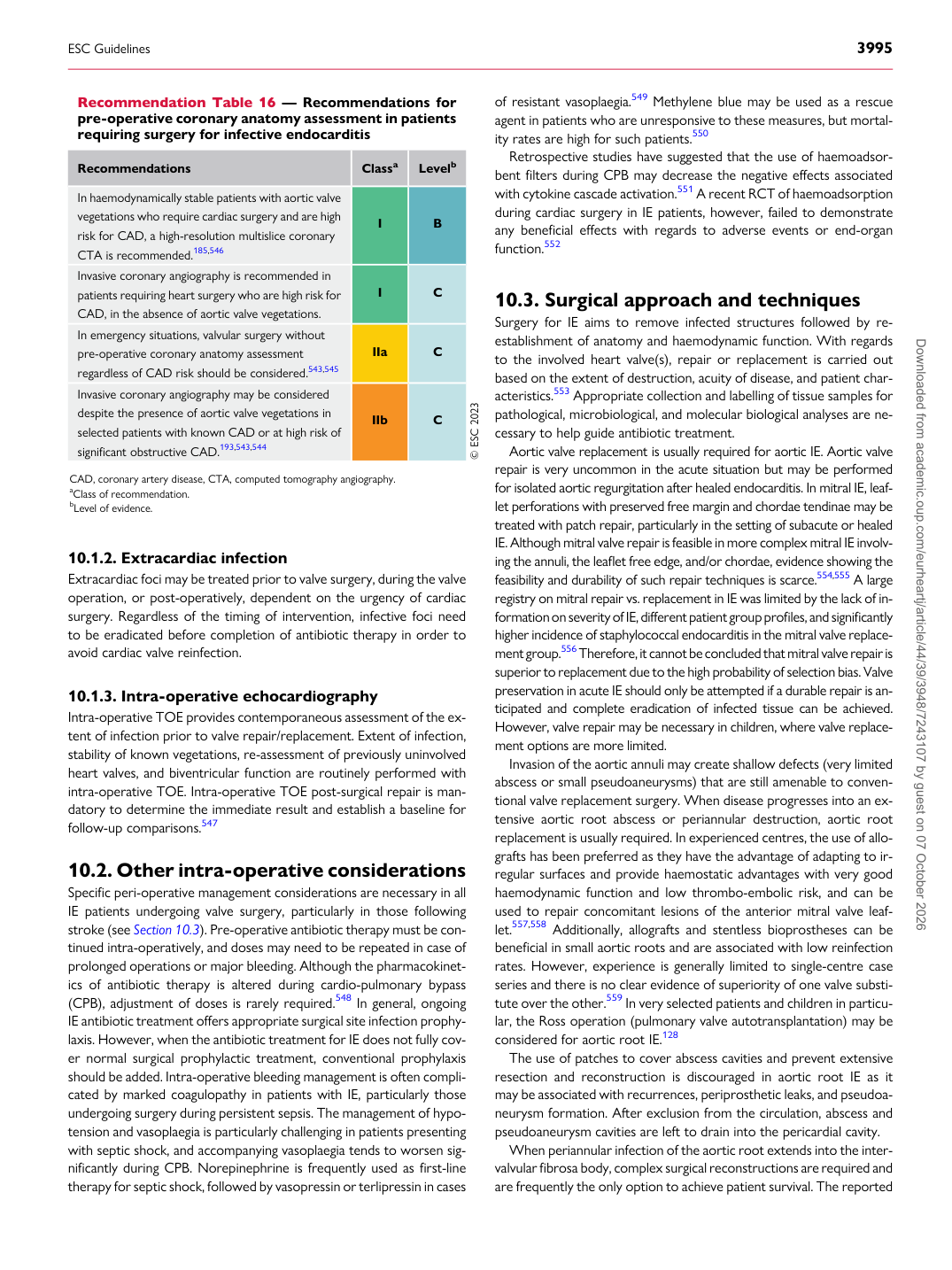
Recommendation Table 16 — Recommendations for pre-operative coronary anatomy assessment in patients requiring surgery for infective endocarditis

Recommendations Classa Levelb

In haemodynamically stable patients with aortic valve vegetations who require cardiac surgery and are high risk for CAD, a high-resolution multislice coronary CTA is recommended.185,546 I B Invasive coronary angiography is recommended in patients requiring heart surgery who are high risk for CAD, in the absence of aortic valve vegetations. I C In emergency situations, valvular surgery without pre-operative coronary anatomy assessment regardless of CAD risk should be considered.543,545 IIa C Invasive coronary angiography may be considered despite the presence of aortic valve vegetations in selected patients with known CAD or at high risk of significant obstructive CAD.193,543,544 IIb C © ESC 2023

CAD, coronary artery disease, CTA, computed tomography angiography. aClass of recommendation. bLevel of evidence.

ESC Guidelines                                                                                                                                                                                          3995

Downloaded from academic.oup.com/eurheartj/article/44/39/3948/7243107 by guest on 07 October 2026