p.45 抽出テキスト
9.1.1 The role of cerebral imaging in infective

endocarditis Cerebral imaging is mandatory when neurological complications of IE are suspected. Evaluation should include MRI with and without gadolinium, or CT with and without contrast if MRI is not possible.487 Vascular imaging should not be performed routinely, and CTA or magnetic resonance angiography (MRA) is probably sufficient for screening when infective aneurysm is suspected. Catheter angiography should be performed in patients in whom an infective aneurysm was diagnosed on CTA or MRA, in patients with an acute brain haemorrhage, or if the suspicion of aneurysm remains despite negative non-invasive techniques, and if mechanical thrombectomy is considered.488 In patients without neurological symptoms, cerebral MRI often detects ‘silent’ lesions such as microbleeds.204 The lack of association with parenchymal haemorrhage and the absence of post-operative neurological complications in patients with microbleeds suggest that microbleeds should not postpone surgery when indicated.489

9.2 Infective aneurysms

An infective (mycotic) aneurysm is a rare but potentially devastating complication of IE. Infective cerebral aneurysms may be asymptomatic, cause headaches, seizures, or focal symptoms, and may progress to a potentially lethal rupture. They are associated with subarachnoid, intracerebral, and intracranial haemorrhage,201 particularly when the patient is anticoagulated. The true incidence of infective cerebral aneurysms may be underdiagnosed as vascular imaging modalities are not systematically performed in asymptomatic patients. In 168 patients who underwent cerebral angiography with a diagnosis of IE or infected left ventricular assist device were retrospectively reviewed and infective aneurysms were present in 9% of patients.488 Another series using CTA identified infective aneurysms in up to 32% of patients with left-sided IE.492 Digital subtraction angiography (DSA) remains the gold standard diagnostic test for the detection of infective aneurysms.487 The sensitivity of CTA and MRA progressively increases with the size of the aneurysm. In a large study including 142 patients, the sensitivity for detection of infective aneurysms smaller than 5 mm was 57% for CTA and 35% for MRA, compared with respective 94% and 86% sensitivities for the detection of aneurysms of 5 mm or larger.493 Compared with the sensitivity of DSA, the sensitivities of CTA and MRA for detecting infective aneurysms are inferior.488,490 Therefore, in patients with IE and high suspicion of infective aneurysms in whom CTA or MRA are negative, DSA may be considered.490,494

Treatment options of infective cerebral aneurysms consist of antibiotic treatment with or without endovascular or surgical therapy, although evidence is limited to case reports and retrospective studies.495–498 Therefore, management should be discussed among the members of the Endocarditis Team and tailored to individual clinical situations. Shi et al.496 reported that in patients with unruptured infective cerebral aneurysms, antibiotic treatment may have similar outcomes to invasive treatment. However, interventional treatment should be considered in cases of ruptured infective aneurysms or unruptured infective aneurysms that do not respond to antibiotic therapy.485,495 Endovascular therapy is highly successful and associated with low morbidity compared with microsurgical and medical management.487,499 A systematic review including 499 patients with infective cerebral aneurysms reported a 36% rate of aneurysm rupture.495 Endovascular surgical and conservative therapies were performed in an approximately equal number of patients. Among patients undergoing valve surgery in this series, only 15% underwent cardiac surgery before aneurysm treatment whereas 85% underwent cardiac surgery after aneurysm treatment.495 Urgency of cardiac surgery plays a pivotal role in decision-making regarding the type of invasive treatment. Compared with neurosurgical clipping that requires a craniotomy and often at least 2-week delay prior to procedure, cardiovascular surgery can be performed on the same day as endovascular treatment.485,487,496,499 Finally, endovascular treatment of infective cerebral aneurysms prior to heart valve surgery may be considered, even if no rupture is documented.499

9.3 Splenic complications

Splenic complications associated with IE range from asymptomatic infarction500 and abscess formation501 through to splenic rupture and cardiovascular collapse.502 Splenic infarcts are common (∼20% of patients in the EURO-ENDO registry) and very often asymptomatic.5 Up to 5% of splenic infarcts can progress to abscess formation.503 Persistent or recurrent fever, abdominal pain, and persistent bacteraemia are suggestive for the presence of such complications. Patients with suspected splenic complications should be evaluated with ultrasound, abdominal CT, MRI, or PET/CT.504 Treatment of splenic complications includes conservative medical therapy with appropriate antibiotics for splenic infarction or for antibiotic-responsive abscesses, although antibiotic penetration may be poor in these circumstances. When an abscess is large, splenectomy may be considered, but the timing of splenectomy in relation to heart valve surgery needs careful assessment.505 Splenectomy and heart valve surgery are seldom performed in the same operative episode.506 Splenectomy is usually performed prior to valve surgery due to concerns of dissemination and reinfection of the heart valve.

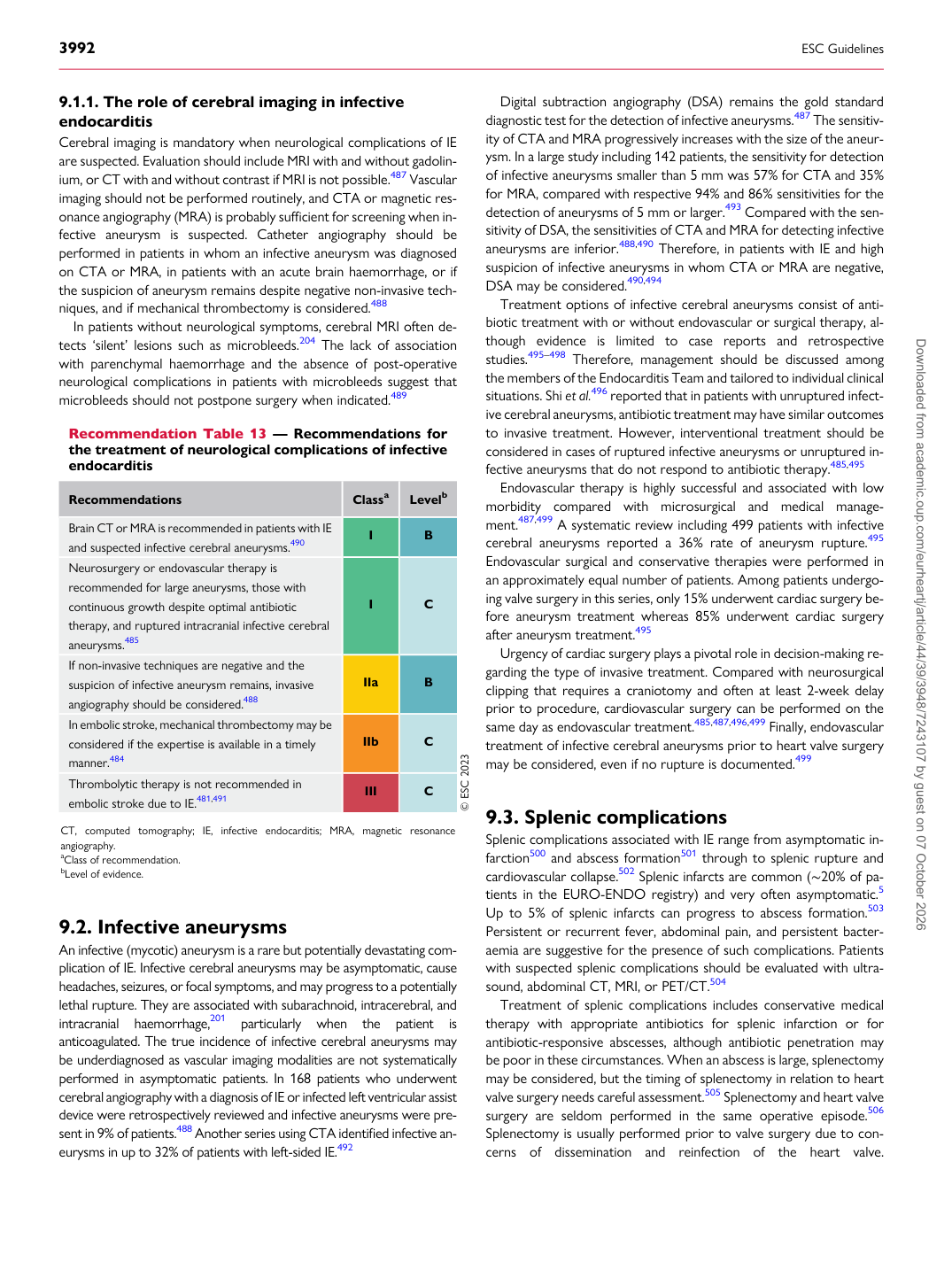
Recommendation Table 13 — Recommendations for the treatment of neurological complications of infective endocarditis

Recommendations Classa Levelb

Brain CT or MRA is recommended in patients with IE and suspected infective cerebral aneurysms.490 I B Neurosurgery or endovascular therapy is recommended for large aneurysms, those with continuous growth despite optimal antibiotic therapy, and ruptured intracranial infective cerebral aneurysms.485 I C If non-invasive techniques are negative and the suspicion of infective aneurysm remains, invasive angiography should be considered.488 IIa B In embolic stroke, mechanical thrombectomy may be considered if the expertise is available in a timely manner.484 IIb C Thrombolytic therapy is not recommended in embolic stroke due to IE.481,491 III C © ESC 2023

CT, computed tomography; IE, infective endocarditis; MRA, magnetic resonance angiography. aClass of recommendation. bLevel of evidence. Downloaded from academic.oup.com/eurheartj/article/44/39/3948/7243107 by guest on 07 October 2026