p.44 抽出テキスト
9 Other complications of infective

endocarditis

9.1 Neurological complications

Neurological manifestations may occur before or after the diagnosis of IE is established and recurrent events can also take place later in the course of IE.451 The possibility of IE should be considered in patients who present with stroke, meningitis, or brain abscess. Unexplained fever accompanying a stroke in a patient with valvular disease should trigger the suspicion of IE with blood cultures taken prior to empirical antibiotic therapy. Symptomatic cerebrovascular complications occur in up to 35% of patients with IE,145,198,451,452 whereas silent cerebrovascular complications (including ischaemia and microhaemorrhage) occur in up to 80% of patients.200,204,403 Clinical presentation is variable, but ischaemic stroke and transient ischaemic attack are the most common presentations.479 Other manifestations include haemorrhage (intracerebral, subarachnoid), meningitis, brain abscess, encephalopathy, and infectious aneurysms. Focal neurological symptoms are present in ∼40% of affected patients, and nonfocal presentations occur in approximately one-third. S. aureus IE is more frequently associated with neurological complications compared with IE caused by other microorganisms. Vegetation size and mobility also correlate with embolic risk. Neurological complications are associated with excess mortality, as well as long-term morbidity, particularly in the case of stroke.480 Prompt diagnosis of IE and early initiation of the antibiotic therapy are pivotal to preventing neurological complications. Early cardiac surgery in high-risk patients is key to preventing embolization of vegetations.471,481 In contrast, antithrombotic/thrombolytic medical therapies are not beneficial.481–483 Mechanical thrombectomy may be considered within time limits in selected cases.484 If mechanical thrombectomy is performed, the retrieved embolic material must be sent off for pathological and microbiological analyses. Neurosurgery or endovascular therapy is recommended for large infective aneurysms, especially when a continuous growth, despite optimal antibiotic therapy or ruptured intracranial infective aneurysms, is observed.485 The use of anticoagulation in patients with left-sided IE does not seem to have an effect on the risk of stroke, cerebrovascular haemorrhage, or mortality at 10 weeks and, therefore, continuation of anticoagulation in patients with left-sided IE and with a pre-existing indication for the use of anticoagulants is recommended in the absence of other contraindications.486 Substitution from oral anticoagulation to heparin in such patients is generally preferred in case of cerebral bleeding or indication for early surgery. Following a neurological event, the indication for cardiac surgery must be balanced against the peri-operative risk and post-operative prognosis of the patient. Randomized studies are impractical and cohort studies suffer from bias that can only be partially compensated for by statistical methods. The majority of publications demonstrate lower risk of secondary haemorrhagic conversion of uncomplicated ischaemic lesions than the risk of recurrent embolism under antibiotic treatment. Therefore, the available evidence supports early surgery in such patients (see Section 10.4). Recommendation Table 13 summarizes the recommended management of neurological complications in IE; considerations for cardiac surgery after neurological complications are discussed in Section 10.4.

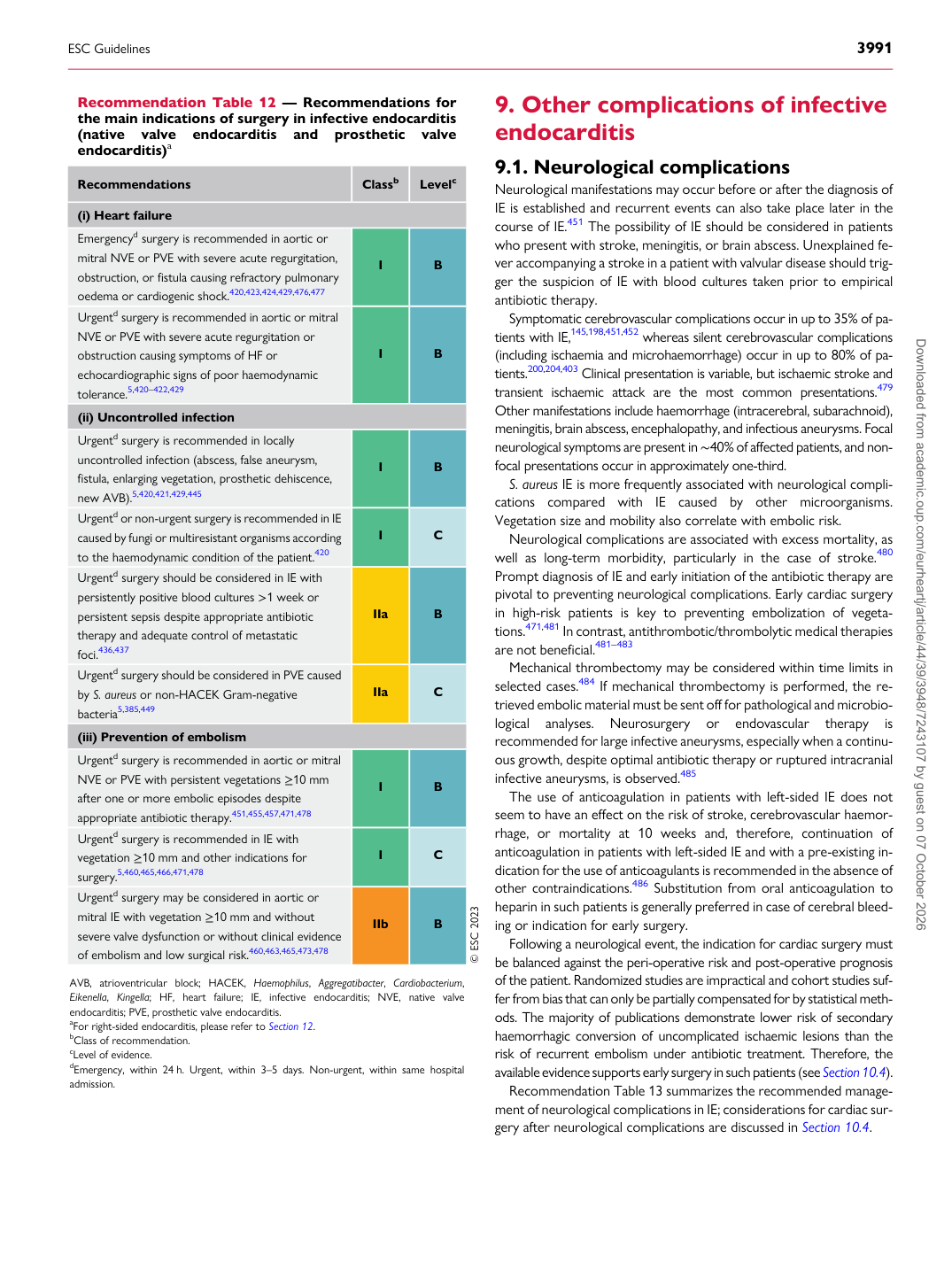
Recommendation Table 12 — Recommendations for the main indications of surgery in infective endocarditis (native valve endocarditis and prosthetic valve endocarditis)a

Recommendations Classb Levelc

(i) Heart failure Emergencyd surgery is recommended in aortic or mitral NVE or PVE with severe acute regurgitation, obstruction, or fistula causing refractory pulmonary oedema or cardiogenic shock.420,423,424,429,476,477 I B Urgentd surgery is recommended in aortic or mitral NVE or PVE with severe acute regurgitation or obstruction causing symptoms of HF or echocardiographic signs of poor haemodynamic tolerance.5,420–422,429 I B (ii) Uncontrolled infection Urgentd surgery is recommended in locally uncontrolled infection (abscess, false aneurysm, fistula, enlarging vegetation, prosthetic dehiscence, new AVB).5,420,421,429,445 I B Urgentd or non-urgent surgery is recommended in IE caused by fungi or multiresistant organisms according to the haemodynamic condition of the patient.420 I C Urgentd surgery should be considered in IE with persistently positive blood cultures >1 week or persistent sepsis despite appropriate antibiotic therapy and adequate control of metastatic foci.436,437 IIa B Urgentd surgery should be considered in PVE caused by S. aureus or non-HACEK Gram-negative bacteria5,385,449 IIa C (iii) Prevention of embolism Urgentd surgery is recommended in aortic or mitral NVE or PVE with persistent vegetations ≥10 mm after one or more embolic episodes despite appropriate antibiotic therapy.451,455,457,471,478 I B Urgentd surgery is recommended in IE with vegetation ≥10 mm and other indications for surgery.5,460,465,466,471,478 I C Urgentd surgery may be considered in aortic or mitral IE with vegetation ≥10 mm and without severe valve dysfunction or without clinical evidence of embolism and low surgical risk.460,463,465,473,478 IIb B © ESC 2023

AVB, atrioventricular block; HACEK, Haemophilus, Aggregatibacter, Cardiobacterium, Eikenella, Kingella; HF, heart failure; IE, infective endocarditis; NVE, native valve endocarditis; PVE, prosthetic valve endocarditis. aFor right-sided endocarditis, please refer to Section 12. bClass of recommendation. cLevel of evidence. dEmergency, within 24 h. Urgent, within 3–5 days. Non-urgent, within same hospital admission.

ESC Guidelines                                                                                                                                                                                          3991

Downloaded from academic.oup.com/eurheartj/article/44/39/3948/7243107 by guest on 07 October 2026