p.41 抽出テキスト
Heart failure

Emergency

surgery (Class I) Uncontrolled infection High risk of embolism or

established embolism

Cardiogenic shock or pulmonary oedema Local complications (abscess, false aneurysm, fistula, enlarging vegetation) Vegetation ≥10 mm and emboli despite appropriate

antibiotic therapy

Poor haemodynamic

tolerance Persistent positive

blood culturesa Vegetation ≥10 mm and other reason for surgeryb

N

Non-urgent surgery

(Class I)

N N

Resistant bacteriac

or fungi

N N

Vegetation ≥10 mm and no evidence of embolus

N

Antibiotic therapy and continued observation

N

Surgical timing for patient with left-sided infective endocarditis

Y

Urgent surgery (Class I)

Y

Urgent surgery (Class I)

Y

Urgent surgery (Class I)

Y

Urgent surgery (Class IIa)

Y

Urgent or non-urgent surgery

(Class I)d

Y

PVE caused by S. aureus

or non-HACEK Gram-negative bacilli

N

Non-urgent surgery

(Class I)

N

Urgent surgery (Class IIa)

Y Urgent surgery (Class I)

Y

Urgent surgery (Class IIb)

Y

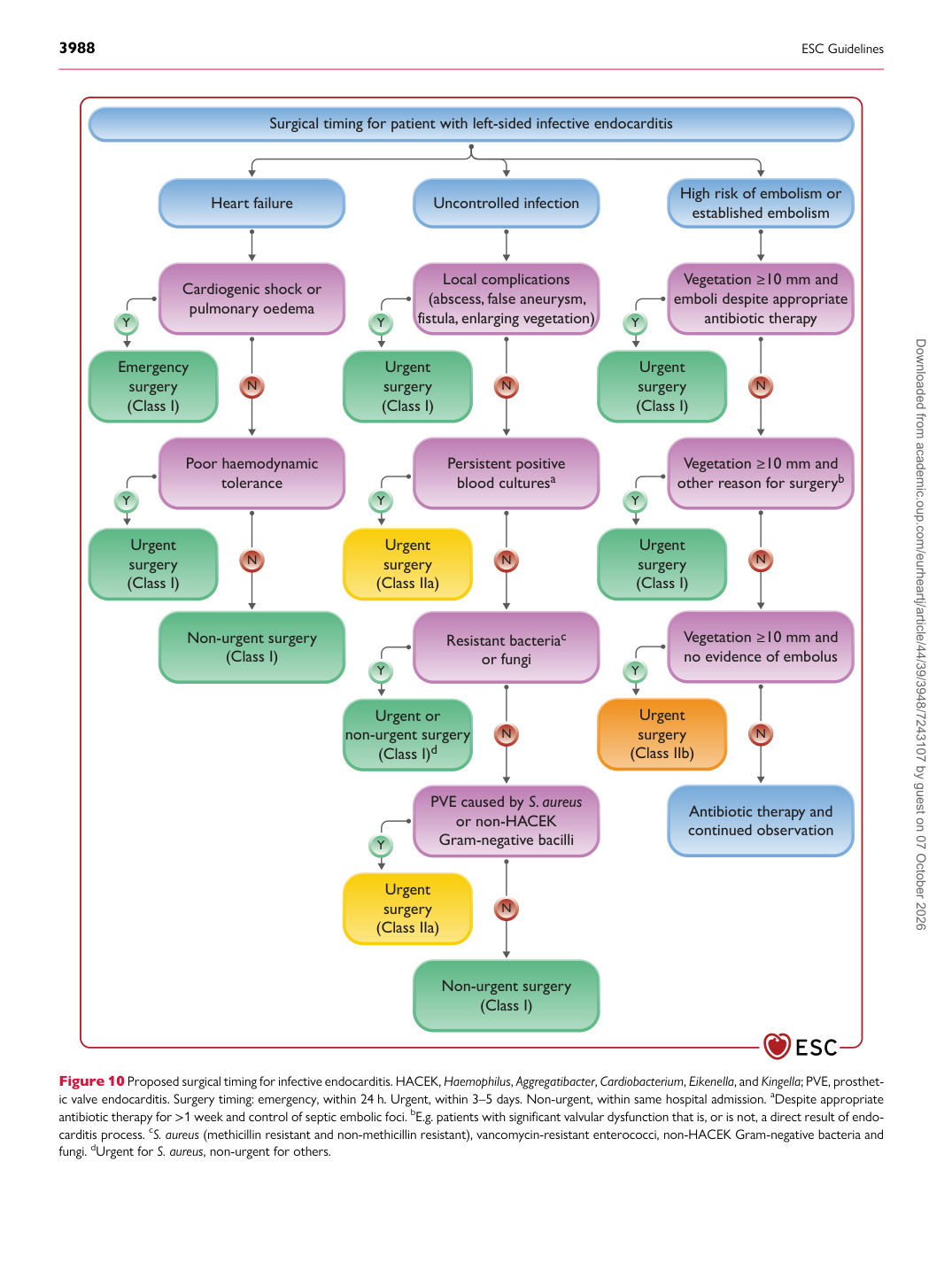
Figure 10 Proposed surgical timing for infective endocarditis. HACEK, Haemophilus, Aggregatibacter, Cardiobacterium, Eikenella, and Kingella; PVE, prosthetic valve endocarditis. Surgery timing: emergency, within 24 h. Urgent, within 3–5 days. Non-urgent, within same hospital admission. aDespite appropriate antibiotic therapy for >1 week and control of septic embolic foci. bE.g. patients with significant valvular dysfunction that is, or is not, a direct result of endocarditis process. cS. aureus (methicillin resistant and non-methicillin resistant), vancomycin-resistant enterococci, non-HACEK Gram-negative bacteria and fungi. dUrgent for S. aureus, non-urgent for others. Downloaded from academic.oup.com/eurheartj/article/44/39/3948/7243107 by guest on 07 October 2026