p.40 抽出テキスト
or in continuous infusion. Dalbavancin is a glycopeptide antibiotic with a very long half-life that can be administered weekly. There is previous positive experience in sensitive Gram-positive IE, although the most effective administration schedule is not clear.274,402 The recommended prescription is 1.5 g as a loading dose followed by 0.5–1 g weekly until completing 6 weeks of antibiotic treatment. Although the evidence is weak, another option (in addition to the combinations listed in the Supplementary data online, Table S9) for staphylococcal IE is the combination of i.v. cotrimoxazole (sulfamethoxazole 4800 mg/day and trimethoprim 960 mg/day in 4–6 doses) plus i.v. clindamycin (1800 mg/day in 3 doses) during the first week followed by only oral cotrimoxazole for 5 weeks.343

8 Indications for surgery and

management of main infective endocarditis complications

Infective endocarditis is associated with certain risks and complications that can only be controlled with surgical intervention. Despite the risks of surgery in these patients, current evidence suggests that surgical treatment may generate a survival advantage of up to 20% in the first year.403,404 There are three main reasons to undergo surgery in the setting of acute IE: HF, uncontrolled infection, and prevention of septic embolization (in particular, to the CNS) (Figure 10). A significant proportion of surgical procedures for IE are performed on an urgent basis. The Task Force has defined urgent surgery as that requiring intervention within 3–5 days, although unnecessary delays should be avoided once the indication for urgent surgery is established. Some cases require emergency surgery (within 24 h), irrespective of the pre-operative duration of antibiotic treatment. A third group requires surgery non-urgently, i.e. within the same hospital admission. In cases where the infective component can be completely healed with antibiotic treatment alone, both timing and indications for treatment of residual valve dysfunction follow the conventional guidelines for valve treatment.128

8.1 Pre-operative risk assessment

The risk of surgical therapy during the active phase of IE can be significant. It is heavily influenced by pre-existing co-morbidities and current organ function, but should not be limited by one risk factor alone (e.g. age or liver function).405,406 The decision to operate should therefore be made by the Endocarditis Team (see Section 4),167 considering urgency of the patient’s clinical condition, peri-operative risk, the potential to recover from the infection, and the patient’s associated long-term prognosis.403,404 There are several scoring systems that predict mortality after general (i.e. non-IE) cardiac surgery and which are in routine clinical use.407,408 Other scoring systems were designed specifically for the setting of IE including the AEPEI (Association for the Study and Prevention of Infective Endocarditis Study) score, the STS (Society of Thoracic Surgeons) IE score, the PALSUSE (prosthetic valve, age ≥70, large intracardiac destruction, Staphylococcus spp., urgent surgery, sex [female], EuroSCORE ≥10) score, the de Feo score, and the ANCLA (anaemia, NYHA [New York Heart Association] class IV, critical state, large intracardiac destruction, surgery of thoracic aorta) score, among others.256,409–414 Some of these scoring systems are web-based and free of charge (e.g. the AEPEI risk calculator https://www.endocardite.org/index.php/calculateurs/score-demortalite-post-chirurgie-aepei). Such scoring systems have been developed based on retrospective data and their performance is variable.250,256,415–417 In addition, none of these scoring systems are used in daily clinical routine. Therefore, prospective surgical scoring systems with better precision need to be developed, particularly for determining operative futility in prohibitively high-risk patients. A significant proportion of patients with clear indications for surgery for IE may have multiple risk factors or other reasons that lead to surgery not being performed, and these patients have the worst prognosis.184,403 Conversely, high-risk but salvageable patients may not be offered life-saving operations on the basis of perceived unacceptable risk, and this is especially true in the elderly (see Section 12.2). The complex decision of not offering surgery when indicated should therefore be made in the setting of an Endocarditis Team with experienced surgical input.418 Determining when operative management for a specific patient is futile requires compassionate multidisciplinary insight along with consideration of the patient’s and family’s wills (see Section 13.2).

8.2 Heart failure

8.2.1. Heart failure in infective endocarditis Heart failure is the most frequent complication of IE and the main indication for urgent and emergency surgery for IE.419 The prevalence of HF with left-sided IE is variable and inconsistently defined between reported series, ranging between 19% and 73%.420–425 Clinical symptoms

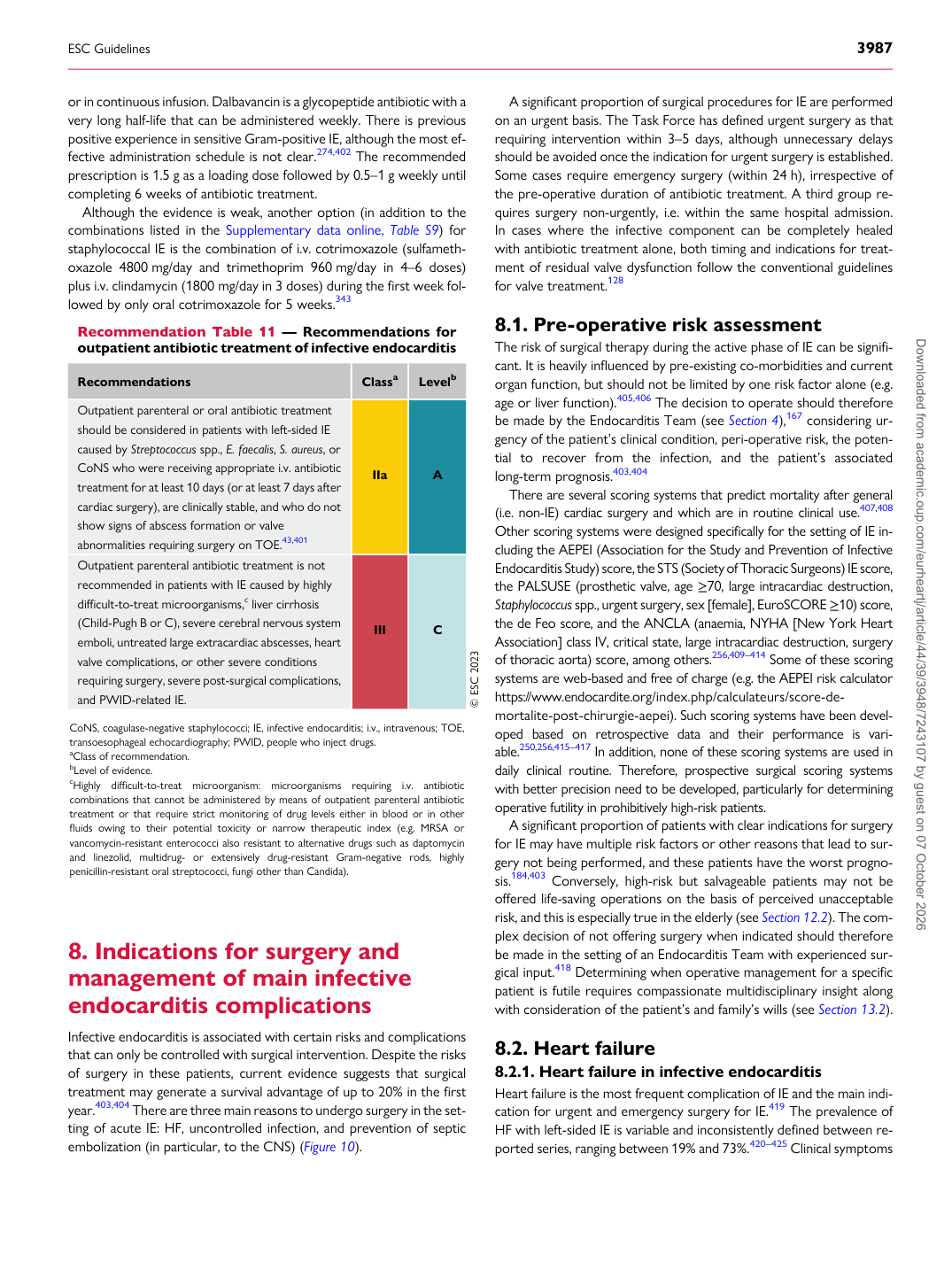
Recommendation Table 11 — Recommendations for outpatient antibiotic treatment of infective endocarditis

Recommendations Classa Levelb

Outpatient parenteral or oral antibiotic treatment should be considered in patients with left-sided IE caused by Streptococcus spp., E. faecalis, S. aureus, or CoNS who were receiving appropriate i.v. antibiotic treatment for at least 10 days (or at least 7 days after cardiac surgery), are clinically stable, and who do not show signs of abscess formation or valve abnormalities requiring surgery on TOE.43,401 IIa A Outpatient parenteral antibiotic treatment is not recommended in patients with IE caused by highly difficult-to-treat microorganisms,c liver cirrhosis (Child-Pugh B or C), severe cerebral nervous system emboli, untreated large extracardiac abscesses, heart valve complications, or other severe conditions requiring surgery, severe post-surgical complications, and PWID-related IE. III C © ESC 2023

CoNS, coagulase-negative staphylococci; IE, infective endocarditis; i.v., intravenous; TOE, transoesophageal echocardiography; PWID, people who inject drugs. aClass of recommendation. bLevel of evidence. cHighly difficult-to-treat microorganism: microorganisms requiring i.v. antibiotic combinations that cannot be administered by means of outpatient parenteral antibiotic treatment or that require strict monitoring of drug levels either in blood or in other fluids owing to their potential toxicity or narrow therapeutic index (e.g. MRSA or vancomycin-resistant enterococci also resistant to alternative drugs such as daptomycin and linezolid, multidrug- or extensively drug-resistant Gram-negative rods, highly penicillin-resistant oral streptococci, fungi other than Candida).

ESC Guidelines                                                                                                                                                                                          3987

Downloaded from academic.oup.com/eurheartj/article/44/39/3948/7243107 by guest on 07 October 2026