p.39 抽出テキスト
In addition to the patient being medically stable, general considerations for suitability for OPAT include assessment of the patient’s home environment and self-care capabilities. Adherence to treatment and follow-up visits are also crucial for a beneficial outcome of outpatient treatment and the healthcare provider–patient relationship is important for ensuring proper and continued treatment and maintenance of infection control.

7.13.1 Parenteral and oral step-down antibiotic

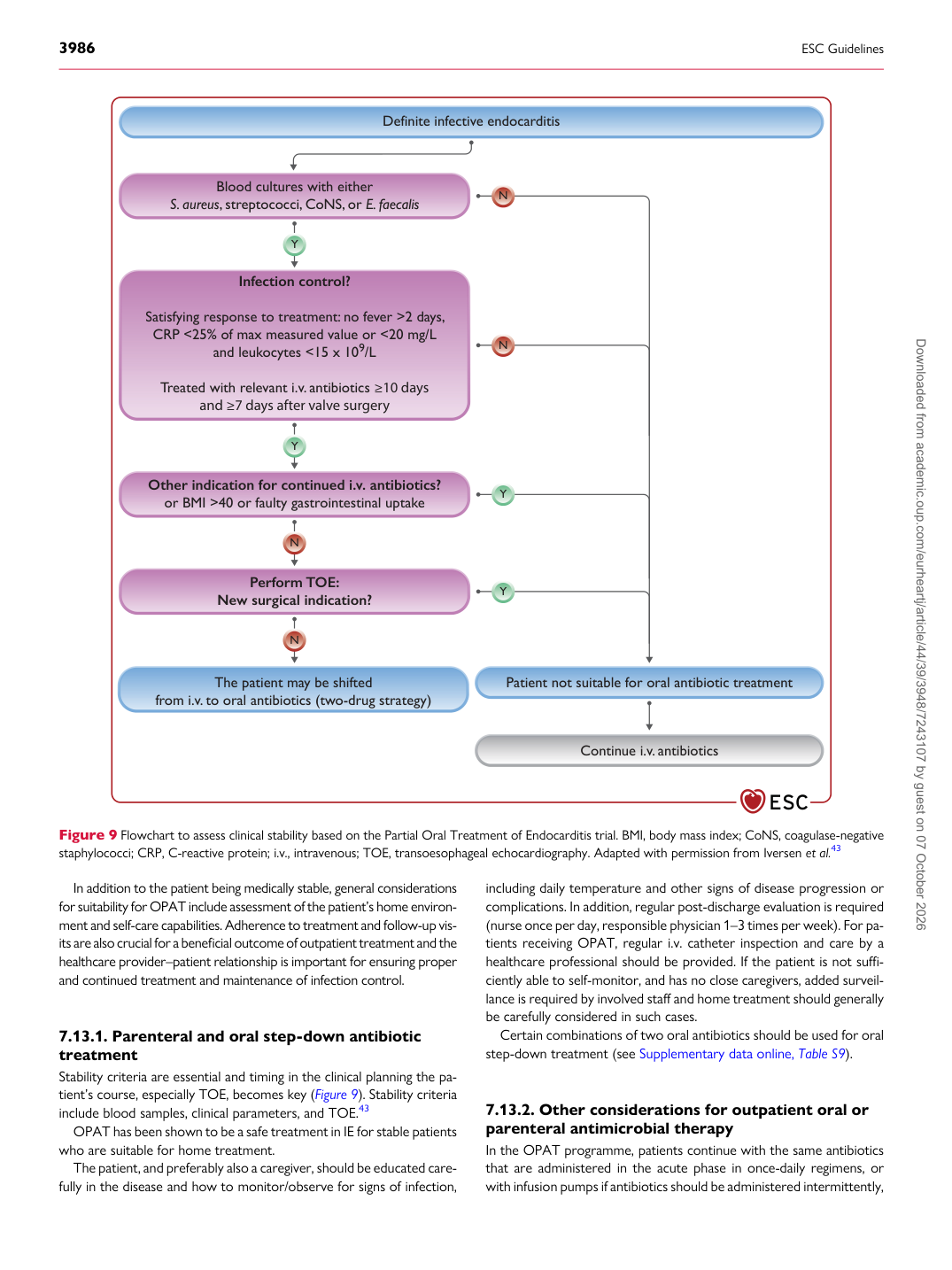
treatment Stability criteria are essential and timing in the clinical planning the patient’s course, especially TOE, becomes key (Figure 9). Stability criteria include blood samples, clinical parameters, and TOE.43 OPAT has been shown to be a safe treatment in IE for stable patients who are suitable for home treatment. The patient, and preferably also a caregiver, should be educated carefully in the disease and how to monitor/observe for signs of infection, including daily temperature and other signs of disease progression or complications. In addition, regular post-discharge evaluation is required (nurse once per day, responsible physician 1–3 times per week). For patients receiving OPAT, regular i.v. catheter inspection and care by a healthcare professional should be provided. If the patient is not sufficiently able to self-monitor, and has no close caregivers, added surveillance is required by involved staff and home treatment should generally be carefully considered in such cases.

Certain combinations of two oral antibiotics should be used for oral step-down treatment (see Supplementary data online, Table S9).

7.13.2 Other considerations for outpatient oral or

parenteral antimicrobial therapy In the OPAT programme, patients continue with the same antibiotics that are administered in the acute phase in once-daily regimens, or with infusion pumps if antibiotics should be administered intermittently,

N N

N

N Definite infective endocarditis

Y

Y

Y

Y

Patient not suitable for oral antibiotic treatment The patient may be shifted from i.v. to oral antibiotics (two-drug strategy)

Blood cultures with either S. aureus, streptococci, CoNS, or E. faecalis

Other indication for continued i.v. antibiotics?

or BMI >40 or faulty gastrointestinal uptake

Perform TOE: New surgical indication?

Infection control?

Satisfying response to treatment: no fever >2 days, CRP <25% of max measured value or <20 mg/L

and leukocytes <15 x 109/L

Treated with relevant i.v. antibiotics ≥10 days

and ≥7 days after valve surgery

Continue i.v. antibiotics

Figure 9 Flowchart to assess clinical stability based on the Partial Oral Treatment of Endocarditis trial. BMI, body mass index; CoNS, coagulase-negative staphylococci; CRP, C-reactive protein; i.v., intravenous; TOE, transoesophageal echocardiography. Adapted with permission from Iversen et al.43 Downloaded from academic.oup.com/eurheartj/article/44/39/3948/7243107 by guest on 07 October 2026