p.38 抽出テキスト
7.13 Outpatient parenteral or oral

antibiotic therapy for infective endocarditis Outpatient parenteral antibiotic treatment or step-down outpatient oral antibiotic treatment is used to consolidate antimicrobial therapy once critical infection-related complications are under control (e.g. perivalvular abscesses, acute HF, septic emboli, and stroke) and the patient is clinically stable.43,396–399 When feasible, early hospital discharge and OPAT helps to alleviate the effects of infection and prolonged hospitalization especially in the elderly.400 In the initial phase of IE treatment, standard i.v. treatment is administered according to recommendations for specific microorganisms. Once the clinical condition of the patient is stable, OPAT or stepdown outpatient oral antibiotic treatment is a safe alternative to in-hospital i.v. treatment in selected patients.43,399 Patients may reach such stability at various points in their disease course but, when criteria for stability are reached, the patient may then be switched to OPAT or alternatively to an oral therapy at hospital discharge. The OPAT regime consists of the same antibiotic combinations administered in the acute phase if possible. The 5-year outcomes from the POET trial showed continued effectiveness of oral antibiotic therapy as compared with i.v. antibiotic therapy for IE in selected patients.401 Hence, clinical stability will then differentiate IE courses into two phases: (i) Critical phase where at least 10 days of i.v. treatment is required: at this time point, OPAT has a restricted indication. (ii) Continuation phase (beyond 10 days of therapy and 7 days

post-surgery), where OPAT/step-down oral therapy may be feasible.

Supplementary data online, Table S8 summarizes the salient questions to address when considering OPAT/step-down oral therapy for IE.

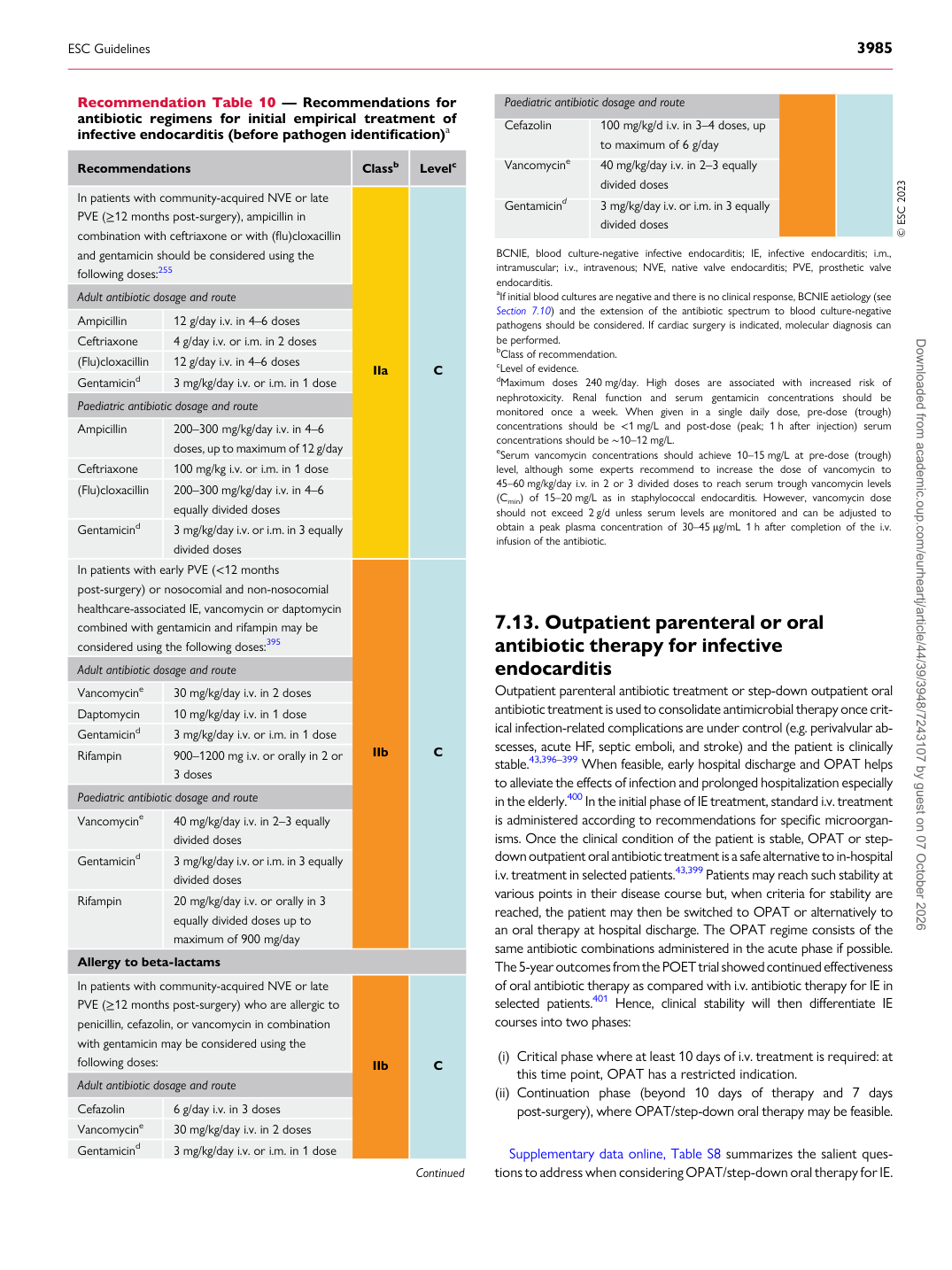
Recommendation Table 10 — Recommendations for antibiotic regimens for initial empirical treatment of infective endocarditis (before pathogen identification)a

Recommendations Classb Levelc

In patients with community-acquired NVE or late PVE (≥12 months post-surgery), ampicillin in combination with ceftriaxone or with (flu)cloxacillin and gentamicin should be considered using the following doses:255

IIa C

Adult antibiotic dosage and route Ampicillin 12 g/day i.v. in 4–6 doses Ceftriaxone 4 g/day i.v. or i.m. in 2 doses (Flu)cloxacillin 12 g/day i.v. in 4–6 doses Gentamicind 3 mg/kg/day i.v. or i.m. in 1 dose Paediatric antibiotic dosage and route Ampicillin 200–300 mg/kg/day i.v. in 4–6

doses, up to maximum of 12 g/day

Ceftriaxone 100 mg/kg i.v. or i.m. in 1 dose (Flu)cloxacillin 200–300 mg/kg/day i.v. in 4–6

equally divided doses

Gentamicind 3 mg/kg/day i.v. or i.m. in 3 equally

divided doses

In patients with early PVE (<12 months post-surgery) or nosocomial and non-nosocomial healthcare-associated IE, vancomycin or daptomycin combined with gentamicin and rifampin may be considered using the following doses:395

IIb C

Adult antibiotic dosage and route Vancomycine 30 mg/kg/day i.v. in 2 doses Daptomycin 10 mg/kg/day i.v. in 1 dose Gentamicind 3 mg/kg/day i.v. or i.m. in 1 dose Rifampin 900–1200 mg i.v. or orally in 2 or

3 doses

Paediatric antibiotic dosage and route Vancomycine 40 mg/kg/day i.v. in 2–3 equally divided doses Gentamicind 3 mg/kg/day i.v. or i.m. in 3 equally divided doses Rifampin 20 mg/kg/day i.v. or orally in 3 equally divided doses up to

maximum of 900 mg/day

Allergy to beta-lactams In patients with community-acquired NVE or late PVE (≥12 months post-surgery) who are allergic to penicillin, cefazolin, or vancomycin in combination with gentamicin may be considered using the following doses: IIb C Adult antibiotic dosage and route Cefazolin 6 g/day i.v. in 3 doses Vancomycine 30 mg/kg/day i.v. in 2 doses Gentamicind 3 mg/kg/day i.v. or i.m. in 1 dose

Continued Paediatric antibiotic dosage and route

Cefazolin 100 mg/kg/d i.v. in 3–4 doses, up to maximum of 6 g/day Vancomycine 40 mg/kg/day i.v. in 2–3 equally divided doses Gentamicind 3 mg/kg/day i.v. or i.m. in 3 equally divided doses © ESC 2023 BCNIE, blood culture-negative infective endocarditis; IE, infective endocarditis; i.m., intramuscular; i.v., intravenous; NVE, native valve endocarditis; PVE, prosthetic valve endocarditis. aIf initial blood cultures are negative and there is no clinical response, BCNIE aetiology (see Section 7.10) and the extension of the antibiotic spectrum to blood culture-negative pathogens should be considered. If cardiac surgery is indicated, molecular diagnosis can be performed. bClass of recommendation. cLevel of evidence. dMaximum doses 240 mg/day. High doses are associated with increased risk of nephrotoxicity. Renal function and serum gentamicin concentrations should be monitored once a week. When given in a single daily dose, pre-dose (trough) concentrations should be <1 mg/L and post-dose (peak; 1 h after injection) serum concentrations should be ∼10–12 mg/L. eSerum vancomycin concentrations should achieve 10–15 mg/L at pre-dose (trough) level, although some experts recommend to increase the dose of vancomycin to 45–60 mg/kg/day i.v. in 2 or 3 divided doses to reach serum trough vancomycin levels (Cmin) of 15–20 mg/L as in staphylococcal endocarditis. However, vancomycin dose should not exceed 2 g/d unless serum levels are monitored and can be adjusted to obtain a peak plasma concentration of 30–45 μg/mL 1 h after completion of the i.v. infusion of the antibiotic.

ESC Guidelines                                                                                                                                                                                          3985

Downloaded from academic.oup.com/eurheartj/article/44/39/3948/7243107 by guest on 07 October 2026