p.37 抽出テキスト
option.370 Ciprofloxacin (400 mg every 8–12 h i.v. or 750 mg every 12 h orally) is a less well-validated alternative.370–373

7.9.2. Non-Haemophilus, Aggregatibacter, Cardiobacterium, Eikenella, and Kingella species The ICE cohort reported non-HACEK Gram-negative bacteria in 49 of 2761 (1.8%) IE cases.279,374 Recommended treatment is early surgery plus prolonged (6 weeks) therapy with bactericidal combinations of beta-lactams and aminoglycosides, sometimes with additional quinolones or cotrimoxazole.375,376 In vitro bactericidal tests and monitoring of serum antibiotic concentrations may be helpful. Because of their rarity and severity, these conditions should be discussed by the Endocarditis Team. 7.10 Blood culture-negative infective

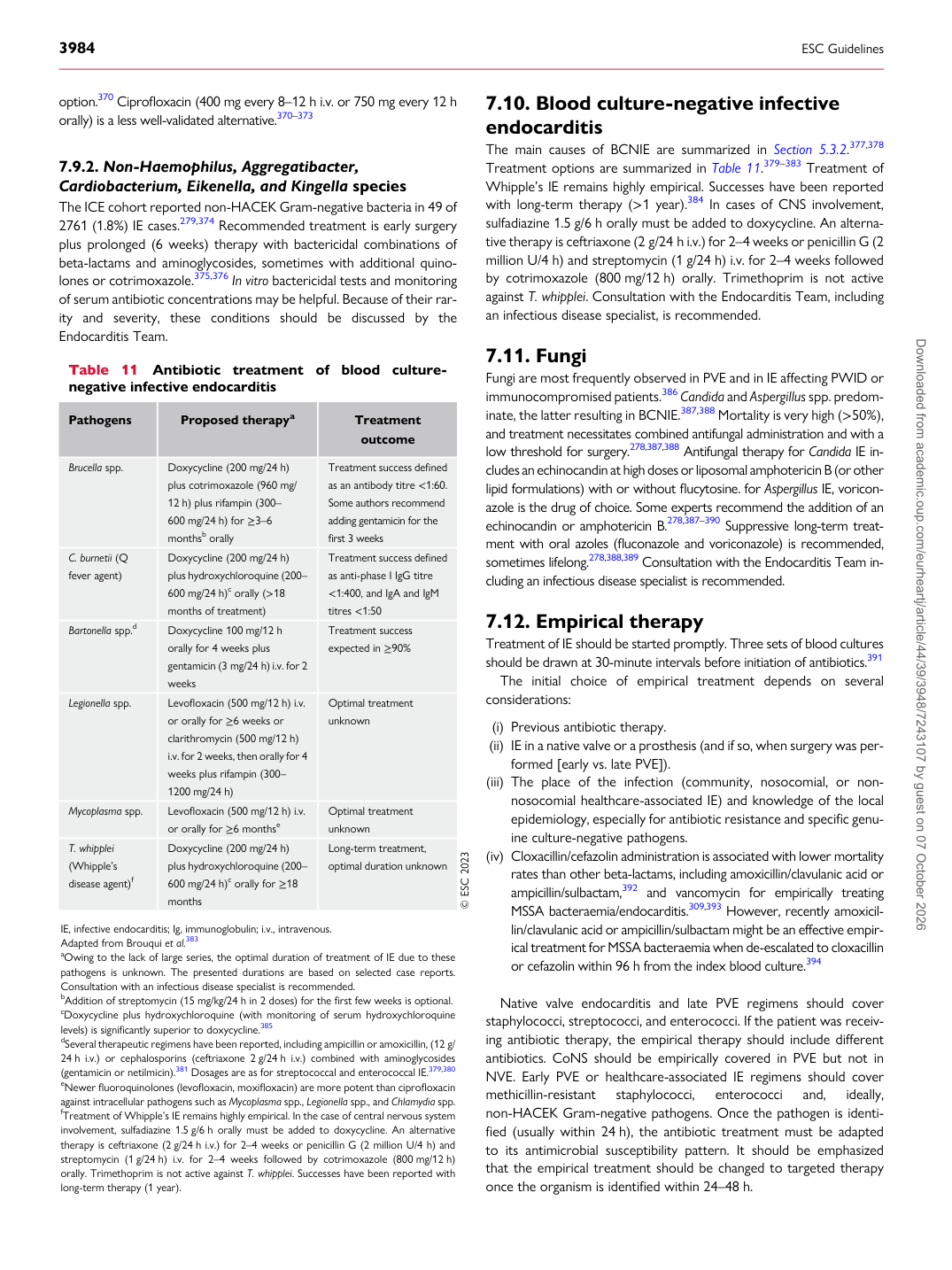
endocarditis The main causes of BCNIE are summarized in Section 5.3.2.377,378 Treatment options are summarized in Table 11.379–383 Treatment of Whipple’s IE remains highly empirical. Successes have been reported with long-term therapy (>1 year).384 In cases of CNS involvement, sulfadiazine 1.5 g/6 h orally must be added to doxycycline. An alternative therapy is ceftriaxone (2 g/24 h i.v.) for 2–4 weeks or penicillin G (2 million U/4 h) and streptomycin (1 g/24 h) i.v. for 2–4 weeks followed by cotrimoxazole (800 mg/12 h) orally. Trimethoprim is not active against T. whipplei. Consultation with the Endocarditis Team, including an infectious disease specialist, is recommended.

7.11 Fungi

Fungi are most frequently observed in PVE and in IE affecting PWID or immunocompromised patients.386 Candida and Aspergillus spp. predominate, the latter resulting in BCNIE.387,388 Mortality is very high (>50%), and treatment necessitates combined antifungal administration and with a low threshold for surgery.278,387,388 Antifungal therapy for Candida IE includes an echinocandin at high doses or liposomal amphotericin B (or other lipid formulations) with or without flucytosine. for Aspergillus IE, voriconazole is the drug of choice. Some experts recommend the addition of an echinocandin or amphotericin B.278,387–390 Suppressive long-term treatment with oral azoles (fluconazole and voriconazole) is recommended, sometimes lifelong.278,388,389 Consultation with the Endocarditis Team including an infectious disease specialist is recommended.

7.12 Empirical therapy

Treatment of IE should be started promptly. Three sets of blood cultures should be drawn at 30-minute intervals before initiation of antibiotics.391 The initial choice of empirical treatment depends on several considerations: (i) Previous antibiotic therapy. (ii) IE in a native valve or a prosthesis (and if so, when surgery was performed [early vs. late PVE]). (iii) The place of the infection (community, nosocomial, or nonnosocomial healthcare-associated IE) and knowledge of the local epidemiology, especially for antibiotic resistance and specific genuine culture-negative pathogens. (iv) Cloxacillin/cefazolin administration is associated with lower mortality

rates than other beta-lactams, including amoxicillin/clavulanic acid or ampicillin/sulbactam,392 and vancomycin for empirically treating MSSA bacteraemia/endocarditis.309,393 However, recently amoxicillin/clavulanic acid or ampicillin/sulbactam might be an effective empirical treatment for MSSA bacteraemia when de-escalated to cloxacillin or cefazolin within 96 h from the index blood culture.394

Native valve endocarditis and late PVE regimens should cover staphylococci, streptococci, and enterococci. If the patient was receiving antibiotic therapy, the empirical therapy should include different antibiotics. CoNS should be empirically covered in PVE but not in NVE. Early PVE or healthcare-associated IE regimens should cover methicillin-resistant staphylococci, enterococci and, ideally, non-HACEK Gram-negative pathogens. Once the pathogen is identified (usually within 24 h), the antibiotic treatment must be adapted to its antimicrobial susceptibility pattern. It should be emphasized that the empirical treatment should be changed to targeted therapy once the organism is identified within 24–48 h.

Table 11 Antibiotic treatment of blood culturenegative infective endocarditis

Pathogens Proposed therapya Treatment

outcome

Brucella spp. Doxycycline (200 mg/24 h)

plus cotrimoxazole (960 mg/ 12 h) plus rifampin (300– 600 mg/24 h) for ≥3–6 monthsb orally Treatment success defined

as an antibody titre <1:60. Some authors recommend adding gentamicin for the first 3 weeks

C. burnetii (Q fever agent) Doxycycline (200 mg/24 h)

plus hydroxychloroquine (200– 600 mg/24 h)c orally (>18 months of treatment) Treatment success defined

as anti-phase I IgG titre <1:400, and IgA and IgM titres <1:50

Bartonella spp.d Doxycycline 100 mg/12 h

orally for 4 weeks plus gentamicin (3 mg/24 h) i.v. for 2 weeks Treatment success

expected in ≥90%

Legionella spp. Levofloxacin (500 mg/12 h) i.v.

or orally for ≥6 weeks or clarithromycin (500 mg/12 h) i.v. for 2 weeks, then orally for 4 weeks plus rifampin (300– 1200 mg/24 h) Optimal treatment

unknown

Mycoplasma spp. Levofloxacin (500 mg/12 h) i.v.

or orally for ≥6 monthse Optimal treatment

unknown

T. whipplei (Whipple’s disease agent)f Doxycycline (200 mg/24 h)

plus hydroxychloroquine (200– 600 mg/24 h)c orally for ≥18 months Long-term treatment,

optimal duration unknown © ESC 2023

IE, infective endocarditis; Ig, immunoglobulin; i.v., intravenous. Adapted from Brouqui et al.383 aOwing to the lack of large series, the optimal duration of treatment of IE due to these pathogens is unknown. The presented durations are based on selected case reports. Consultation with an infectious disease specialist is recommended. bAddition of streptomycin (15 mg/kg/24 h in 2 doses) for the first few weeks is optional. cDoxycycline plus hydroxychloroquine (with monitoring of serum hydroxychloroquine levels) is significantly superior to doxycycline.385 dSeveral therapeutic regimens have been reported, including ampicillin or amoxicillin, (12 g/ 24 h i.v.) or cephalosporins (ceftriaxone 2 g/24 h i.v.) combined with aminoglycosides (gentamicin or netilmicin).381 Dosages are as for streptococcal and enterococcal IE.379,380 eNewer fluoroquinolones (levofloxacin, moxifloxacin) are more potent than ciprofloxacin against intracellular pathogens such as Mycoplasma spp., Legionella spp., and Chlamydia spp. fTreatment of Whipple’s IE remains highly empirical. In the case of central nervous system involvement, sulfadiazine 1.5 g/6 h orally must be added to doxycycline. An alternative therapy is ceftriaxone (2 g/24 h i.v.) for 2–4 weeks or penicillin G (2 million U/4 h) and streptomycin (1 g/24 h) i.v. for 2–4 weeks followed by cotrimoxazole (800 mg/12 h) orally. Trimethoprim is not active against T. whipplei. Successes have been reported with long-term therapy (1 year). Downloaded from academic.oup.com/eurheartj/article/44/39/3948/7243107 by guest on 07 October 2026