p.35 抽出テキスト
7.8. Enterococcus spp. Enterococcal IE is primarily caused by E. faecalis (90% of cases) and less often by Enterococcus faecium (5% of cases), or other species.350 Enterococcal IE poses two major problems. First, enterococci are highly resistant to antibiotic-induced killing, and eradication requires prolonged administration (up to 6 weeks) of synergistic bactericidal combinations of two cell wall inhibitors (ampicillin plus ceftriaxone, which synergize by inhibiting complementary PBPs), or one cell wall inhibitor with aminoglycosides.351–353 Second, they may be resistant to multiple drugs, including aminoglycosides (HLAR), beta-lactams (via PBP 5 modification and sometimes beta-lactamases), and vancomycin.351–357 Penicillin-susceptible strains are treated with penicillin G or ampicillin (or amoxicillin) combined with gentamicin. However, ampicillin (or amoxicillin) is preferred since the MIC is two to four times lower than that of penicillin G. Gentamicin resistance is frequent in both E. faecalis and E. faecium (up to 75%).358,359 An aminoglycoside MIC >128 mg/L (HLAR) is associated with the loss of bactericidal synergism with cell wall inhibitors, and aminoglycosides should not be used in such conditions. There have been two important advances in recent years. First, in several cohort studies of E. faecalis IE including hundreds of cases, it was observed that ampicillin plus ceftriaxone is as effective as ampicillin plus gentamicin for non-HLAR E. faecalis IE. The combination of ampicillin plus ceftriaxone was also associated with a beneficial safety profile, due to the lack of nephrotoxicity.355,360,361 Therefore, this is the combination of choice for treating NVE and PVE caused by HLAR E. faecalis. This double beta-lactam therapy is not effective against E. faecium and the experience in the treatment of other enterococcal species is very limited. Second, the total daily dose of gentamicin can be given in a single daily dose instead of the 2 or 3 divided doses previously recommended, and the length of the treatment with gentamicin for non-HLAR E. faecalis IE may be safely shortened from 4–6 weeks to 2 weeks, reducing the rates of nephrotoxicity to very low levels.266,362,363 After 10–14 days of therapy, OPAT or outpatient oral antibiotic therapy should be considered if the patient is clinically stable (see Section 7.13).364–367

Beta-lactam or vancomycin resistance is mainly observed in E. faecium. Since dual resistance is rare, beta-lactam might be used against vancomycin-resistant strains and vice versa. Varying results have been reported with quinupristin–dalfopristin (not active against E. faecalis), linezolid, daptomycin, teicoplanin, and tigecycline.353,365,368 Daptomycin 10–12 mg/kg/24 h, always combined with beta-lactams (ampicillin, ertapenem, or ceftaroline) or fosfomycin in order to prevent the development of daptomycin resistance, is the best option for treating multidrug- and vancomycin-resistant enterococcal IE.369

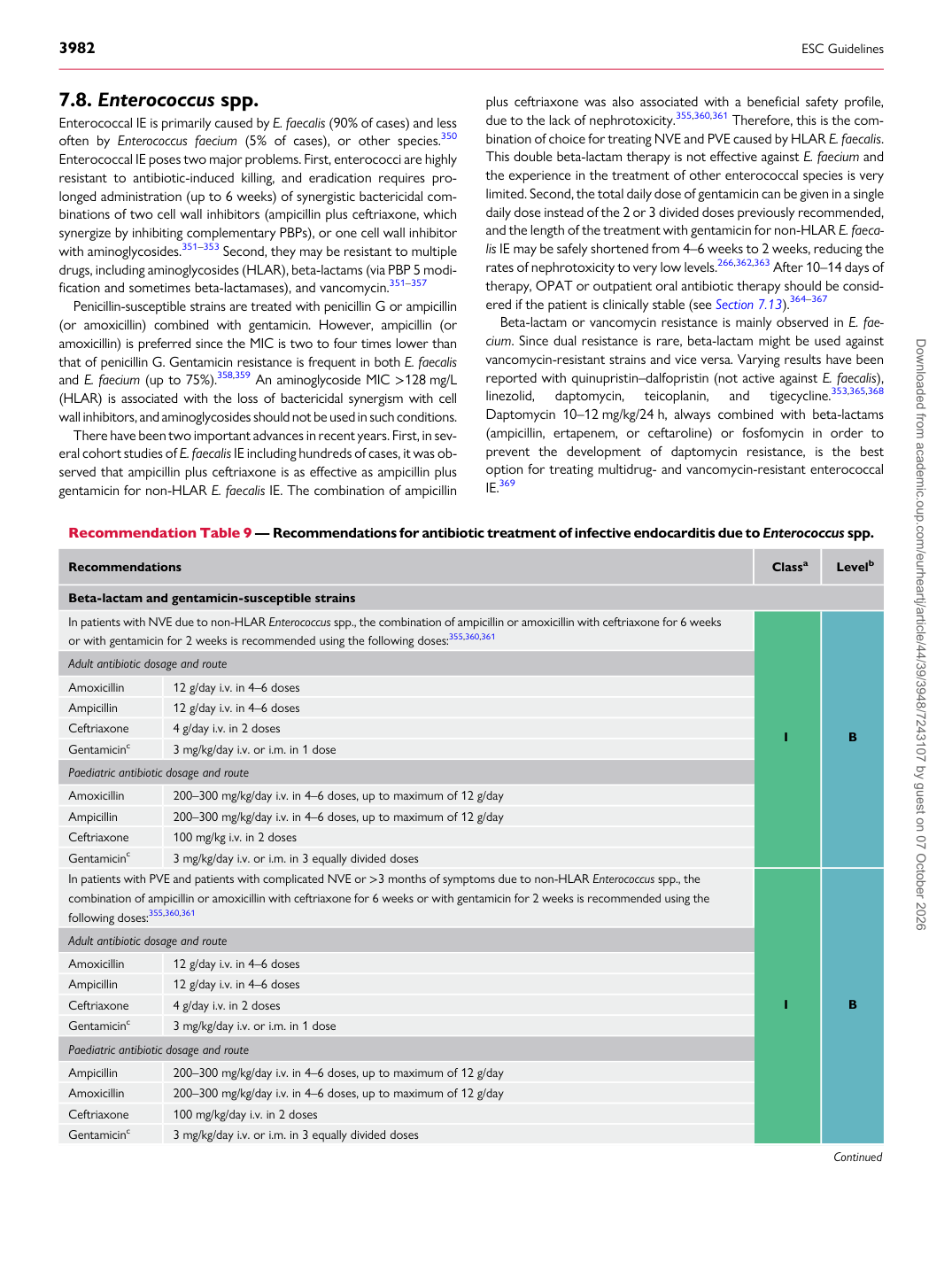
Recommendation Table 9 — Recommendations for antibiotic treatment of infective endocarditis due to Enterococcus spp.

Recommendations Classa Levelb

Beta-lactam and gentamicin-susceptible strains In patients with NVE due to non-HLAR Enterococcus spp., the combination of ampicillin or amoxicillin with ceftriaxone for 6 weeks or with gentamicin for 2 weeks is recommended using the following doses:355,360,361

I B

Adult antibiotic dosage and route Amoxicillin 12 g/day i.v. in 4–6 doses Ampicillin 12 g/day i.v. in 4–6 doses Ceftriaxone 4 g/day i.v. in 2 doses Gentamicinc 3 mg/kg/day i.v. or i.m. in 1 dose Paediatric antibiotic dosage and route Amoxicillin 200–300 mg/kg/day i.v. in 4–6 doses, up to maximum of 12 g/day Ampicillin 200–300 mg/kg/day i.v. in 4–6 doses, up to maximum of 12 g/day Ceftriaxone 100 mg/kg i.v. in 2 doses Gentamicinc 3 mg/kg/day i.v. or i.m. in 3 equally divided doses In patients with PVE and patients with complicated NVE or >3 months of symptoms due to non-HLAR Enterococcus spp., the combination of ampicillin or amoxicillin with ceftriaxone for 6 weeks or with gentamicin for 2 weeks is recommended using the following doses:355,360,361

I B

Adult antibiotic dosage and route Amoxicillin 12 g/day i.v. in 4–6 doses Ampicillin 12 g/day i.v. in 4–6 doses Ceftriaxone 4 g/day i.v. in 2 doses Gentamicinc 3 mg/kg/day i.v. or i.m. in 1 dose Paediatric antibiotic dosage and route Ampicillin 200–300 mg/kg/day i.v. in 4–6 doses, up to maximum of 12 g/day Amoxicillin 200–300 mg/kg/day i.v. in 4–6 doses, up to maximum of 12 g/day Ceftriaxone 100 mg/kg/day i.v. in 2 doses Gentamicinc 3 mg/kg/day i.v. or i.m. in 3 equally divided doses

Continued Downloaded from academic.oup.com/eurheartj/article/44/39/3948/7243107 by guest on 07 October 2026