p.30 抽出テキスト
(vii) The antibiotic regimens need to adapt to the local circumstances and the availability of antibiotics. (viii) Data on the efficacy of long-term antibiotic suppressive therapy in pa-

tients with IE who do not undergo cardiac surgery are limited to small and heterogeneous series with various antibiotic regimens.184,274 In a small series of Gram-positive bloodstream infections and IE, dalbavancin (500 mg weekly or 1000 mg biweekly regimens) has been shown effective.274,275 Relapses are not infrequent.184

7.2 Penicillin-susceptible oral streptococci

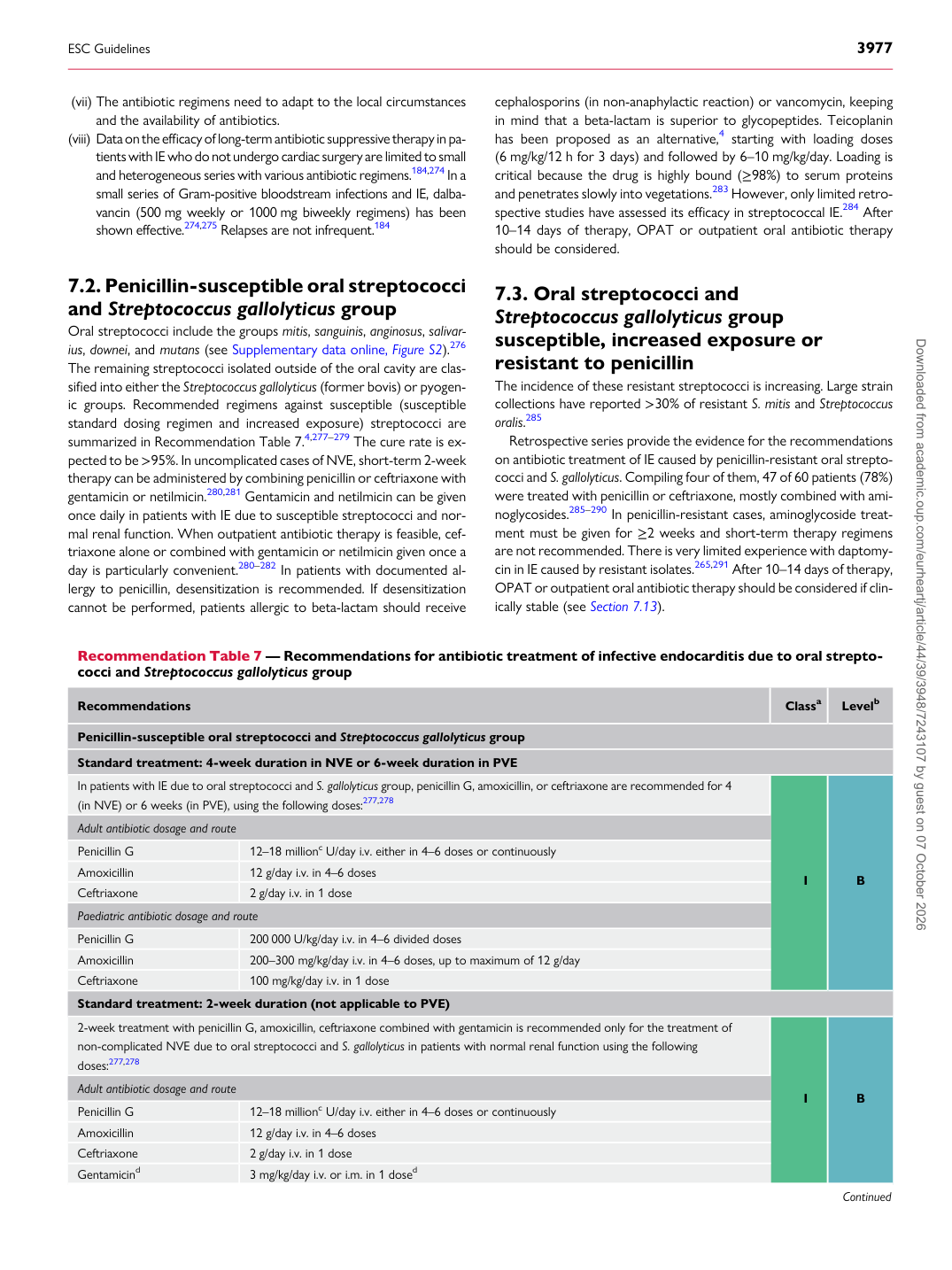
and Streptococcus gallolyticus group Oral streptococci include the groups mitis, sanguinis, anginosus, salivarius, downei, and mutans (see Supplementary data online, Figure S2).276 The remaining streptococci isolated outside of the oral cavity are classified into either the Streptococcus gallolyticus (former bovis) or pyogenic groups. Recommended regimens against susceptible (susceptible standard dosing regimen and increased exposure) streptococci are summarized in Recommendation Table 7.4,277–279 The cure rate is expected to be >95%. In uncomplicated cases of NVE, short-term 2-week therapy can be administered by combining penicillin or ceftriaxone with gentamicin or netilmicin.280,281 Gentamicin and netilmicin can be given once daily in patients with IE due to susceptible streptococci and normal renal function. When outpatient antibiotic therapy is feasible, ceftriaxone alone or combined with gentamicin or netilmicin given once a day is particularly convenient.280–282 In patients with documented allergy to penicillin, desensitization is recommended. If desensitization cannot be performed, patients allergic to beta-lactam should receive cephalosporins (in non-anaphylactic reaction) or vancomycin, keeping in mind that a beta-lactam is superior to glycopeptides. Teicoplanin has been proposed as an alternative,4 starting with loading doses (6 mg/kg/12 h for 3 days) and followed by 6–10 mg/kg/day. Loading is critical because the drug is highly bound (≥98%) to serum proteins and penetrates slowly into vegetations.283 However, only limited retrospective studies have assessed its efficacy in streptococcal IE.284 After 10–14 days of therapy, OPAT or outpatient oral antibiotic therapy should be considered.

7.3 Oral streptococci and

Streptococcus gallolyticus group susceptible, increased exposure or resistant to penicillin The incidence of these resistant streptococci is increasing. Large strain collections have reported >30% of resistant S. mitis and Streptococcus oralis.285 Retrospective series provide the evidence for the recommendations on antibiotic treatment of IE caused by penicillin-resistant oral streptococci and S. gallolyticus. Compiling four of them, 47 of 60 patients (78%) were treated with penicillin or ceftriaxone, mostly combined with aminoglycosides.285–290 In penicillin-resistant cases, aminoglycoside treatment must be given for ≥2 weeks and short-term therapy regimens are not recommended. There is very limited experience with daptomycin in IE caused by resistant isolates.265,291 After 10–14 days of therapy, OPAT or outpatient oral antibiotic therapy should be considered if clinically stable (see Section 7.13).

Recommendation Table 7 — Recommendations for antibiotic treatment of infective endocarditis due to oral streptococci and Streptococcus gallolyticus group

Recommendations Classa Levelb

Penicillin-susceptible oral streptococci and Streptococcus gallolyticus group Standard treatment: 4-week duration in NVE or 6-week duration in PVE In patients with IE due to oral streptococci and S. gallolyticus group, penicillin G, amoxicillin, or ceftriaxone are recommended for 4 (in NVE) or 6 weeks (in PVE), using the following doses:277,278

I B

Adult antibiotic dosage and route Penicillin G 12–18 millionc U/day i.v. either in 4–6 doses or continuously Amoxicillin 12 g/day i.v. in 4–6 doses Ceftriaxone 2 g/day i.v. in 1 dose Paediatric antibiotic dosage and route Penicillin G 200 000 U/kg/day i.v. in 4–6 divided doses Amoxicillin 200–300 mg/kg/day i.v. in 4–6 doses, up to maximum of 12 g/day Ceftriaxone 100 mg/kg/day i.v. in 1 dose Standard treatment: 2-week duration (not applicable to PVE) 2-week treatment with penicillin G, amoxicillin, ceftriaxone combined with gentamicin is recommended only for the treatment of non-complicated NVE due to oral streptococci and S. gallolyticus in patients with normal renal function using the following doses:277,278 I B Adult antibiotic dosage and route Penicillin G 12–18 millionc U/day i.v. either in 4–6 doses or continuously Amoxicillin 12 g/day i.v. in 4–6 doses Ceftriaxone 2 g/day i.v. in 1 dose Gentamicind 3 mg/kg/day i.v. or i.m. in 1 dosed

Continued

ESC Guidelines                                                                                                                                                                                          3977

Downloaded from academic.oup.com/eurheartj/article/44/39/3948/7243107 by guest on 07 October 2026