p.21 抽出テキスト
Echocardiographic imaging should be performed as soon as the IE diagnosis is suspected. The degree of valvular damage, the rate of peripheral embolic events, and the need for valve surgery increase with increasing time to initial echocardiographic assessment.167 Echocardiography should be repeated 5–7 days after an initial normal or inconclusive echocardiography, if the suspicion of IE remains high, and in patients with diagnosed IE at high risk of complications (e.g. aggressive microorganisms, prosthetic valves).22,165,168,169 There is uncertainty regarding whether echocardiography should be systematically performed in patients with bloodstream infections due to different bacterial species, or if there are strategies (microbiological or imaging) that allow the identification of patients at higher risk of IE. Scoring systems have been developed to help in the appropriate indication to perform echocardiography when bacteraemia of different microorganisms occurs (see Supplementary data online, Table S4).60,170–173 The combination of microbiological parameters (type of microorganism and number of positive blood culture bottles) and cardiac-related risk factors (native valve disease, previous IE, prosthetic valve, and cardiac devices) may help identify the patients in whom echocardiography (TTE+TOE) is needed.19,174 Three risk scores were recently developed to identify patients at high risk of IE caused by S. aureus, and those who should be evaluated with echocardiography (see Supplementary data online, Section S2.2.1).170–173,175–178 The cut-off values of the various scores are provided in Supplementary data online, Table S4.

N

N

N

N

N Suspected IE

Y

Y

Y Y

Blood cultures

Culture Serologies

BCNIE Identification by MALDI-TOF MS

Microbiological identification

Antimicrobial susceptibility testing Gram-positive

and negative bacteria, fungi, Mycobacterium spp.

Blood and vegetations PCRa

Antinuclear antibodiesb Antiphospholipid antibodiesb

Anti-pork antibodiesb

Specific PCR

Antibiotic resistance

and culture C. burnetii Bartonella spp. Aspergillus spp. L. pneumophila

Brucella spp. M. pneumoniae

Y

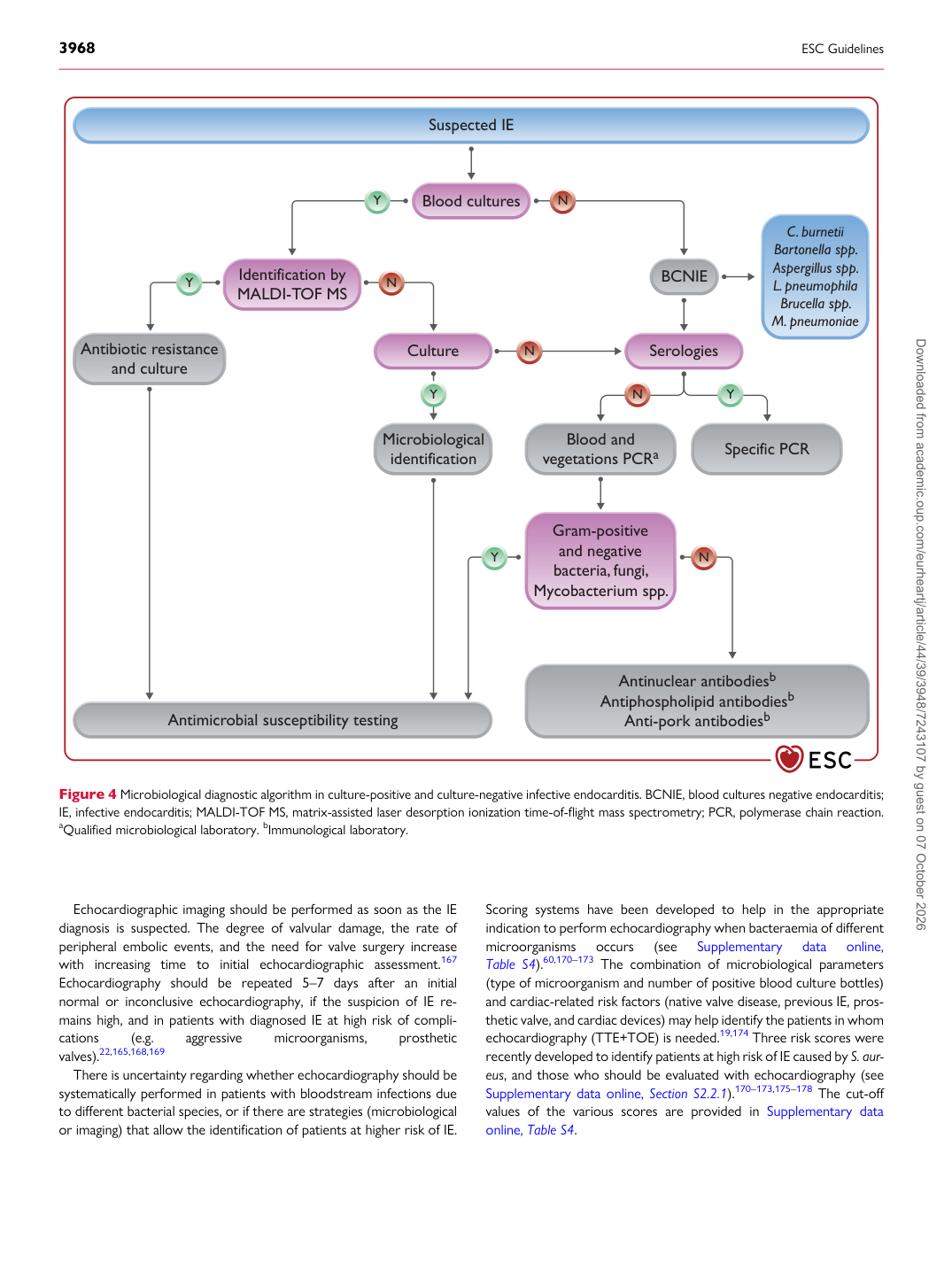
Figure 4 Microbiological diagnostic algorithm in culture-positive and culture-negative infective endocarditis. BCNIE, blood cultures negative endocarditis; IE, infective endocarditis; MALDI-TOF MS, matrix-assisted laser desorption ionization time-of-flight mass spectrometry; PCR, polymerase chain reaction. aQualified microbiological laboratory. bImmunological laboratory. Downloaded from academic.oup.com/eurheartj/article/44/39/3948/7243107 by guest on 07 October 2026