p.16 抽出テキスト
experiencing fever of unknown origin, report to their physician that they are at risk, in which case clinicians should consider screening for IE before initiating antibiotics. Use of non-medical language, visual aids, digital tools, repetition, and teach back methods all aid the patients’ comprehension and is encouraged.115 National cardiology societies should be encouraged to develop specific IE cards for patient awareness (Figure 2).

4 The Endocarditis Team

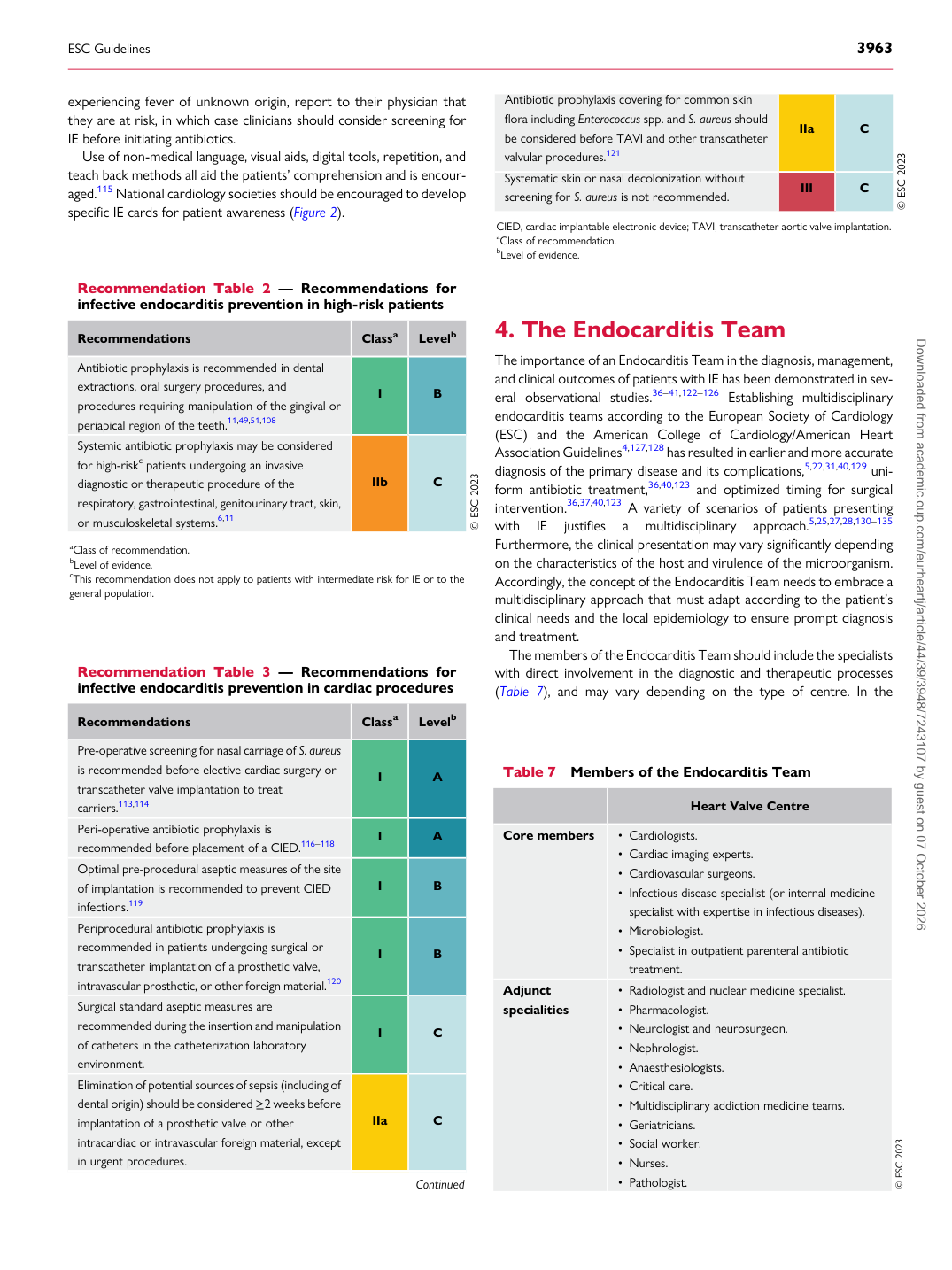
The importance of an Endocarditis Team in the diagnosis, management, and clinical outcomes of patients with IE has been demonstrated in several observational studies.36–41,122–126 Establishing multidisciplinary endocarditis teams according to the European Society of Cardiology (ESC) and the American College of Cardiology/American Heart Association Guidelines4,127,128 has resulted in earlier and more accurate diagnosis of the primary disease and its complications,5,22,31,40,129 uniform antibiotic treatment,36,40,123 and optimized timing for surgical intervention.36,37,40,123 A variety of scenarios of patients presenting with IE justifies a multidisciplinary approach.5,25,27,28,130–135 Furthermore, the clinical presentation may vary significantly depending on the characteristics of the host and virulence of the microorganism. Accordingly, the concept of the Endocarditis Team needs to embrace a multidisciplinary approach that must adapt according to the patient’s clinical needs and the local epidemiology to ensure prompt diagnosis and treatment. The members of the Endocarditis Team should include the specialists with direct involvement in the diagnostic and therapeutic processes (Table 7), and may vary depending on the type of centre. In the

Recommendation Table 2 — Recommendations for infective endocarditis prevention in high-risk patients

Recommendations Classa Levelb

Antibiotic prophylaxis is recommended in dental extractions, oral surgery procedures, and procedures requiring manipulation of the gingival or periapical region of the teeth.11,49,51,108 I B Systemic antibiotic prophylaxis may be considered for high-riskc patients undergoing an invasive diagnostic or therapeutic procedure of the respiratory, gastrointestinal, genitourinary tract, skin, or musculoskeletal systems.6,11 IIb C © ESC 2023 aClass of recommendation. bLevel of evidence. cThis recommendation does not apply to patients with intermediate risk for IE or to the general population.

Recommendation Table 3 — Recommendations for infective endocarditis prevention in cardiac procedures

Recommendations Classa Levelb

Pre-operative screening for nasal carriage of S. aureus is recommended before elective cardiac surgery or transcatheter valve implantation to treat carriers.113,114 I A Peri-operative antibiotic prophylaxis is recommended before placement of a CIED.116–118 I A Optimal pre-procedural aseptic measures of the site of implantation is recommended to prevent CIED infections.119 I B Periprocedural antibiotic prophylaxis is recommended in patients undergoing surgical or transcatheter implantation of a prosthetic valve, intravascular prosthetic, or other foreign material.120 I B Surgical standard aseptic measures are recommended during the insertion and manipulation of catheters in the catheterization laboratory environment. I C Elimination of potential sources of sepsis (including of dental origin) should be considered ≥2 weeks before implantation of a prosthetic valve or other intracardiac or intravascular foreign material, except in urgent procedures. IIa C

Continued Antibiotic prophylaxis covering for common skin flora including Enterococcus spp. and S. aureus should

be considered before TAVI and other transcatheter valvular procedures.121 IIa C Systematic skin or nasal decolonization without screening for S. aureus is not recommended. III C © ESC 2023 CIED, cardiac implantable electronic device; TAVI, transcatheter aortic valve implantation. aClass of recommendation. bLevel of evidence.

Table 7 Members of the Endocarditis Team

Heart Valve Centre

Core members • Cardiologists.

• Cardiac imaging experts. • Cardiovascular surgeons. • Infectious disease specialist (or internal medicine specialist with expertise in infectious diseases). • Microbiologist. • Specialist in outpatient parenteral antibiotic

treatment.

Adjunct specialities • Radiologist and nuclear medicine specialist.

• Pharmacologist. • Neurologist and neurosurgeon. • Nephrologist. • Anaesthesiologists. • Critical care. • Multidisciplinary addiction medicine teams. • Geriatricians. • Social worker. • Nurses. • Pathologist. © ESC 2023

ESC Guidelines                                                                                                                                                                                          3963

Downloaded from academic.oup.com/eurheartj/article/44/39/3948/7243107 by guest on 07 October 2026