p.15 抽出テキスト
several invasive non-dental medical procedures were associated with increased risk of IE, including cardiovascular interventions, skin procedures and wound management, transfusion, dialysis, bone marrow puncture, and endoscopic procedures.6,11,51 For this reason, an aseptic operational environment should be ensured during all these procedures to minimize the risk of IE. As previously indicated, it is very unlikely that an RCT on antibiotic prophylaxis for IE will be performed in the foreseeable future. However, at-risk patients have longer survival due to the advent of newer medical and device-based medical therapies. In addition, the ageing general population with their accumulating number of co-morbidities has an increased risk of surgical therapy, if IE occurs. For these reasons, this Task Force no longer felt that a class III recommendation for antibiotic prophylaxis in high-risk patients undergoing non-dental medical procedures (see Recommendation Table 2) was appropriate, despite the limitations of observational data used to support this class IIb recommendation.

3.3.3 Cardiac or vascular interventions

In all patients undergoing implantation of a prosthetic valve, any type of prosthetic graft/occluder device or CIED, peri-operative antibiotic prophylaxis is recommended due to the increased risk and adverse outcome of an infection.6 The most frequent microorganisms underlying early (1 year after surgery) surgical PVE are coagulase-negative staphylococci (CoNS) and S. aureus. Pre-operative screening of nasal carriage for S. aureus is recommended before elective cardiac surgery or transcatheter valve implantation to treat carriers using local mupirocin and chlorhexidine.113,114 Rapid identification techniques using gene amplification are useful to avoid delaying urgent surgery. Systematic local treatment without screening is not recommended. It is strongly recommended that potential sources of dental sepsis should be eliminated at least 2 weeks before implantation of a prosthetic valve or other intracardiac or intravascular foreign material unless the latter procedure is urgent. For specific prophylactic measures in other cardiac and vascular interventions (i.e. CIED, transcatheter aortic valve implantation [TAVI]), please see the Supplementary data online, Section S1.1.

3.4 Patient education

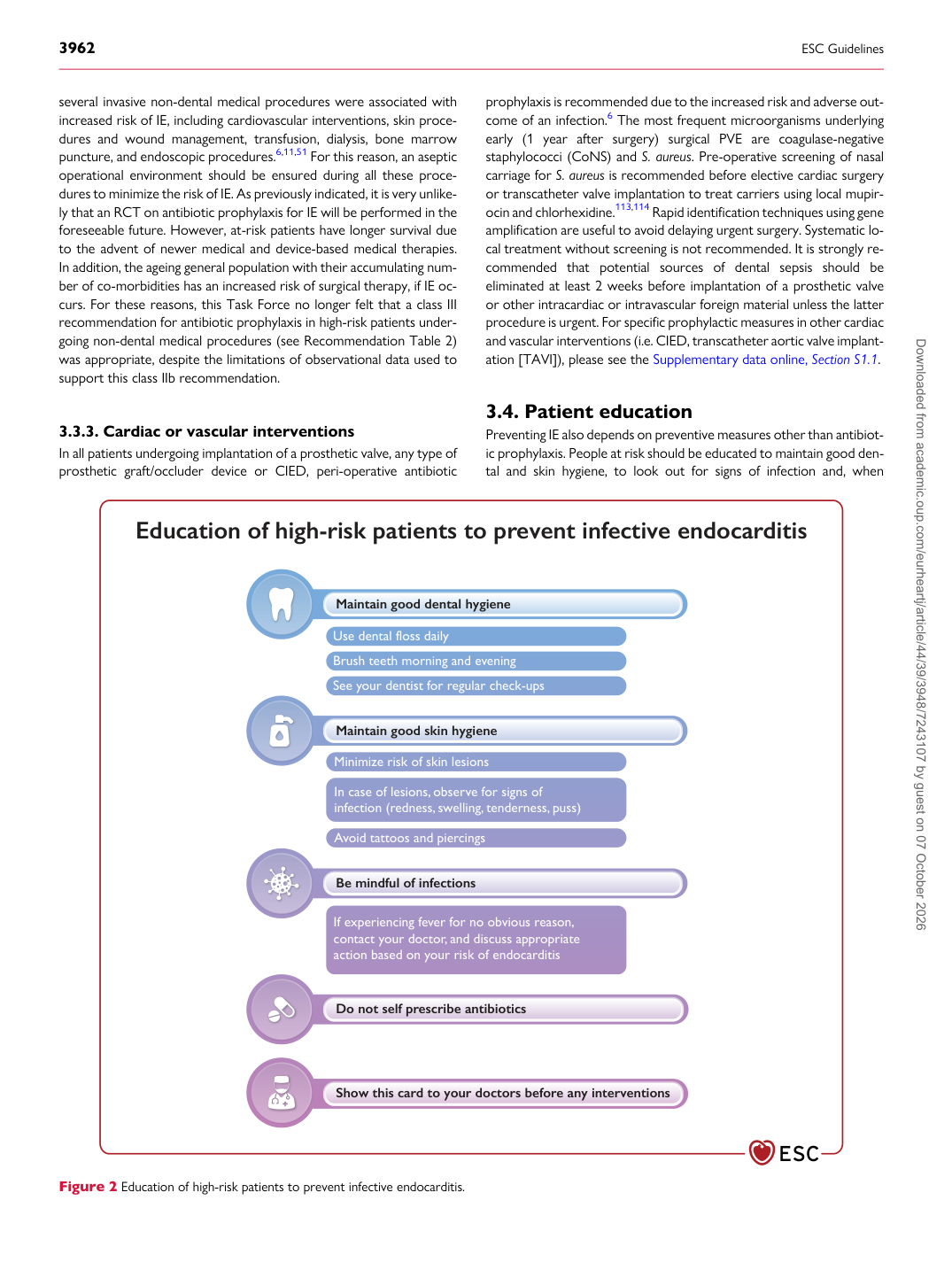
Preventing IE also depends on preventive measures other than antibiotic prophylaxis. People at risk should be educated to maintain good dental and skin hygiene, to look out for signs of infection and, when

Education of high-risk patients to prevent infective endocarditis

Use dental floss daily Brush teeth morning and evening See your dentist for regular check-ups

Maintain good dental hygiene

If experiencing fever for no obvious reason, contact your doctor, and discuss appropriate action based on your risk of endocarditis

Minimize risk of skin lesions In case of lesions, observe for signs of infection (redness, swelling, tenderness, puss) Avoid tattoos and piercings

Maintain good skin hygiene

Be mindful of infections

Do not self prescribe antibiotics

Show this card to your doctors before any interventions

Figure 2 Education of high-risk patients to prevent infective endocarditis. Downloaded from academic.oup.com/eurheartj/article/44/39/3948/7243107 by guest on 07 October 2026