p.14 抽出テキスト
with a higher risk of IE compared with the background population,47,90,103 but further studies are required. In patients at intermediate risk of IE, antibiotic prophylaxis is not routinely recommended and may be considered on an individual basis. However, prevention measures (Table 5) are strongly encouraged in these patients.7 Most of the IE in recipients of solid organ transplant is nosocomial. A recent systematic review of patient-level data including 57 heart transplant patients has shown that IE occurs frequently during the first year post-transplant, and the most common pathogen is S. aureus followed by Aspergillus fumigatus.105 Oral streptococci are a very infrequent cause of IE, making the value of antibiotic prophylaxis after invasive orodental procedures questionable. However, IE in this group of patients is associated with very high mortality, particularly in patients with fungal IE. In contrast, other series that include a larger proportion of noncardiac solid organ transplant patients have shown that the pathogens are more frequently from the Staphylococcus spp. and the mortality seems to be similar to that of patients without solid organ transplant.106,107 3.3 Situations and procedures at risk

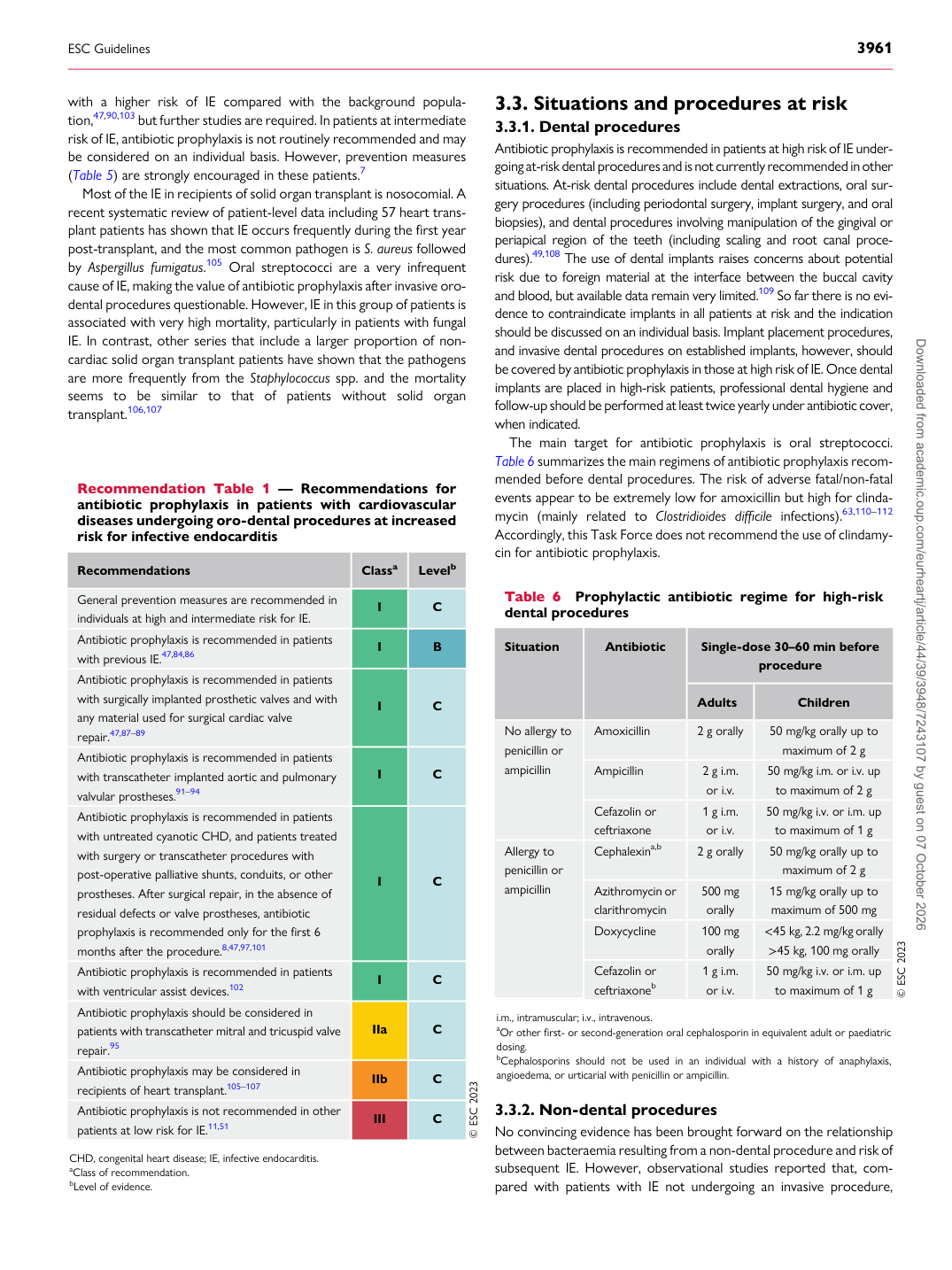
3.3.1. Dental procedures Antibiotic prophylaxis is recommended in patients at high risk of IE undergoing at-risk dental procedures and is not currently recommended in other situations. At-risk dental procedures include dental extractions, oral surgery procedures (including periodontal surgery, implant surgery, and oral biopsies), and dental procedures involving manipulation of the gingival or periapical region of the teeth (including scaling and root canal procedures).49,108 The use of dental implants raises concerns about potential risk due to foreign material at the interface between the buccal cavity and blood, but available data remain very limited.109 So far there is no evidence to contraindicate implants in all patients at risk and the indication should be discussed on an individual basis. Implant placement procedures, and invasive dental procedures on established implants, however, should be covered by antibiotic prophylaxis in those at high risk of IE. Once dental implants are placed in high-risk patients, professional dental hygiene and follow-up should be performed at least twice yearly under antibiotic cover, when indicated. The main target for antibiotic prophylaxis is oral streptococci. Table 6 summarizes the main regimens of antibiotic prophylaxis recommended before dental procedures. The risk of adverse fatal/non-fatal events appear to be extremely low for amoxicillin but high for clindamycin (mainly related to Clostridioides difficile infections).63,110–112 Accordingly, this Task Force does not recommend the use of clindamycin for antibiotic prophylaxis.

3.3.2 Non-dental procedures

No convincing evidence has been brought forward on the relationship between bacteraemia resulting from a non-dental procedure and risk of subsequent IE. However, observational studies reported that, compared with patients with IE not undergoing an invasive procedure,

Recommendation Table 1 — Recommendations for antibiotic prophylaxis in patients with cardiovascular diseases undergoing oro-dental procedures at increased risk for infective endocarditis

Recommendations Classa Levelb

General prevention measures are recommended in individuals at high and intermediate risk for IE. I C Antibiotic prophylaxis is recommended in patients with previous IE.47,84,86 I B Antibiotic prophylaxis is recommended in patients with surgically implanted prosthetic valves and with any material used for surgical cardiac valve repair.47,87–89 I C Antibiotic prophylaxis is recommended in patients with transcatheter implanted aortic and pulmonary valvular prostheses.91–94 I C Antibiotic prophylaxis is recommended in patients with untreated cyanotic CHD, and patients treated with surgery or transcatheter procedures with post-operative palliative shunts, conduits, or other prostheses. After surgical repair, in the absence of residual defects or valve prostheses, antibiotic prophylaxis is recommended only for the first 6 months after the procedure.8,47,97,101 I C Antibiotic prophylaxis is recommended in patients with ventricular assist devices.102 I C Antibiotic prophylaxis should be considered in patients with transcatheter mitral and tricuspid valve repair.95 IIa C Antibiotic prophylaxis may be considered in recipients of heart transplant.105–107 IIb C Antibiotic prophylaxis is not recommended in other patients at low risk for IE.11,51 III C © ESC 2023

CHD, congenital heart disease; IE, infective endocarditis. aClass of recommendation. bLevel of evidence. Table 6 Prophylactic antibiotic regime for high-risk dental procedures

Situation Antibiotic Single-dose 30–60 min before

procedure

Adults Children

No allergy to penicillin or ampicillin Amoxicillin 2 g orally 50 mg/kg orally up to maximum of 2 g

Ampicillin 2 g i.m. or i.v. 50 mg/kg i.m. or i.v. up to maximum of 2 g Cefazolin or ceftriaxone 1 g i.m. or i.v. 50 mg/kg i.v. or i.m. up to maximum of 1 g

Allergy to penicillin or ampicillin Cephalexina,b 2 g orally 50 mg/kg orally up to maximum of 2 g

Azithromycin or clarithromycin 500 mg orally 15 mg/kg orally up to maximum of 500 mg Doxycycline 100 mg orally <45 kg, 2.2 mg/kg orally

>45 kg, 100 mg orally

Cefazolin or ceftriaxoneb 1 g i.m.

or i.v. 50 mg/kg i.v. or i.m. up

to maximum of 1 g © ESC 2023

i.m., intramuscular; i.v., intravenous. aOr other first- or second-generation oral cephalosporin in equivalent adult or paediatric dosing. bCephalosporins should not be used in an individual with a history of anaphylaxis, angioedema, or urticarial with penicillin or ampicillin.

ESC Guidelines                                                                                                                                                                                          3961

Downloaded from academic.oup.com/eurheartj/article/44/39/3948/7243107 by guest on 07 October 2026