p.13 抽出テキスト
have evaluated the efficacy of antibiotic prophylaxis using bacteraemia as a surrogate of IE.16–18,52,62 However, the relationship between bacteraemia and IE is not straightforward. Bacteraemia may be caused by daily activities such as tooth brushing, flossing, and chewing, and although these constitute low-level bacteraemia, they occur repetitively and may therefore outweigh the risk of bacteraemia associated with dental procedures.48,49 A meta-analysis of 36 studies, including 21 trials that investigated the effect of antibiotic prophylaxis on the incidence of bacteraemia following dental procedures, demonstrated that antibiotic prophylaxis is effective in reducing the incidence of bacteraemia, but did not lead to a statistically significant protective effect against IE in casecontrol studies.52 Additionally, the potential risk of anaphylaxis,63 or other adverse side effects in a small minority of patients, and the fact that a widespread use of antibiotics may be associated with antibiotic resistance, are areas of concern.57,58,64–67 While some studies did not demonstrate significant increases in IE-related hospitalizations and death rates after scaling down antibiotic prophylaxis indications,68–77 others showed an increase in the incidence of IE among individuals at moderate and high risk of IE.13,26,59,78–81 A meta-analysis including 16 studies reporting over 1.3 million cases of IE has shown that restricting antibiotic prophylaxis to only high-risk individuals has not resulted in an increase in the incidence of streptococcal IE in a North American population (despite the fact that it was unable to draw that conclusion for other populations).18 In contrast, a systematic review including multiple nationwide population-based studies in Europe has shown a 4% per year rise in the incidence of IE.82 These contrasting results may be explained by differences in the methodology of the studies (retrospective, population- or health-system-based studies that relied on claims data or epidemiological observations to estimate the incidence of IE), greater disease diagnosis with the use of newer imaging technologies, lack of microbiological data, and the lack of specific International Classification of Diseases codes for oral streptococci.83 Recently, it has been shown that antibiotic prophylaxis in high-risk individuals was associated with a significant reduction of IE after invasive dental procedures (particularly extractions and oral surgical procedures).11,51 After careful consideration of all the new studies published after 2015, the present Task Force decided to revise and update the risk categories for IE, strengthening the recommendation of antibiotic prophylaxis, clarifying the definition of the population at risk, and considering the advances in transcatheter valve interventions.

3.2 Populations at risk of infective

endocarditis The groups of individuals at high risk of IE in whom antibiotic prophylaxis is recommended or should be considered include the following: (i) Patients with previous IE: the highest risk of IE is observed in pa-

tients with previous history of IE who have an ominous prognosis during IE-related hospitalization. Patients with recurrent IE more frequently have prosthetic valves or prosthetic material, are more commonly PWID, or have staphylococcal IE.47,84–86 (ii) Patients with surgically implanted prosthetic valves, with transcath-

eter implanted prosthetic valves, and with any material used for cardiac valve repair: the increased risk of IE in these patients, combined with the ominous outcomes as compared with patients with native IE (NVE), make antibiotic prophylaxis advisable in this patient group. Patients with prosthetic valve endocarditis (PVE) have an in-hospital mortality rate that is twice as high with more complications (e.g. heart failure [HF], conduction disturbances) as compared with patients with NVE, regardless of the pathogen.87,88 Furthermore, mitral and aortic bioprostheses may be associated with increased risk of IE as compared with mechanical prostheses,89,90 and bioprostheses are being implanted in an ever-increasing proportion of patients requiring valve replacement therapy. The indication for prophylaxis also expands to transcatheter aortic and pulmonic prosthetic valves, since IE is also associated with a high risk of morbidity and mortality in these patients.91–94 In terms of transcatheter mitral and tricuspid valve interventions, the data on the risk of IE are limited.95 Patients with septal defect closure devices, left atrial appendage closure devices, vascular grafts, vena cava filters, and central venous system ventriculo-atrial shunts are considered within this risk category in the first 6 months after implantation.96

(iii) Patients with congenital heart disease (CHD) (not including iso-

lated congenital valve abnormalities) are at increased risk of IE.8,47,97–99 The cumulative incidence over time is influenced strongly by the improved long-term survival of children with CHD into adulthood.98 Indeed, there are now more adults living with CHD than children with CHD.100 The overall incidence rate of IE among adult patients with CHD is 27–44 times that reported for contemporary adults of the general population (1.33 cases per 1000 persons per year)8 while in children with CHD the incidence of IE is 0.41 cases per 1000 persons per year.101 CHD groups at increased risk include those with untreated cyanotic CHD, and those whose surgery includes prosthetic material, including valved conduits or systemic to pulmonary shunts.8,47,97 The risk of post-operative IE for CHD patients undergoing transcatheter atrial or ventricular septal defect closure with devices or surgery with non-valve-related prosthetic material is also increased, but predominantly for the first 6 months after surgery.8 (iv) Patients with ventricular assist devices as destination therapy are

also considered at high risk because of associated morbidity and mortality, and prophylaxis is also recommended in such patients.102

Patients at intermediate risk of IE include those with: (i) rheumatic heart disease (RHD); (ii) non-rheumatic degenerative valve disease; (iii) congenital valve abnormalities including bicuspid aortic valve disease; (iv) cardiovascular implanted electronic devices (CIEDs); and (v) hypertrophic cardiomyopathy.47,103,104 Some epidemiological data suggest that certain conditions stratified as intermediate risk are associated

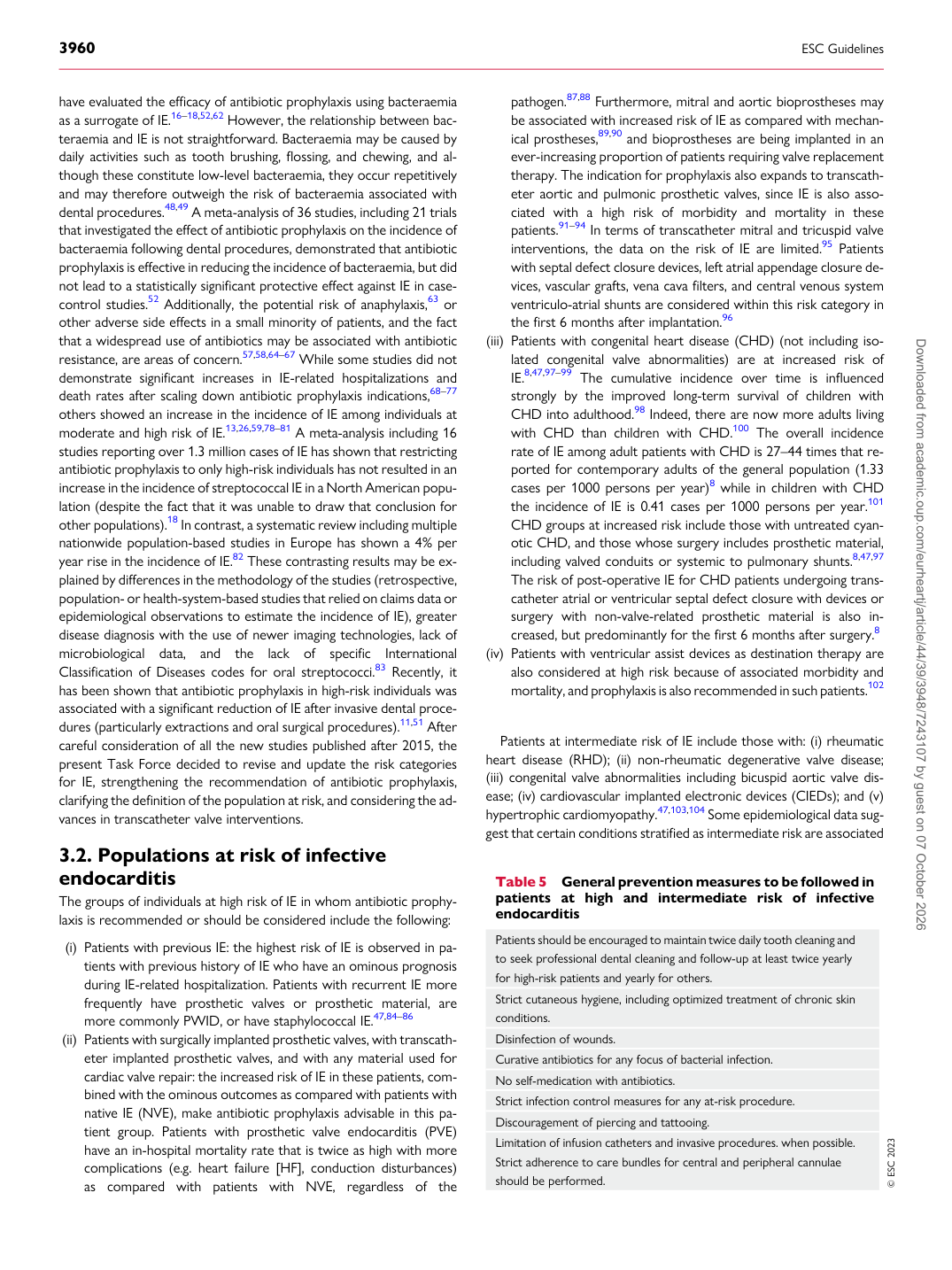
Table 5 General prevention measures to be followed in patients at high and intermediate risk of infective endocarditis Patients should be encouraged to maintain twice daily tooth cleaning and to seek professional dental cleaning and follow-up at least twice yearly for high-risk patients and yearly for others. Strict cutaneous hygiene, including optimized treatment of chronic skin conditions. Disinfection of wounds. Curative antibiotics for any focus of bacterial infection. No self-medication with antibiotics. Strict infection control measures for any at-risk procedure. Discouragement of piercing and tattooing. Limitation of infusion catheters and invasive procedures. when possible. Strict adherence to care bundles for central and peripheral cannulae should be performed. © ESC 2023 Downloaded from academic.oup.com/eurheartj/article/44/39/3948/7243107 by guest on 07 October 2026