p.11 抽出テキスト
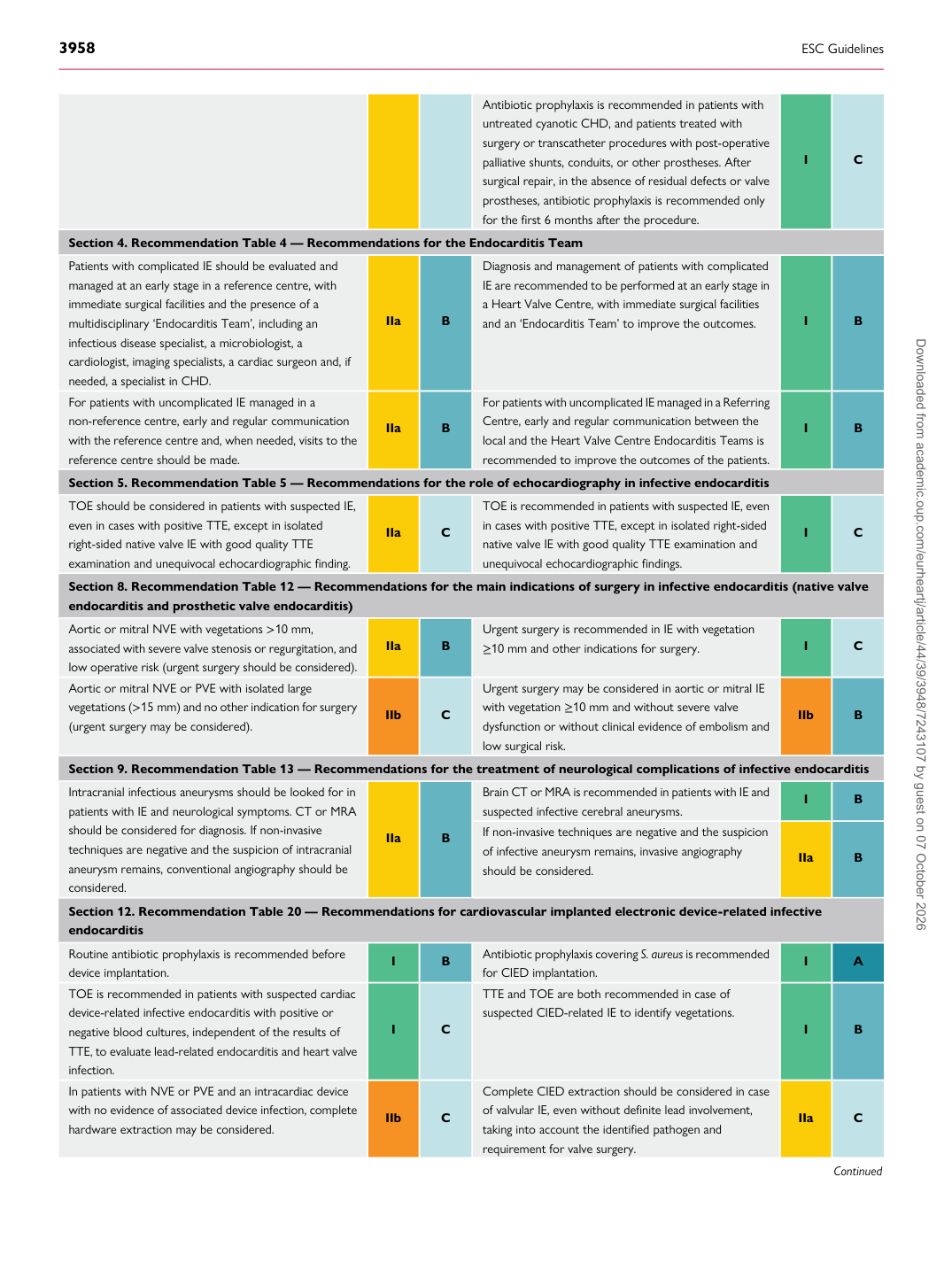
Antibiotic prophylaxis is recommended in patients with untreated cyanotic CHD, and patients treated with surgery or transcatheter procedures with post-operative palliative shunts, conduits, or other prostheses. After surgical repair, in the absence of residual defects or valve prostheses, antibiotic prophylaxis is recommended only for the first 6 months after the procedure. I C

Section 4. Recommendation Table 4 — Recommendations for the Endocarditis Team Patients with complicated IE should be evaluated and managed at an early stage in a reference centre, with immediate surgical facilities and the presence of a multidisciplinary ‘Endocarditis Team’, including an infectious disease specialist, a microbiologist, a cardiologist, imaging specialists, a cardiac surgeon and, if needed, a specialist in CHD. IIa B Diagnosis and management of patients with complicated

IE are recommended to be performed at an early stage in a Heart Valve Centre, with immediate surgical facilities and an ‘Endocarditis Team’ to improve the outcomes. I B

For patients with uncomplicated IE managed in a non-reference centre, early and regular communication with the reference centre and, when needed, visits to the reference centre should be made. IIa B For patients with uncomplicated IE managed in a Referring

Centre, early and regular communication between the local and the Heart Valve Centre Endocarditis Teams is recommended to improve the outcomes of the patients. I B

Section 5. Recommendation Table 5 — Recommendations for the role of echocardiography in infective endocarditis TOE should be considered in patients with suspected IE, even in cases with positive TTE, except in isolated right-sided native valve IE with good quality TTE examination and unequivocal echocardiographic finding. IIa C TOE is recommended in patients with suspected IE, even in cases with positive TTE, except in isolated right-sided

native valve IE with good quality TTE examination and unequivocal echocardiographic findings. I C

Section 8. Recommendation Table 12 — Recommendations for the main indications of surgery in infective endocarditis (native valve endocarditis and prosthetic valve endocarditis) Aortic or mitral NVE with vegetations >10 mm, associated with severe valve stenosis or regurgitation, and low operative risk (urgent surgery should be considered). IIa B Urgent surgery is recommended in IE with vegetation

≥10 mm and other indications for surgery. I C

Aortic or mitral NVE or PVE with isolated large vegetations (>15 mm) and no other indication for surgery (urgent surgery may be considered). IIb C Urgent surgery may be considered in aortic or mitral IE with vegetation ≥10 mm and without severe valve

dysfunction or without clinical evidence of embolism and low surgical risk. IIb B

Section 9. Recommendation Table 13 — Recommendations for the treatment of neurological complications of infective endocarditis Intracranial infectious aneurysms should be looked for in patients with IE and neurological symptoms. CT or MRA should be considered for diagnosis. If non-invasive techniques are negative and the suspicion of intracranial aneurysm remains, conventional angiography should be considered. IIa B Brain CT or MRA is recommended in patients with IE and

suspected infective cerebral aneurysms. I B If non-invasive techniques are negative and the suspicion of infective aneurysm remains, invasive angiography should be considered. IIa B

Section 12. Recommendation Table 20 — Recommendations for cardiovascular implanted electronic device-related infective endocarditis Routine antibiotic prophylaxis is recommended before device implantation. I B Antibiotic prophylaxis covering S. aureus is recommended for CIED implantation. I A TOE is recommended in patients with suspected cardiac device-related infective endocarditis with positive or negative blood cultures, independent of the results of TTE, to evaluate lead-related endocarditis and heart valve infection. I C TTE and TOE are both recommended in case of suspected CIED-related IE to identify vegetations. I B In patients with NVE or PVE and an intracardiac device with no evidence of associated device infection, complete hardware extraction may be considered. IIb C Complete CIED extraction should be considered in case of valvular IE, even without definite lead involvement,

taking into account the identified pathogen and requirement for valve surgery. IIa C

Continued Downloaded from academic.oup.com/eurheartj/article/44/39/3948/7243107 by guest on 07 October 2026