p.9 抽出テキスト
with developing CVD. The combination of diabetes with these cardio-renal comorbidities enhances the risk not only for cardiovascular (CV) events but also for CV and all-cause mortality. The current European Society of Cardiology (ESC) Guidelines on the management of cardiovascular disease in patients with diabetes are designed to guide prevention and management of the manifestations of CVD in patients with diabetes based on data published until end of January 2023. Over the last decade, the results of various large cardiovascular outcome trials (CVOTs) in patients with diabetes at high CV risk with novel glucoselowering agents, such as sodium–glucose co-transporter-2 (SGLT2) inhibitors and glucagon-like peptide-1 (GLP-1) receptor agonists (RAs), but also novel non-steroidal mineralocorticoid receptor antagonists (MRAs), such as finerenone have substantially expanded available therapeutic options, leading to numerous evidence-based recommendations for the management of this patient population. The current Guidelines—in contrast to the previous 2019 ESC Guidelines on diabetes, pre-diabetes, and cardiovascular diseases— only focus on CVD and diabetes and, given the lack of clear evidence, leave aside the aspect of pre-diabetes. In addition, this version of the Guidelines gives recommendations on stratifying CV risk, as well as on screening, diagnosis, and treatment of CVD in patients with diabetes. For all other aspects concerning the management of patients with diabetes, we refer to the recommendations from diabetes associations, e.g. the European Association for the Study of Diabetes (EASD) or the American Diabetes Association (ADA).1

These Guidelines offer evidence-based recommendations to manage CV risk in patients with diabetes and provide guidance for the treatment of atherosclerotic cardiovascular disease (ASCVD) in patients with diabetes. To individualize treatment strategies, the current Guidelines introduce a novel, dedicated, type 2 diabetes mellitus (T2DM)-specific,

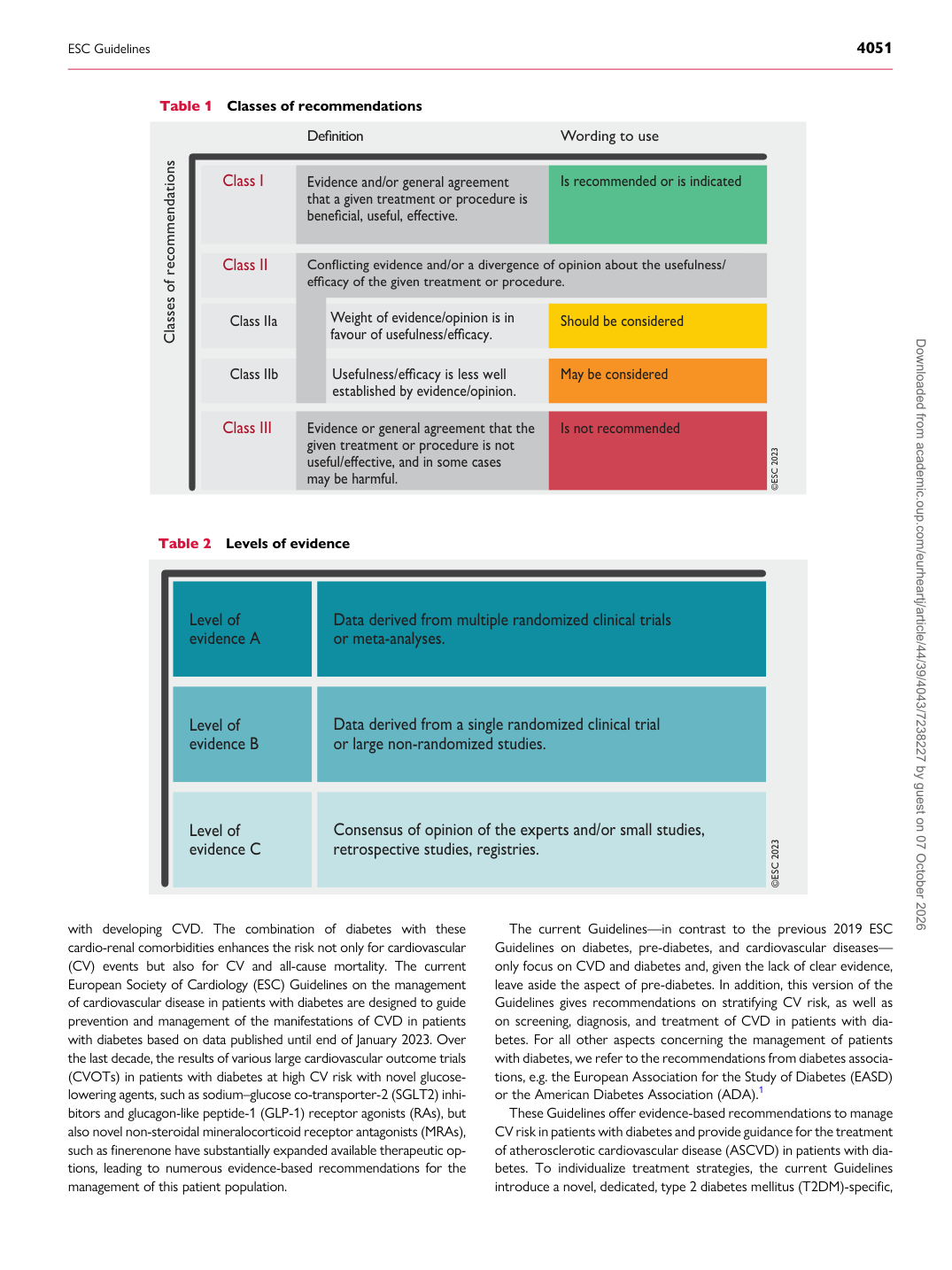
Table 1 Classes of recommendations

©ESC 2023

Classes of recommendations Class I Evidence and/or general agreement that a given treatment or procedure is beneficial, useful, effective.

Conflicting evidence and/or a divergence of opinion about the usefulness/ efficacy of the given treatment or procedure.

Is recommended or is indicated

Wording to use Definition

Class III Evidence or general agreement that the given treatment or procedure is not useful/effective, and in some cases may be harmful. Is not recommended

Class IIb Usefulness/efficacy is less well established by evidence/opinion. May be considered

Class IIa Weight of evidence/opinion is in favour of usefulness/efficacy. Should be considered

Class II

© ESC 2023

Table 2 Levels of evidence

Level of evidence A

Level of evidence B

Level of evidence C Data derived from multiple randomized clinical trials or meta-analyses.

Data derived from a single randomized clinical trial or large non-randomized studies.

Consensus of opinion of the experts and/or small studies, retrospective studies, registries. ©ESC 2023 © ESC 2023

ESC Guidelines                                                                                                                                                                                          4051

Downloaded from academic.oup.com/eurheartj/article/44/39/4043/7238227 by guest on 07 October 2026