p.75 抽出テキスト
18 Quality indicators

Quality indicators (QIs) are tools that may be used to evaluate care quality, including structural, process, and outcomes of care.838 They may also serve as a mechanism for enhancing adherence to Guideline recommendations, through associated quality-improvement initiatives and benchmarking of care clinicians.839,840 As such, the role of QIs in improving care and outcomes for CVD is increasingly recognized by healthcare authorities, professional organizations, payers, and the public.838 The ESC understands the need for measuring and reporting quality and outcomes of CV care and has established methods for developing the ESC QIs for quantifying care and outcomes for CVDs.838 To date, the ESC has developed QI suites for a number of CVDs in parallel with writing the ESC Clinical Practice Guidelines.841–844 The ESC aims to harmonize its QIs for various CV conditions and integrate them with ESC registries, providing real-world data about the patterns and outcomes of care for CVD across Europe.845

19 Supplementary data

Supplementary data is available at European Heart Journal online.

20 Data availability statement

No new data were generated or analysed in support of this research. 21 Author information

Author/Task Force Member Affiliations: Katharina Schütt, Department of Internal Medicine I Cardiology, RWTH Aachen University, Aachen, Germany; Dirk Müller-Wieland, Department of Internal Medicine I Cardiology, RWTH Aachen University, Aachen, Germany; Ramzi A. Ajjan, Clinical Population and Sciences Department, Leeds Institute of Cardiovascular and Metabolic Medicine, University of Leeds, Leeds, United Kingdom, Department of Diabetes and Endocrinology, Leeds Teaching Hospitals Trust, Leeds, United Kingdom; Manuel J. Antunes, Faculty of Medicine, University of Coimbra, Coimbra, Portugal; Ruxandra M. Christodorescu, Department V Internal Medicine, University of Medicine and Pharmacy V. Babeș, Timișoara, Romania, Research Center Institute of Cardiovascular Diseases, Timișoara, Romania; Carolyn Crawford (United Kingdom), ESC Patient Forum, Sophia Antipolis, France; Emanuele Di Angelantonio, Department of Public Health and Primary Care University of Cambridge, Cambridge, United Kingdom, Health Data Science Centre, Human Technopole, Milan, Italy; Björn Eliasson, Institute of Medicine, Sahlgrenska University Hospital, Gothenburg, Sweden; Christine Espinola-Klein, Department of Angiology, Center of Cardiology, University Medical Center of the Johannes Gutenberg University Mainz, Mainz, Germany; Laurent Fauchier, Cardiology Department Centre Hospitalier Universitaire Trousseau, Université de Tours, Tours, France; Martin Halle, Preventive Sports Medicine and Sports Cardiology, Technical University

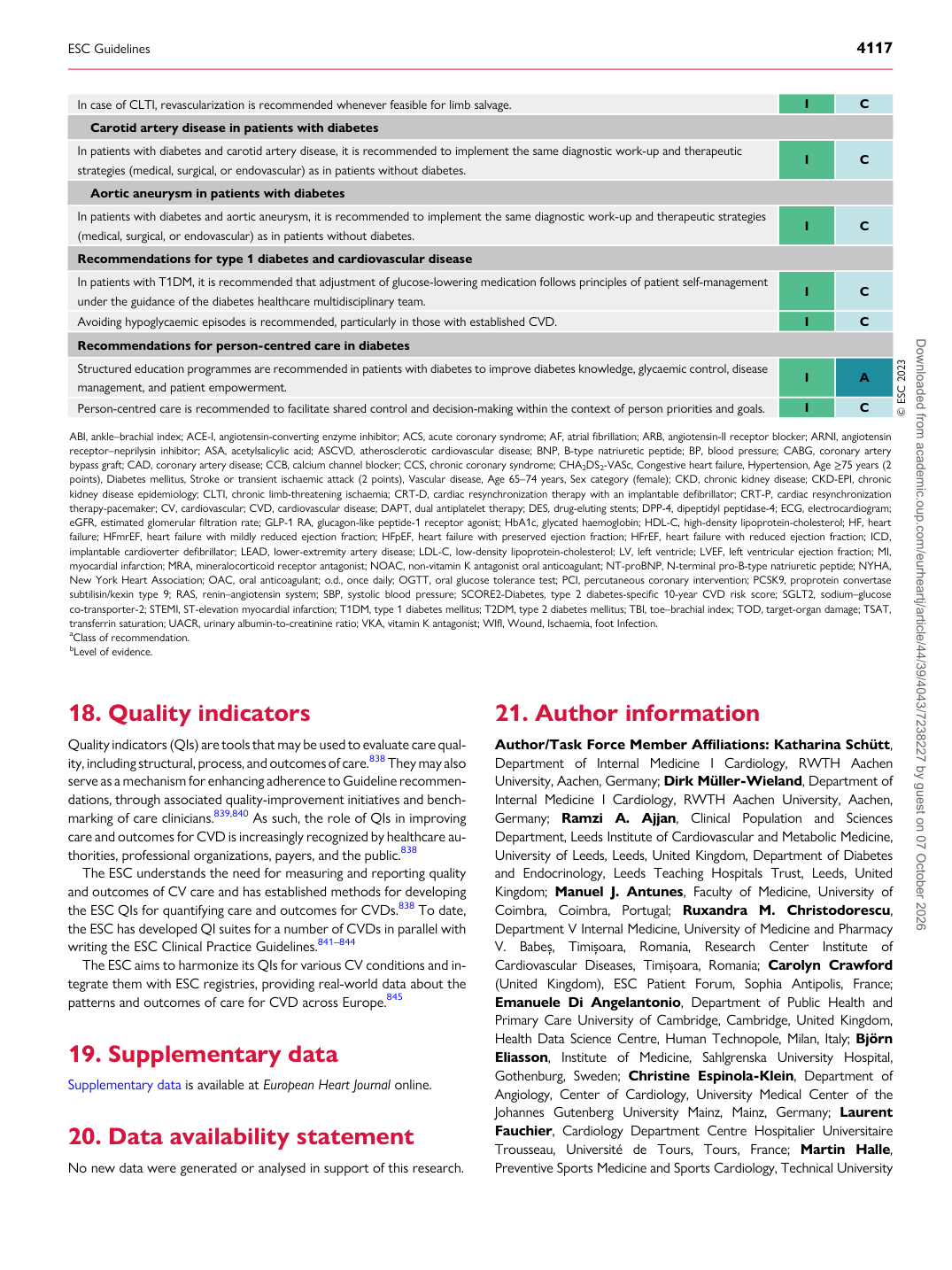
In case of CLTI, revascularization is recommended whenever feasible for limb salvage. I C

Carotid artery disease in patients with diabetes In patients with diabetes and carotid artery disease, it is recommended to implement the same diagnostic work-up and therapeutic strategies (medical, surgical, or endovascular) as in patients without diabetes. I C

Aortic aneurysm in patients with diabetes In patients with diabetes and aortic aneurysm, it is recommended to implement the same diagnostic work-up and therapeutic strategies (medical, surgical, or endovascular) as in patients without diabetes. I C Recommendations for type 1 diabetes and cardiovascular disease In patients with T1DM, it is recommended that adjustment of glucose-lowering medication follows principles of patient self-management under the guidance of the diabetes healthcare multidisciplinary team. I C Avoiding hypoglycaemic episodes is recommended, particularly in those with established CVD. I C Recommendations for person-centred care in diabetes Structured education programmes are recommended in patients with diabetes to improve diabetes knowledge, glycaemic control, disease management, and patient empowerment. I A Person-centred care is recommended to facilitate shared control and decision-making within the context of person priorities and goals. I C © ESC 2023

ABI, ankle–brachial index; ACE-I, angiotensin-converting enzyme inhibitor; ACS, acute coronary syndrome; AF, atrial fibrillation; ARB, angiotensin-II receptor blocker; ARNI, angiotensin receptor–neprilysin inhibitor; ASA, acetylsalicylic acid; ASCVD, atherosclerotic cardiovascular disease; BNP, B-type natriuretic peptide; BP, blood pressure; CABG, coronary artery bypass graft; CAD, coronary artery disease; CCB, calcium channel blocker; CCS, chronic coronary syndrome; CHA2DS2-VASc, Congestive heart failure, Hypertension, Age ≥75 years (2 points), Diabetes mellitus, Stroke or transient ischaemic attack (2 points), Vascular disease, Age 65–74 years, Sex category (female); CKD, chronic kidney disease; CKD-EPI, chronic kidney disease epidemiology; CLTI, chronic limb-threatening ischaemia; CRT-D, cardiac resynchronization therapy with an implantable defibrillator; CRT-P, cardiac resynchronization therapy-pacemaker; CV, cardiovascular; CVD, cardiovascular disease; DAPT, dual antiplatelet therapy; DES, drug-eluting stents; DPP-4, dipeptidyl peptidase-4; ECG, electrocardiogram; eGFR, estimated glomerular filtration rate; GLP-1 RA, glucagon-like peptide-1 receptor agonist; HbA1c, glycated haemoglobin; HDL-C, high-density lipoprotein-cholesterol; HF, heart failure; HFmrEF, heart failure with mildly reduced ejection fraction; HFpEF, heart failure with preserved ejection fraction; HFrEF, heart failure with reduced ejection fraction; ICD, implantable cardioverter defibrillator; LEAD, lower-extremity artery disease; LDL-C, low-density lipoprotein-cholesterol; LV, left ventricle; LVEF, left ventricular ejection fraction; MI, myocardial infarction; MRA, mineralocorticoid receptor antagonist; NOAC, non-vitamin K antagonist oral anticoagulant; NT-proBNP, N-terminal pro-B-type natriuretic peptide; NYHA, New York Heart Association; OAC, oral anticoagulant; o.d., once daily; OGTT, oral glucose tolerance test; PCI, percutaneous coronary intervention; PCSK9, proprotein convertase subtilisin/kexin type 9; RAS, renin–angiotensin system; SBP, systolic blood pressure; SCORE2-Diabetes, type 2 diabetes-specific 10-year CVD risk score; SGLT2, sodium–glucose co-transporter-2; STEMI, ST-elevation myocardial infarction; T1DM, type 1 diabetes mellitus; T2DM, type 2 diabetes mellitus; TBI, toe–brachial index; TOD, target-organ damage; TSAT, transferrin saturation; UACR, urinary albumin-to-creatinine ratio; VKA, vitamin K antagonist; WIfI, Wound, Ischaemia, foot Infection. aClass of recommendation. bLevel of evidence.

ESC Guidelines                                                                                                                                                                                          4117

Downloaded from academic.oup.com/eurheartj/article/44/39/4043/7238227 by guest on 07 October 2026