p.74 抽出テキスト
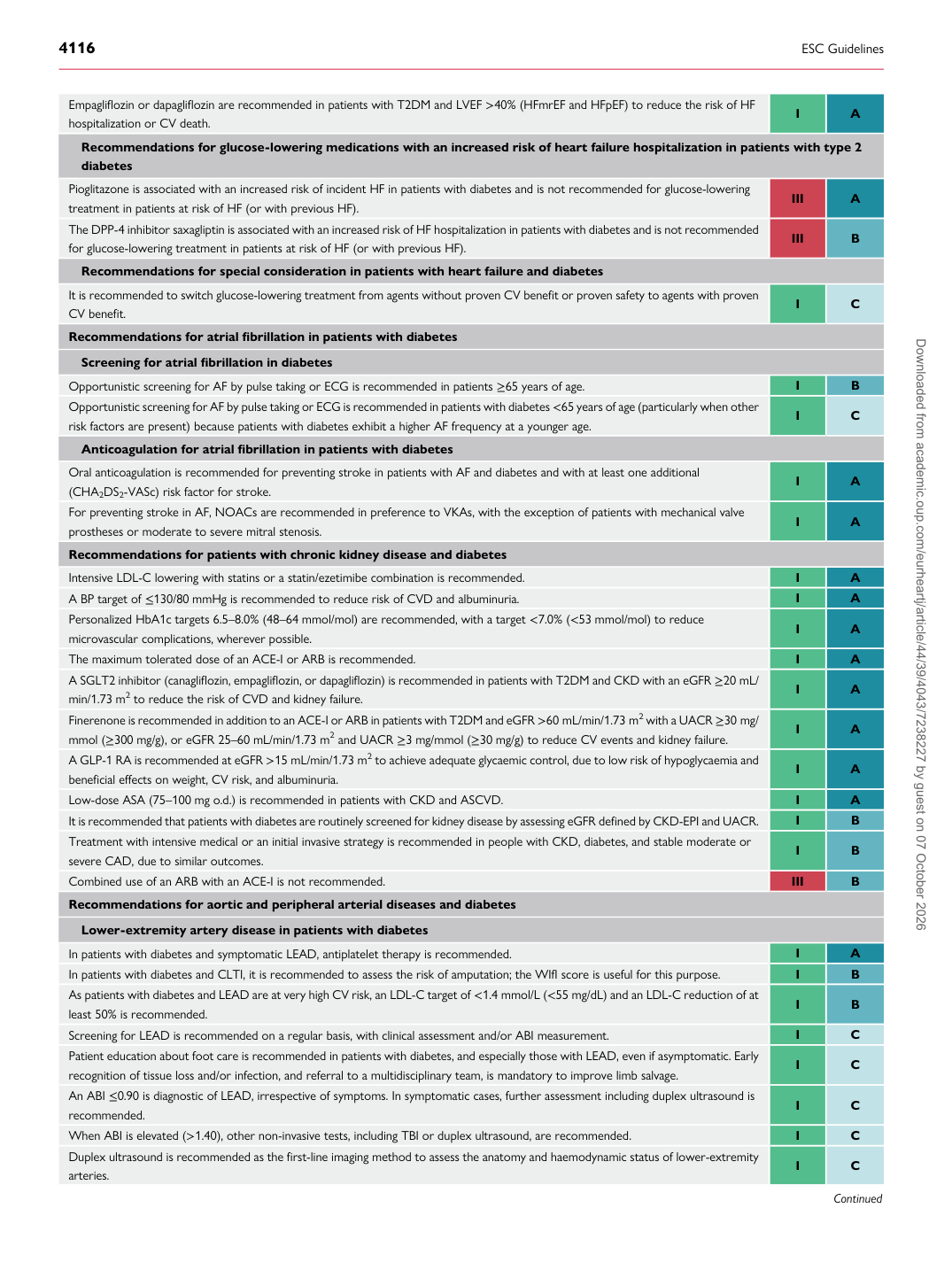
Empagliflozin or dapagliflozin are recommended in patients with T2DM and LVEF >40% (HFmrEF and HFpEF) to reduce the risk of HF hospitalization or CV death. I A

Recommendations for glucose-lowering medications with an increased risk of heart failure hospitalization in patients with type 2 diabetes Pioglitazone is associated with an increased risk of incident HF in patients with diabetes and is not recommended for glucose-lowering treatment in patients at risk of HF (or with previous HF). III A The DPP-4 inhibitor saxagliptin is associated with an increased risk of HF hospitalization in patients with diabetes and is not recommended for glucose-lowering treatment in patients at risk of HF (or with previous HF). III B

Recommendations for special consideration in patients with heart failure and diabetes It is recommended to switch glucose-lowering treatment from agents without proven CV benefit or proven safety to agents with proven CV benefit. I C Recommendations for atrial fibrillation in patients with diabetes

Screening for atrial fibrillation in diabetes Opportunistic screening for AF by pulse taking or ECG is recommended in patients ≥65 years of age. I B Opportunistic screening for AF by pulse taking or ECG is recommended in patients with diabetes <65 years of age (particularly when other risk factors are present) because patients with diabetes exhibit a higher AF frequency at a younger age. I C

Anticoagulation for atrial fibrillation in patients with diabetes Oral anticoagulation is recommended for preventing stroke in patients with AF and diabetes and with at least one additional (CHA2DS2-VASc) risk factor for stroke. I A For preventing stroke in AF, NOACs are recommended in preference to VKAs, with the exception of patients with mechanical valve prostheses or moderate to severe mitral stenosis. I A Recommendations for patients with chronic kidney disease and diabetes Intensive LDL-C lowering with statins or a statin/ezetimibe combination is recommended. I A A BP target of ≤130/80 mmHg is recommended to reduce risk of CVD and albuminuria. I A Personalized HbA1c targets 6.5–8.0% (48–64 mmol/mol) are recommended, with a target <7.0% (<53 mmol/mol) to reduce microvascular complications, wherever possible. I A The maximum tolerated dose of an ACE-I or ARB is recommended. I A A SGLT2 inhibitor (canagliflozin, empagliflozin, or dapagliflozin) is recommended in patients with T2DM and CKD with an eGFR ≥20 mL/ min/1.73 m2 to reduce the risk of CVD and kidney failure. I A Finerenone is recommended in addition to an ACE-I or ARB in patients with T2DM and eGFR >60 mL/min/1.73 m2 with a UACR ≥30 mg/ mmol (≥300 mg/g), or eGFR 25–60 mL/min/1.73 m2 and UACR ≥3 mg/mmol (≥30 mg/g) to reduce CV events and kidney failure. I A A GLP-1 RA is recommended at eGFR >15 mL/min/1.73 m2 to achieve adequate glycaemic control, due to low risk of hypoglycaemia and beneficial effects on weight, CV risk, and albuminuria. I A Low-dose ASA (75–100 mg o.d.) is recommended in patients with CKD and ASCVD. I A It is recommended that patients with diabetes are routinely screened for kidney disease by assessing eGFR defined by CKD-EPI and UACR. I B Treatment with intensive medical or an initial invasive strategy is recommended in people with CKD, diabetes, and stable moderate or severe CAD, due to similar outcomes. I B Combined use of an ARB with an ACE-I is not recommended. III B Recommendations for aortic and peripheral arterial diseases and diabetes

Lower-extremity artery disease in patients with diabetes In patients with diabetes and symptomatic LEAD, antiplatelet therapy is recommended. I A In patients with diabetes and CLTI, it is recommended to assess the risk of amputation; the WIfI score is useful for this purpose. I B As patients with diabetes and LEAD are at very high CV risk, an LDL-C target of <1.4 mmol/L (<55 mg/dL) and an LDL-C reduction of at least 50% is recommended. I B Screening for LEAD is recommended on a regular basis, with clinical assessment and/or ABI measurement. I C Patient education about foot care is recommended in patients with diabetes, and especially those with LEAD, even if asymptomatic. Early recognition of tissue loss and/or infection, and referral to a multidisciplinary team, is mandatory to improve limb salvage. I C An ABI ≤0.90 is diagnostic of LEAD, irrespective of symptoms. In symptomatic cases, further assessment including duplex ultrasound is recommended. I C When ABI is elevated (>1.40), other non-invasive tests, including TBI or duplex ultrasound, are recommended. I C Duplex ultrasound is recommended as the first-line imaging method to assess the anatomy and haemodynamic status of lower-extremity arteries. I C

Continued Downloaded from academic.oup.com/eurheartj/article/44/39/4043/7238227 by guest on 07 October 2026