p.72 抽出テキスト
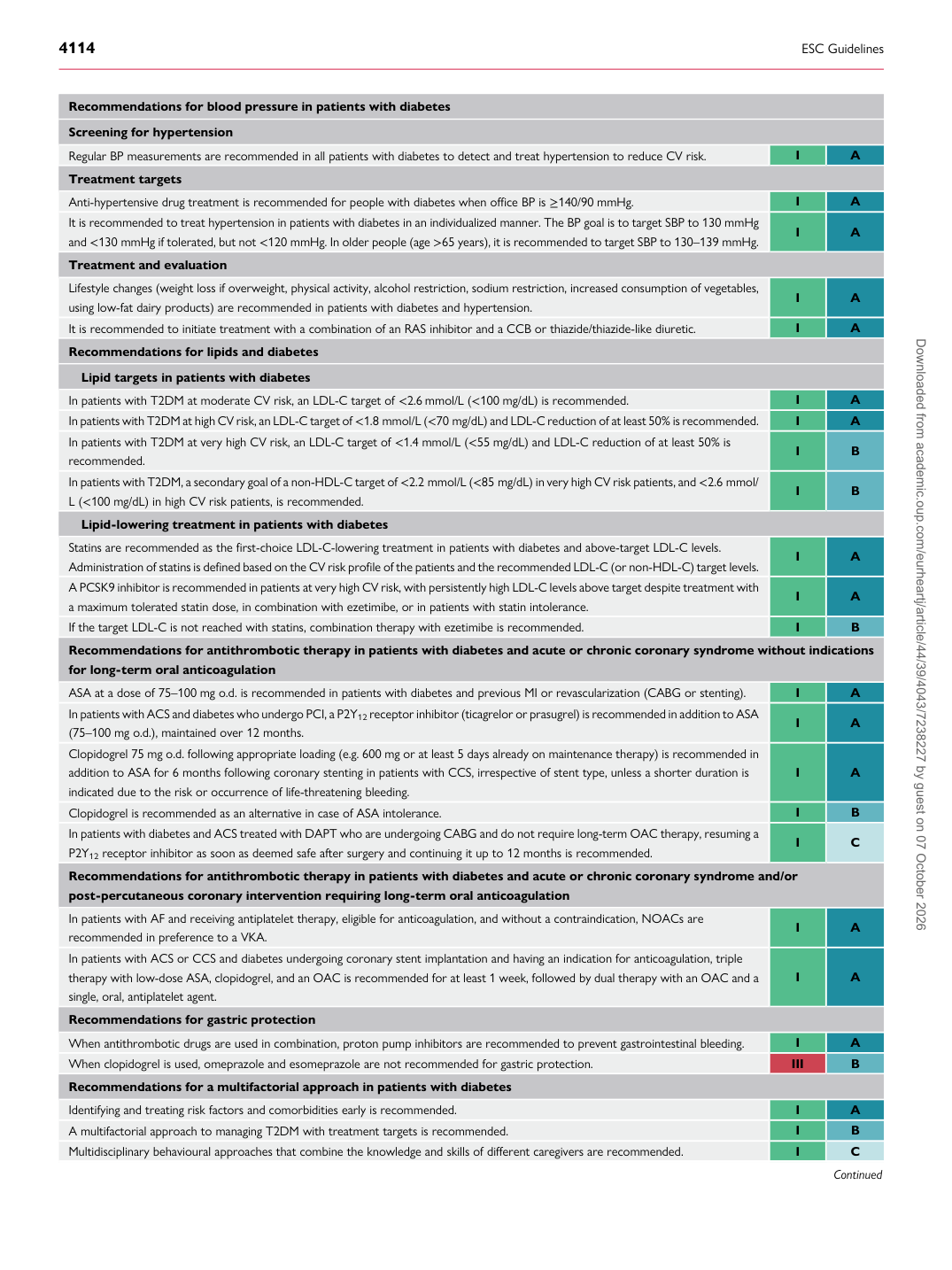
Recommendations for blood pressure in patients with diabetes Screening for hypertension Regular BP measurements are recommended in all patients with diabetes to detect and treat hypertension to reduce CV risk. I A Treatment targets Anti-hypertensive drug treatment is recommended for people with diabetes when office BP is ≥140/90 mmHg. I A It is recommended to treat hypertension in patients with diabetes in an individualized manner. The BP goal is to target SBP to 130 mmHg and <130 mmHg if tolerated, but not <120 mmHg. In older people (age >65 years), it is recommended to target SBP to 130–139 mmHg. I A Treatment and evaluation Lifestyle changes (weight loss if overweight, physical activity, alcohol restriction, sodium restriction, increased consumption of vegetables, using low-fat dairy products) are recommended in patients with diabetes and hypertension. I A It is recommended to initiate treatment with a combination of an RAS inhibitor and a CCB or thiazide/thiazide-like diuretic. I A Recommendations for lipids and diabetes

Lipid targets in patients with diabetes In patients with T2DM at moderate CV risk, an LDL-C target of <2.6 mmol/L (<100 mg/dL) is recommended. I A In patients with T2DM at high CV risk, an LDL-C target of <1.8 mmol/L (<70 mg/dL) and LDL-C reduction of at least 50% is recommended. I A In patients with T2DM at very high CV risk, an LDL-C target of <1.4 mmol/L (<55 mg/dL) and LDL-C reduction of at least 50% is recommended. I B In patients with T2DM, a secondary goal of a non-HDL-C target of <2.2 mmol/L (<85 mg/dL) in very high CV risk patients, and <2.6 mmol/ L (<100 mg/dL) in high CV risk patients, is recommended. I B

Lipid-lowering treatment in patients with diabetes Statins are recommended as the first-choice LDL-C-lowering treatment in patients with diabetes and above-target LDL-C levels. Administration of statins is defined based on the CV risk profile of the patients and the recommended LDL-C (or non-HDL-C) target levels. I A A PCSK9 inhibitor is recommended in patients at very high CV risk, with persistently high LDL-C levels above target despite treatment with a maximum tolerated statin dose, in combination with ezetimibe, or in patients with statin intolerance. I A If the target LDL-C is not reached with statins, combination therapy with ezetimibe is recommended. I B Recommendations for antithrombotic therapy in patients with diabetes and acute or chronic coronary syndrome without indications for long-term oral anticoagulation ASA at a dose of 75–100 mg o.d. is recommended in patients with diabetes and previous MI or revascularization (CABG or stenting). I A In patients with ACS and diabetes who undergo PCI, a P2Y12 receptor inhibitor (ticagrelor or prasugrel) is recommended in addition to ASA (75–100 mg o.d.), maintained over 12 months. I A Clopidogrel 75 mg o.d. following appropriate loading (e.g. 600 mg or at least 5 days already on maintenance therapy) is recommended in addition to ASA for 6 months following coronary stenting in patients with CCS, irrespective of stent type, unless a shorter duration is indicated due to the risk or occurrence of life-threatening bleeding. I A Clopidogrel is recommended as an alternative in case of ASA intolerance. I B In patients with diabetes and ACS treated with DAPT who are undergoing CABG and do not require long-term OAC therapy, resuming a P2Y12 receptor inhibitor as soon as deemed safe after surgery and continuing it up to 12 months is recommended. I C Recommendations for antithrombotic therapy in patients with diabetes and acute or chronic coronary syndrome and/or post-percutaneous coronary intervention requiring long-term oral anticoagulation In patients with AF and receiving antiplatelet therapy, eligible for anticoagulation, and without a contraindication, NOACs are recommended in preference to a VKA. I A In patients with ACS or CCS and diabetes undergoing coronary stent implantation and having an indication for anticoagulation, triple therapy with low-dose ASA, clopidogrel, and an OAC is recommended for at least 1 week, followed by dual therapy with an OAC and a single, oral, antiplatelet agent. I A Recommendations for gastric protection When antithrombotic drugs are used in combination, proton pump inhibitors are recommended to prevent gastrointestinal bleeding. I A When clopidogrel is used, omeprazole and esomeprazole are not recommended for gastric protection. III B Recommendations for a multifactorial approach in patients with diabetes Identifying and treating risk factors and comorbidities early is recommended. I A A multifactorial approach to managing T2DM with treatment targets is recommended. I B Multidisciplinary behavioural approaches that combine the knowledge and skills of different caregivers are recommended. I C

Continued Downloaded from academic.oup.com/eurheartj/article/44/39/4043/7238227 by guest on 07 October 2026