p.70 抽出テキスト
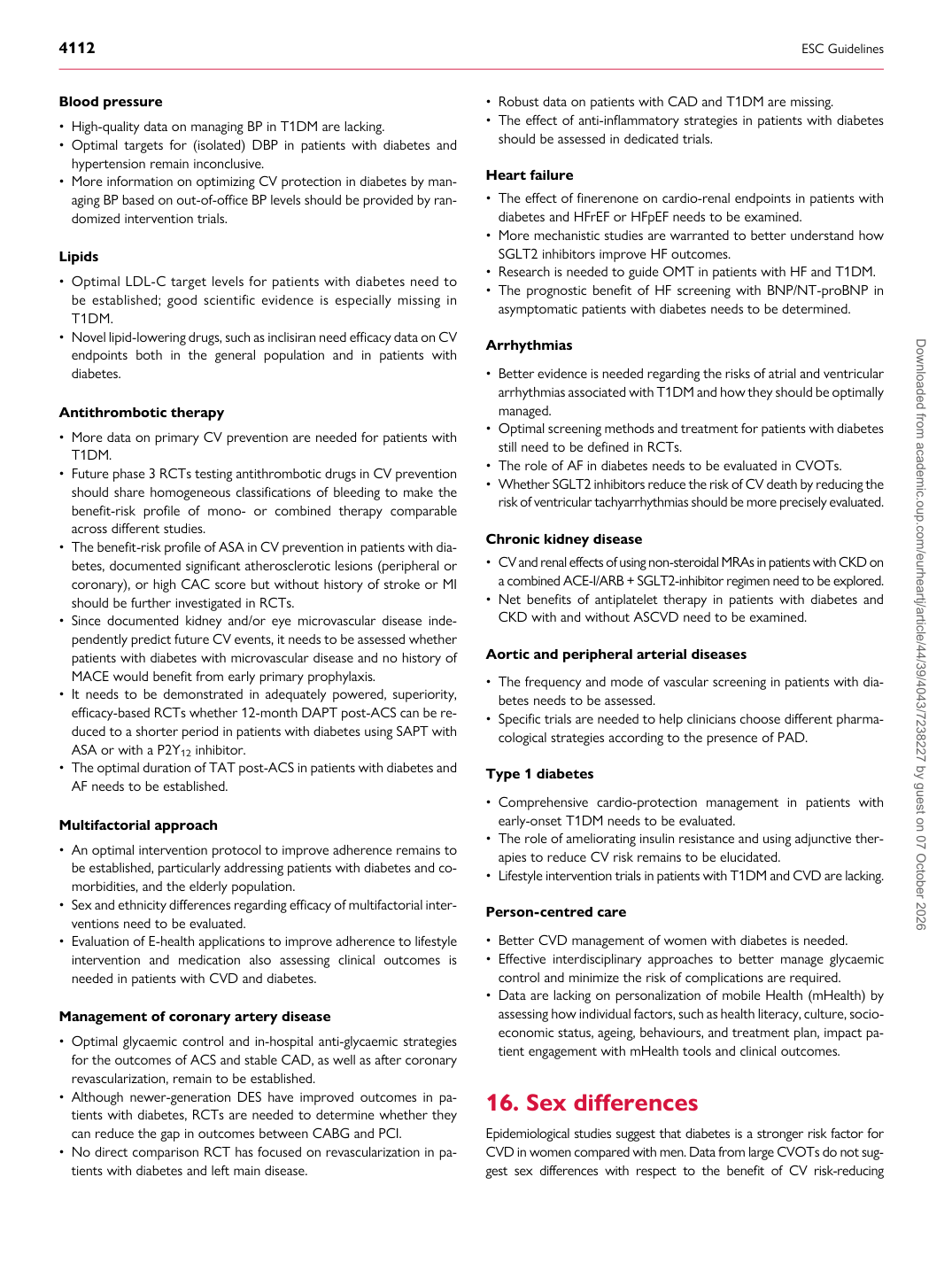
Blood pressure • High-quality data on managing BP in T1DM are lacking. • Optimal targets for (isolated) DBP in patients with diabetes and hypertension remain inconclusive. • More information on optimizing CV protection in diabetes by managing BP based on out-of-office BP levels should be provided by randomized intervention trials.

Lipids • Optimal LDL-C target levels for patients with diabetes need to be established; good scientific evidence is especially missing in T1DM. • Novel lipid-lowering drugs, such as inclisiran need efficacy data on CV endpoints both in the general population and in patients with diabetes.

Antithrombotic therapy • More data on primary CV prevention are needed for patients with T1DM. • Future phase 3 RCTs testing antithrombotic drugs in CV prevention should share homogeneous classifications of bleeding to make the benefit-risk profile of mono- or combined therapy comparable across different studies. • The benefit-risk profile of ASA in CV prevention in patients with diabetes, documented significant atherosclerotic lesions (peripheral or coronary), or high CAC score but without history of stroke or MI should be further investigated in RCTs. • Since documented kidney and/or eye microvascular disease independently predict future CV events, it needs to be assessed whether patients with diabetes with microvascular disease and no history of MACE would benefit from early primary prophylaxis. • It needs to be demonstrated in adequately powered, superiority, efficacy-based RCTs whether 12-month DAPT post-ACS can be reduced to a shorter period in patients with diabetes using SAPT with ASA or with a P2Y12 inhibitor. • The optimal duration of TAT post-ACS in patients with diabetes and AF needs to be established.

Multifactorial approach • An optimal intervention protocol to improve adherence remains to be established, particularly addressing patients with diabetes and comorbidities, and the elderly population. • Sex and ethnicity differences regarding efficacy of multifactorial interventions need to be evaluated. • Evaluation of E-health applications to improve adherence to lifestyle intervention and medication also assessing clinical outcomes is needed in patients with CVD and diabetes.

Management of coronary artery disease • Optimal glycaemic control and in-hospital anti-glycaemic strategies for the outcomes of ACS and stable CAD, as well as after coronary revascularization, remain to be established. • Although newer-generation DES have improved outcomes in patients with diabetes, RCTs are needed to determine whether they can reduce the gap in outcomes between CABG and PCI. • No direct comparison RCT has focused on revascularization in patients with diabetes and left main disease. • Robust data on patients with CAD and T1DM are missing. • The effect of anti-inflammatory strategies in patients with diabetes should be assessed in dedicated trials.

Heart failure • The effect of finerenone on cardio-renal endpoints in patients with diabetes and HFrEF or HFpEF needs to be examined. • More mechanistic studies are warranted to better understand how SGLT2 inhibitors improve HF outcomes. • Research is needed to guide OMT in patients with HF and T1DM. • The prognostic benefit of HF screening with BNP/NT-proBNP in asymptomatic patients with diabetes needs to be determined.

Arrhythmias • Better evidence is needed regarding the risks of atrial and ventricular arrhythmias associated with T1DM and how they should be optimally managed. • Optimal screening methods and treatment for patients with diabetes still need to be defined in RCTs. • The role of AF in diabetes needs to be evaluated in CVOTs. • Whether SGLT2 inhibitors reduce the risk of CV death by reducing the risk of ventricular tachyarrhythmias should be more precisely evaluated.

Chronic kidney disease • CV and renal effects of using non-steroidal MRAs in patients with CKD on a combined ACE-I/ARB + SGLT2-inhibitor regimen need to be explored. • Net benefits of antiplatelet therapy in patients with diabetes and CKD with and without ASCVD need to be examined.

Aortic and peripheral arterial diseases • The frequency and mode of vascular screening in patients with diabetes needs to be assessed. • Specific trials are needed to help clinicians choose different pharmacological strategies according to the presence of PAD.

Type 1 diabetes • Comprehensive cardio-protection management in patients with early-onset T1DM needs to be evaluated. • The role of ameliorating insulin resistance and using adjunctive therapies to reduce CV risk remains to be elucidated. • Lifestyle intervention trials in patients with T1DM and CVD are lacking.

Person-centred care • Better CVD management of women with diabetes is needed. • Effective interdisciplinary approaches to better manage glycaemic control and minimize the risk of complications are required. • Data are lacking on personalization of mobile Health (mHealth) by assessing how individual factors, such as health literacy, culture, socioeconomic status, ageing, behaviours, and treatment plan, impact patient engagement with mHealth tools and clinical outcomes.

16 Sex differences

Epidemiological studies suggest that diabetes is a stronger risk factor for CVD in women compared with men. Data from large CVOTs do not suggest sex differences with respect to the benefit of CV risk-reducing Downloaded from academic.oup.com/eurheartj/article/44/39/4043/7238227 by guest on 07 October 2026