p.68 抽出テキスト
13 Practical guidance

New guidelines and clinical recommendations for treating T2DM are patient centred and evidence based; the clinical picture and risk of cardio-renal complications, rather than HbA1c alone, are the forefront of personalized treatment decisions. The primary therapeutic goals in patients with diabetes and ASCVD or increased risk of CV complications is protecting organs and improving prognosis (Figure 1). Accordingly, these ESC Guidelines on CVD and diabetes are based on the extensive data from large CVOTs of recent years. For patients with T2DM and ASCVD, a wealth of data exists but CV risk reduction in those without ASCVD is less clear. Thus, to provide recommendations for treatment strategies to lower CV risk in patients with T2DM but without ASCVD or severe TOD, an appropriate tool for stratifying risk in these patients is of major importance. Therefore, an extension of SCORE2 for T2DM, named SCORE2-Diabetes, is provided to predict 10-year risk of fatal and non-fatal CVD events (MI, stroke) across four European risk regions in patients without ASCVD or severe TOD.63 Implementation of the current Guidelines should be fostered not only by using respective educational tools developed by the ESC including the ESC Clinical Practice Guideline, but also by integrating it into national electronic health-record systems and digital-based healthcare solutions. The evidence-based concept of the current Guidelines, its key messages, and gaps of evidence as medical needs for future research must be distributed to all healthcare stakeholders, policymakers, politicians, and the general public. Awareness should be raised, respectively, on national and European levels, including in European Union (EU) parliament and responsible commissions. From our point of view, the current Guidelines might provide a blueprint for approaching multimorbid patients with common, chronic, non-communicable diseases such as ASCVD, HF, diabetes, and CKD. Non-communicable diseases are one of the greatest burdens on healthcare systems and societies in Europe and many other areas of the world. Therefore, we hope that the current Guidelines will contribute to the ultimate goal of managing CVD and CV risk in patients with diabetes: to improve patients’ prognosis and health-related quality of life.

14 Key messages

Diagnosis of diabetes • Raised fasting or random glucose, elevated HbA1c, or an abnormal OGTT is diagnostic of diabetes; a single abnormal test is sufficient with symptoms, while two abnormal tests are usually required without symptoms. • Undiagnosed diabetes is common, particularly in individuals with CVD. Therefore, screening for diabetes in all individuals with CVD, including HF, is recommended using HbA1c and/or fasting glucose.

Cardiovascular risk assessment • All patients with diabetes should be evaluated for the presence of ASCVD and severe TOD. • In patients with T2DM without symptomatic ASCVD or severe TOD, 10-year CVD risk via SCORE2-Diabetes should be calculated.

Lifestyle • For smokers, smoking cessation is a primary target of lifestyle intervention in patients with CVD and diabetes. • Exercise should be introduced in all patients with CVD and T2DM, following the paradigm ‘every step counts’. • In patients with obesity and T2DM with or without CVD, reducing weight combined with increasing daily PA through structured exercise sessions are key lifestyle components to improve metabolic control, improve exercise capacity, and reduce clinical outcomes. • A Mediterranean diet supplemented with olive oil and/or nuts reduces the incidence of major CV events in patients with CVD.

Glycaemic targets • Tight glycaemic control reduces short- and long-term microvascular disease. • Tight glycaemic control reduces long-term macrovascular complications (over 20 years). • Hypoglycaemia is associated with adverse CV outcomes and is best avoided.

Glucose-lowering therapy • ASCVD complications are common in patients with T2DM. • Glycaemic status should be systematically evaluated in all patients with or at high risk of CVD, as diabetes status informs many clinical decisions in cardiology. • Independent of baseline HbA1c or additional glucose-lowering agents, selected SGLT2 inhibitors and GLP-1 RAs reduce CV events in patients with T2DM with ASCVD and/or severe TOD.

Blood pressure • BP targets should be individualized for hypertensive patients. • Optimal BP control reduces the risk of micro- and macrovascular complications. • Controlling BP often requires multiple drug therapies with an RAS inhibitor, and a CCB or diuretic. Dual therapy is recommended as firstline treatment. • All hypertensive patients with diabetes, irrespective of their antihypertensive treatments, should monitor their BP at home.

Lipids • Statins remain the first-line and state-of-the-art therapy to decrease LDL-C levels. • Ezetimibe and PCSK9 inhibitors in addition to statins (if treatment targets have not been achieved)—or alone (in case of documented

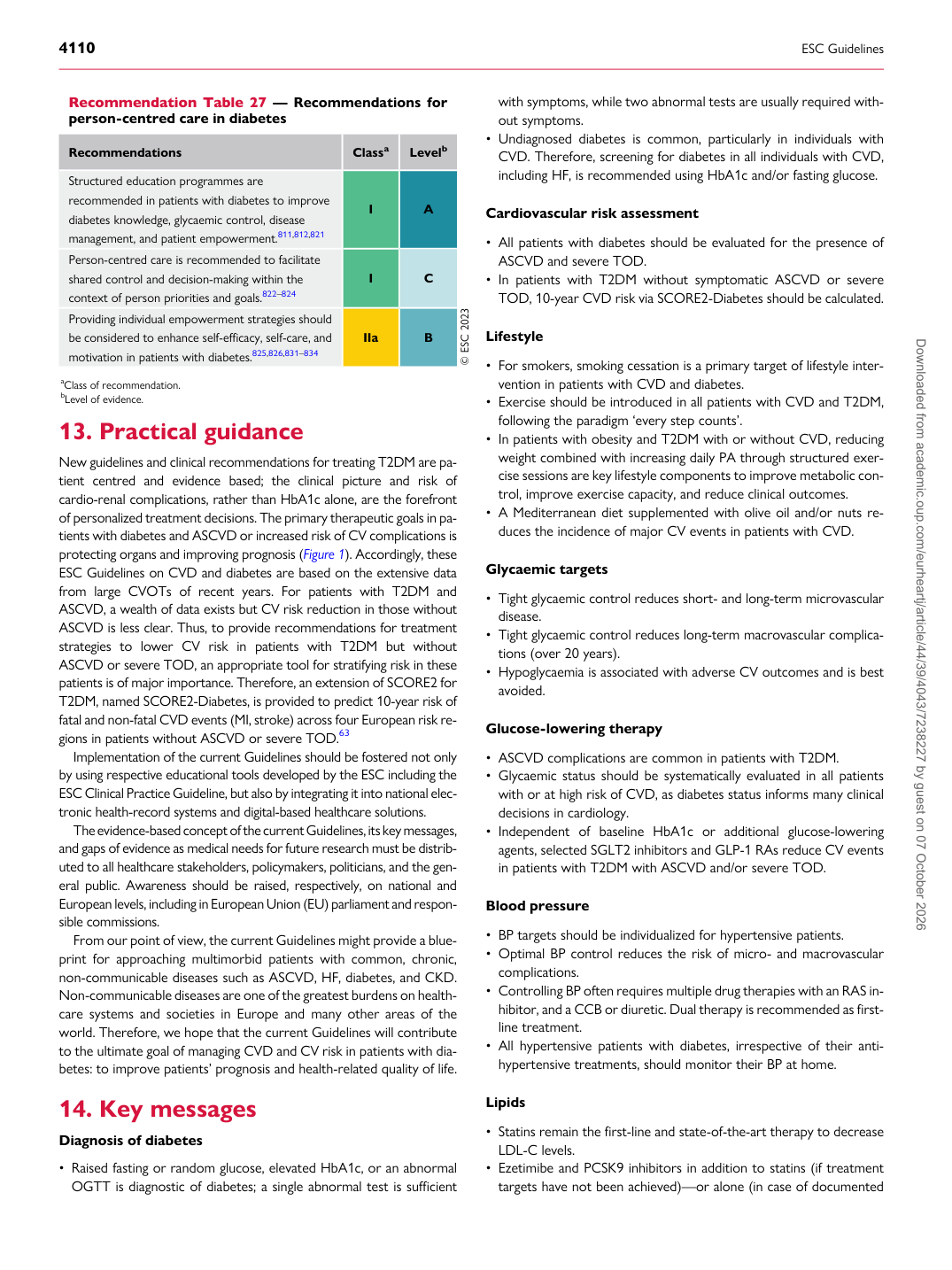
Recommendation Table 27 — Recommendations for person-centred care in diabetes

Recommendations Classa Levelb

Structured education programmes are recommended in patients with diabetes to improve diabetes knowledge, glycaemic control, disease management, and patient empowerment.811,812,821 I A Person-centred care is recommended to facilitate shared control and decision-making within the context of person priorities and goals.822–824 I C Providing individual empowerment strategies should be considered to enhance self-efficacy, self-care, and motivation in patients with diabetes.825,826,831–834 IIa B © ESC 2023 aClass of recommendation. bLevel of evidence. Downloaded from academic.oup.com/eurheartj/article/44/39/4043/7238227 by guest on 07 October 2026