p.66 抽出テキスト
BP, differs in patients with T1DM or T2DM. However, the recommendations are given in the awareness that, in most CVOTs for lipids, BP, antiplatelet agents, and anticoagulation, patients with T1DM were excluded or recruited in small groups. In the following, we summarize recommendations of the respective sections with focus on specific aspects or caveats that should be considered in patients with T1DM.794

11.2.1 Exercise and lifestyle

Data on the effects of exercise on T1DM are inconclusive. Aerobic fitness improved HbA1c in patients with T1DM, but did not affect BMI, BP, and lipids.795

11.2.2 Lipid lowering

Statins remain the cornerstone of lipid-lowering treatment. In patients with T1DM at a younger age, starting statins early might be justified with long duration of disease, two additional risk factors, or microalbuminuria. In the Cholesterol Treatment Trialists’ Collaboration meta-analysis, 1466 patients with T1DM were also included.248 Increased cholesterol absorption in T1DM compared with T2DM may explain why ezetimibe, a drug that directly decreases cholesterol absorption, may reduce LDL-C more in T1DM than in T2DM.796,797

11.2.3 Blood pressure

People with T1DM may benefit from stringent BP-lowering strategies. A recent analysis of the EDC study in patients without known CAD showed that the optimal BP threshold associated with reduced CVD risk was 120/80 mmHg in young adults with childhood-onset T1DM.798 Routine ambulatory BP monitoring is recommended to identify subjects with masked hypertension, as demonstrated in a Finnish study in which one-quarter of patients with T1DM had underlying hypertension and increased arterial stiffness.799

11.2.4 Antiplatelet therapy

Antiplatelet agents may be beneficial in individuals with T1DM without symptomatic ASCVD who have at least one additional major CV risk factor.800

11.3 Glucose-lowering agents beyond

insulin Glucagon-like peptide-1 receptor agonists or SGLT2 inhibitors are currently not indicated for T1DM. Although GLP-1 RAs and SGLT2 inhibitors reduce CV risk in patients with T2DM in large CVOTs, no such data are available for patients with T1DM. For GLP-1 RAs, despite showing potential in reducing HbA1c and weight in patients with T1DM in the ADJUNCT ONE (The Efficacy and Safety of Liraglutide as Adjunct Therapy to Insulin in the Treatment of Type 1 Diabetes) Treat-To-Target trial, concerns have been raised about increased rates of symptomatic hypoglycaemia and hyperglycaemia with ketosis.801 Another RCT in patients with T1DM also showed no significant overall reduction in HbA1c by liraglutide compared with placebo.802 Adding SGLT2 inhibitors at a lower than usual dose to insulin therapy in T1DM may reduce glucose variability and facilitate glucose control, thereby reducing insulin doses and hypoglycaemia.803 However, ketoacidosis at lower glucose levels, so called ‘euglycaemic ketoacidosis’, has been reported in 2–3% of patients with T1DM taking SGLT2 inhibitors.804 This is a potentially lethal complication. 11.4 Renal protection in type 1 diabetes

As in patients with T2DM, patients with T1DM should be regularly screened for kidney disease by assessing eGFR defined by CKD-EPI and UACR.677 RAS blockade with an ACE-I prevents kidney failure in patients with T1DM and overt nephropathy (Section 9).705,805 RAS inhibitors are therefore recommended in patients with T1DM as soon as kidney damage is first clinically evident.

12 Person-centred care

A person-centred approach that encourages and empowers patients to actively take part in finding solutions to their problems is suggested.806 Person-centred care, including shared decision-making, goes beyond maintaining active person consent to decisions and the person’s participation to the development of the therapeutic plan. It shapes disease management to advance the life and health-related quality of life of the person.806,807 It helps people make better healthcare decisions based on their informed preferences in collaboration with their healthcare professionals (HCPs). 806 Person-centred care requires:

• Identifying and integrating patient needs, background, and culture into decisions regarding health practices.808–812 • Active person participation as a key factor for successful selfmanagement.808 This encompasses all kinds of preferences, as well as physical, psychosocial, behavioural, and financial needs in the development of the therapeutic plan.808,813 It also refers to meal planning, planned physical activity, managing symptoms, blood glucose monitoring, medical treatments, and managing episodes of illness and of low and high blood glucose, as well as psychosocial, cultural, and spiritual consequences of health conditions.814–816

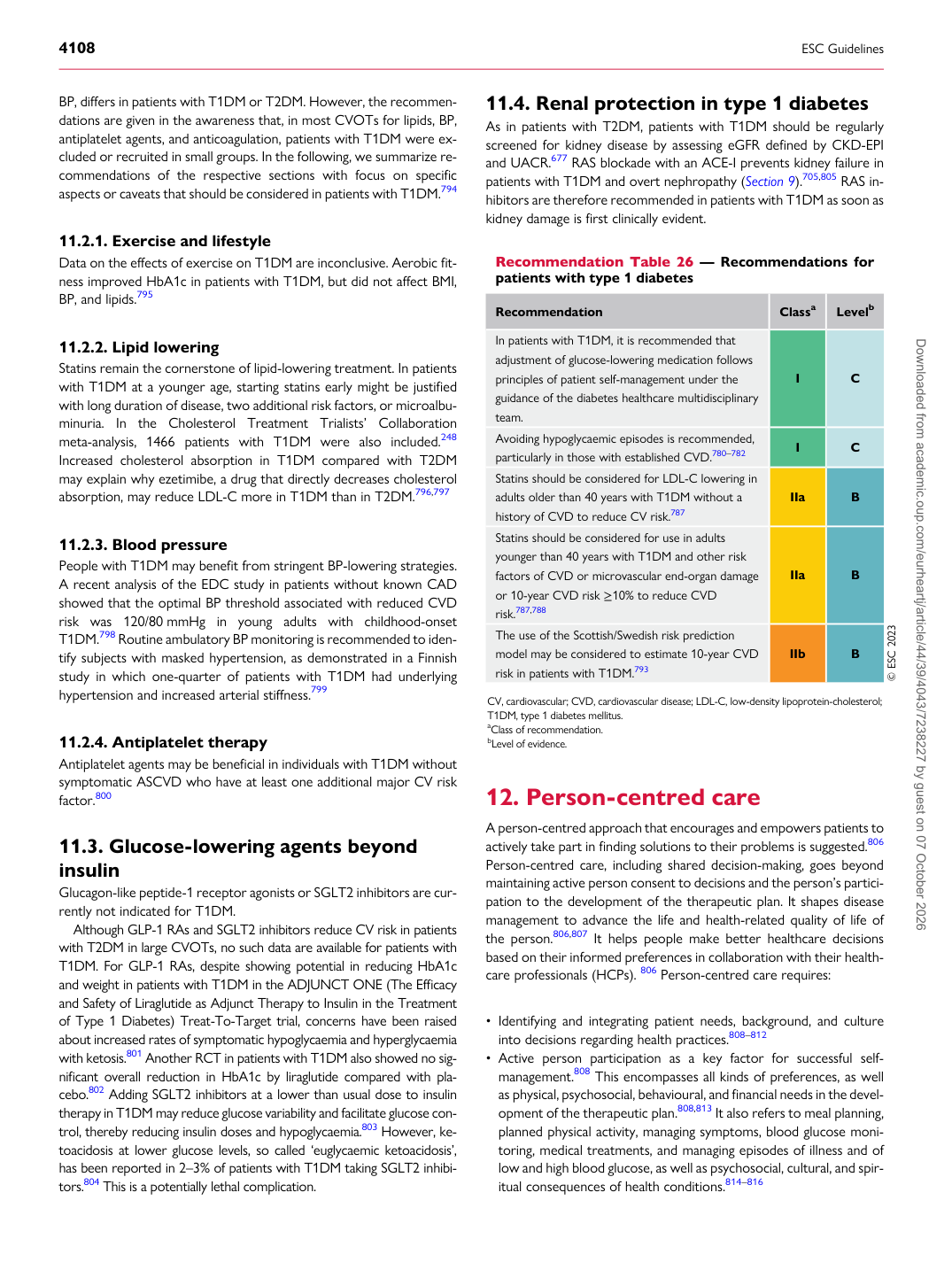
Recommendation Table 26 — Recommendations for patients with type 1 diabetes

Recommendation Classa Levelb

In patients with T1DM, it is recommended that adjustment of glucose-lowering medication follows principles of patient self-management under the guidance of the diabetes healthcare multidisciplinary team. I C Avoiding hypoglycaemic episodes is recommended, particularly in those with established CVD.780–782 I C Statins should be considered for LDL-C lowering in adults older than 40 years with T1DM without a history of CVD to reduce CV risk.787 IIa B Statins should be considered for use in adults younger than 40 years with T1DM and other risk factors of CVD or microvascular end-organ damage or 10-year CVD risk ≥10% to reduce CVD risk.787,788 IIa B The use of the Scottish/Swedish risk prediction model may be considered to estimate 10-year CVD risk in patients with T1DM.793 IIb B © ESC 2023

CV, cardiovascular; CVD, cardiovascular disease; LDL-C, low-density lipoprotein-cholesterol; T1DM, type 1 diabetes mellitus. aClass of recommendation. bLevel of evidence. Downloaded from academic.oup.com/eurheartj/article/44/39/4043/7238227 by guest on 07 October 2026