p.65 抽出テキスト
11 Type 1 diabetes and

cardiovascular disease

This section summarizes evidence-based recommendations to effectively manage CV risk factors in patients with T1DM; the section does not address the control of glucose levels, which must follow the principles of patient self-management under the guidance of the diabetes healthcare multidisciplinary team according to clinical recommendations by EASD/ADA.1 People with T1DM face a three-fold increase in mortality compared with the general population, which translates into an 11-year reduction in life expectancy; CVD mortality accounts for 30–44% of all deaths in patients with T1DM.780–784 The DCCT prospectively investigated not only the impact of an intensified glucose-lowering treatment strategy on microvascular complications in patients with T1DM, but also the rate of macrovascular events at long-term follow-up. This study showed that intensified insulin therapy lasting over a mean of 6.5 years halved the incidence and progression of microvascular sequelae, which was associated with a significant decrease in HbA1c, compared with conventional therapy.126 After a mean follow-up of 17 years in >90% of the initially enrolled patients, CV risk was also significantly reduced by 42% in the intensifiedtreatment group, and the reduction in HbA1c over the first 6.5 years was significantly associated with a reduction in CV risk.785 In the EDIC (Epidemiology of Diabetes Interventions and Complications) study, patients were followed up for over 30 years and the following was concluded: (i) hyperglycaemia is the primary modifiable mediator of late complications in T1DM; (ii) near-normal glucose control reduces the incidence and progression of microvascular complications, such as retinopathy, nephropathy, and neuropathy; and (iii) intensive diabetes therapy reduces CV complications in T1DM.786 Recently, a mediation analysis and multi-variable models of the EDIC trial showed that the quality of adjustment of traditional risk factors accounts for only ∼50% of the cardio-protective effect of improved metabolic control.787 About 40% of the cardio-protective effect remains for HbA1c or elevated glucose concentrations per se. Accordingly, recent analyses from the Swedish National Diabetes Register evaluated the prognostic significance of 17 risk factors for death, acute MI, or stroke. Of the 32 611 patients with T1DM in this Swedish registry cohort, 5.5% died over the course of 10.4 years. The strongest predictors of death and CV endpoints were HbA1c, albuminuria, diabetes duration, systolic BP, and LDL-C concentration.788

Thus, reducing CV risk in patients with T1DM relates to both lowering HbA1c and controlling other classical CV risk factors, including BP and LDL-C. Therefore, glucose control target values are recommended for most adults with T1DM by the joint consensus report of the ADA and EASD: HbA1c <53 mmol/mol or <7.0%; pre-prandial glucose 4.4–7.2 mmol/L or 80–130 mg/dL; and 1–2 h post-prandial glucose <10.0 mmol/L or <180 mg/dL.13 Hypoglycaemia should be avoided, especially in patients with CV complications. Advances in diabetes technologies have started a new era in clinical practice, and the use of CGM has now become widespread. CGM can significantly improve glycaemic control in T1DM, providing more detailed information and introducing new outcome variables including time-in-range and glycaemic variability.138 Management strategies should adapt new therapies and technologies as they become available, according to the wishes and desires of the person with diabetes.

11.1 Cardiovascular risk assessment in

type 1 diabetes With respect to treatment targets and thresholds for other CV risk factors, a critical question is predicting CV risk in patients with T1DM without CVD. Determining ASCVD risk in patients with T1DM is less well studied than in patients with T2DM. In 2011, an observational study using the data from 3661 patients in the Swedish National Diabetes Register proposed a 5-year CVD risk model for use in patients with T1DM.789 More recently, the Steno Type 1 Risk Engine was externally validated at 5 years but lacks validation at 10 years.790 Age at the onset and duration of diabetes are two risk factors that lead the estimation of CV risk. Thus, patients diagnosed with T1DM at an early age show an increased incidence of CVD. In addition, excess mortality in patients diagnosed with T1DM under the age of 10 years, compared with those aged 26–30 years at diagnosis, has been highlighted by a Swedish study.791 This concept has been underlined by the Pittsburgh Epidemiology of Diabetes Complications (EDC) study, which showed duration of diabetes to be an independent risk factor for MACE.791,792 Several other risk factors related to diabetes management, including glycaemic control, insulin requirements, smoking, cardiac autonomic neuropathy, dysfunctional immune response, and insulin resistance, are to be taken into account.788 A recent risk tool, developed based on the Scottish/Swedish Diabetes Registry and validated in the Swedish National Diabetes Register can provide individualized risk predictions.793 This 10-year ASCVD risk prediction tool https://diabepi.shinyapps.io/cvdrisk/ could facilitate risk estimation and discussions with patients with T1DM.

11.2 Managing cardiovascular risk

Analogies of recommendations for risk-factor modifications in patients with T1DM derive from the fact that there is no direct evidence that CV risk reduction by lowering causal CV risk factors, like LDL-C or

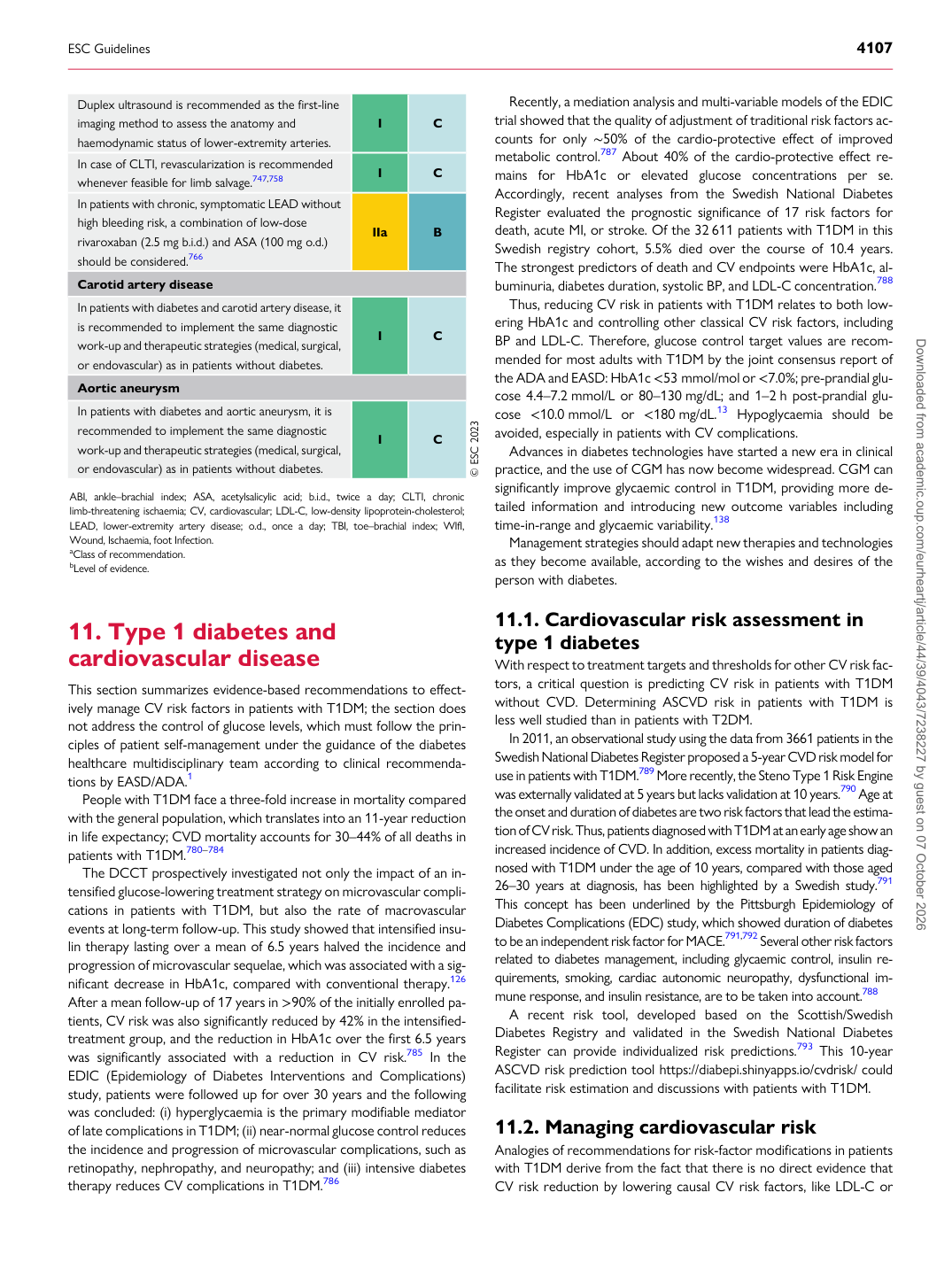
Duplex ultrasound is recommended as the first-line imaging method to assess the anatomy and haemodynamic status of lower-extremity arteries. I C In case of CLTI, revascularization is recommended whenever feasible for limb salvage.747,758 I C In patients with chronic, symptomatic LEAD without high bleeding risk, a combination of low-dose rivaroxaban (2.5 mg b.i.d.) and ASA (100 mg o.d.) should be considered.766 IIa B Carotid artery disease In patients with diabetes and carotid artery disease, it is recommended to implement the same diagnostic work-up and therapeutic strategies (medical, surgical, or endovascular) as in patients without diabetes. I C Aortic aneurysm In patients with diabetes and aortic aneurysm, it is recommended to implement the same diagnostic work-up and therapeutic strategies (medical, surgical, or endovascular) as in patients without diabetes. I C © ESC 2023

ABI, ankle–brachial index; ASA, acetylsalicylic acid; b.i.d., twice a day; CLTI, chronic limb-threatening ischaemia; CV, cardiovascular; LDL-C, low-density lipoprotein-cholesterol; LEAD, lower-extremity artery disease; o.d., once a day; TBI, toe–brachial index; WIfI, Wound, Ischaemia, foot Infection. aClass of recommendation. bLevel of evidence.

ESC Guidelines                                                                                                                                                                                          4107

Downloaded from academic.oup.com/eurheartj/article/44/39/4043/7238227 by guest on 07 October 2026