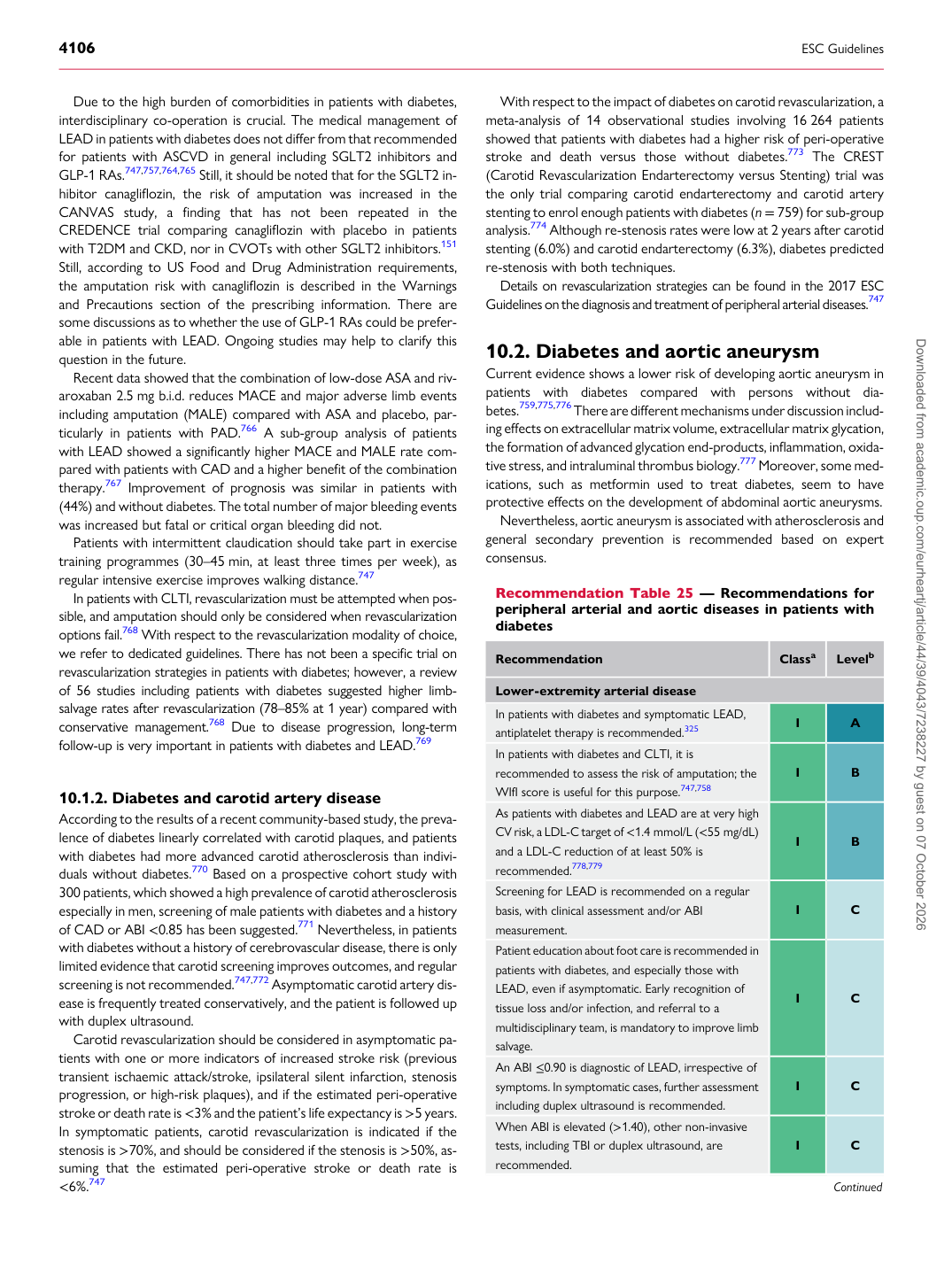
p.64 抽出テキスト
Due to the high burden of comorbidities in patients with diabetes, interdisciplinary co-operation is crucial. The medical management of LEAD in patients with diabetes does not differ from that recommended for patients with ASCVD in general including SGLT2 inhibitors and GLP-1 RAs.747,757,764,765 Still, it should be noted that for the SGLT2 inhibitor canagliflozin, the risk of amputation was increased in the CANVAS study, a finding that has not been repeated in the CREDENCE trial comparing canagliflozin with placebo in patients with T2DM and CKD, nor in CVOTs with other SGLT2 inhibitors.151 Still, according to US Food and Drug Administration requirements, the amputation risk with canagliflozin is described in the Warnings and Precautions section of the prescribing information. There are some discussions as to whether the use of GLP-1 RAs could be preferable in patients with LEAD. Ongoing studies may help to clarify this question in the future. Recent data showed that the combination of low-dose ASA and rivaroxaban 2.5 mg b.i.d. reduces MACE and major adverse limb events including amputation (MALE) compared with ASA and placebo, particularly in patients with PAD.766 A sub-group analysis of patients with LEAD showed a significantly higher MACE and MALE rate compared with patients with CAD and a higher benefit of the combination therapy.767 Improvement of prognosis was similar in patients with (44%) and without diabetes. The total number of major bleeding events was increased but fatal or critical organ bleeding did not. Patients with intermittent claudication should take part in exercise training programmes (30–45 min, at least three times per week), as regular intensive exercise improves walking distance.747 In patients with CLTI, revascularization must be attempted when possible, and amputation should only be considered when revascularization options fail.768 With respect to the revascularization modality of choice, we refer to dedicated guidelines. There has not been a specific trial on revascularization strategies in patients with diabetes; however, a review of 56 studies including patients with diabetes suggested higher limbsalvage rates after revascularization (78–85% at 1 year) compared with conservative management.768 Due to disease progression, long-term follow-up is very important in patients with diabetes and LEAD.769

10.1.2 Diabetes and carotid artery disease

According to the results of a recent community-based study, the prevalence of diabetes linearly correlated with carotid plaques, and patients with diabetes had more advanced carotid atherosclerosis than individuals without diabetes.770 Based on a prospective cohort study with 300 patients, which showed a high prevalence of carotid atherosclerosis especially in men, screening of male patients with diabetes and a history of CAD or ABI <0.85 has been suggested.771 Nevertheless, in patients with diabetes without a history of cerebrovascular disease, there is only limited evidence that carotid screening improves outcomes, and regular screening is not recommended.747,772 Asymptomatic carotid artery disease is frequently treated conservatively, and the patient is followed up with duplex ultrasound. Carotid revascularization should be considered in asymptomatic patients with one or more indicators of increased stroke risk (previous transient ischaemic attack/stroke, ipsilateral silent infarction, stenosis progression, or high-risk plaques), and if the estimated peri-operative stroke or death rate is <3% and the patient’s life expectancy is >5 years. In symptomatic patients, carotid revascularization is indicated if the stenosis is >70%, and should be considered if the stenosis is >50%, assuming that the estimated peri-operative stroke or death rate is <6%.747 With respect to the impact of diabetes on carotid revascularization, a meta-analysis of 14 observational studies involving 16 264 patients showed that patients with diabetes had a higher risk of peri-operative stroke and death versus those without diabetes.773 The CREST (Carotid Revascularization Endarterectomy versus Stenting) trial was the only trial comparing carotid endarterectomy and carotid artery stenting to enrol enough patients with diabetes (n = 759) for sub-group analysis.774 Although re-stenosis rates were low at 2 years after carotid stenting (6.0%) and carotid endarterectomy (6.3%), diabetes predicted re-stenosis with both techniques.

Details on revascularization strategies can be found in the 2017 ESC Guidelines on the diagnosis and treatment of peripheral arterial diseases.747

10.2 Diabetes and aortic aneurysm

Current evidence shows a lower risk of developing aortic aneurysm in patients with diabetes compared with persons without diabetes.759,775,776 There are different mechanisms under discussion including effects on extracellular matrix volume, extracellular matrix glycation, the formation of advanced glycation end-products, inflammation, oxidative stress, and intraluminal thrombus biology.777 Moreover, some medications, such as metformin used to treat diabetes, seem to have protective effects on the development of abdominal aortic aneurysms. Nevertheless, aortic aneurysm is associated with atherosclerosis and general secondary prevention is recommended based on expert consensus.

Recommendation Table 25 — Recommendations for peripheral arterial and aortic diseases in patients with diabetes

Recommendation Classa Levelb

Lower-extremity arterial disease In patients with diabetes and symptomatic LEAD, antiplatelet therapy is recommended.325 I A In patients with diabetes and CLTI, it is recommended to assess the risk of amputation; the WIfI score is useful for this purpose.747,758 I B As patients with diabetes and LEAD are at very high CV risk, a LDL-C target of <1.4 mmol/L (<55 mg/dL) and a LDL-C reduction of at least 50% is recommended.778,779 I B Screening for LEAD is recommended on a regular basis, with clinical assessment and/or ABI measurement. I C Patient education about foot care is recommended in patients with diabetes, and especially those with LEAD, even if asymptomatic. Early recognition of tissue loss and/or infection, and referral to a multidisciplinary team, is mandatory to improve limb salvage. I C An ABI ≤0.90 is diagnostic of LEAD, irrespective of symptoms. In symptomatic cases, further assessment including duplex ultrasound is recommended. I C When ABI is elevated (>1.40), other non-invasive tests, including TBI or duplex ultrasound, are recommended. I C

Continued Downloaded from academic.oup.com/eurheartj/article/44/39/4043/7238227 by guest on 07 October 2026