p.62 抽出テキスト
10 Aortic and peripheral arterial

diseases and diabetes

10.1 The impact of diabetes on peripheral

atherosclerosis Diabetes is one of the most important risk factors for the development and progression of atherosclerosis.747–751 The number of patients with atherosclerosis associated with diabetes is steadily increasing alongside the increasing number of patients with diabetes worldwide. Peripheral atherosclerosis summarizes LEAD and carotid atherosclerosis.

10.1.1 Diabetes and lower-extremity artery disease

The impact of diabetes differs between vascular territories.747 The strong correlation between LEAD and diabetes is well established.747–749 Up to 30% of all patients with intermittent claudication and ∼50–70% of patients with chronic limb-threatening ischaemia (CLTI) have diabetes.750,752 Patients with diabetes and LEAD show specific anatomic and morphologic characteristics, which are important for further management.753 In addition, patients with diabetes have occlusions of arteries below the knee more often than do patients without diabetes. Moreover, severe calcification, such as media sclerosis and development of collateral circulation, is typical for these patients.753

Compared with patients without diabetes, those with diabetes develop LEAD at a younger age and have faster LEAD progression, with more patients having CLTI. Prolonged diabetes duration, suboptimal glycaemic control, co-existing CV risk factors, and other end-organ damage (e.g. proteinuria) increase the prevalence of LEAD.751 Moreover, patients with microangiopathy are at increased risk of CLTI and major amputation.754,755 In a cohort study with 125 674 participants, the presence of microvascular disease such as retinopathy, nephropathy, or neuropathy independently increased the risk of amputation.754 For patients with a diabetic foot ulcer (diabetic foot disease), the risk of death at 5 years is 2.5 times higher than for patients with diabetes but no foot ulcer.752,756 In patients with diabetes, pain is often masked because of peripheral neuropathy with decreased pain sensitivity. Therefore, atherosclerosis is often advanced when diagnosed. CLTI is the clinical presentation of advanced disease, characterized by ischaemic rest pain; however, pain may be absent in patients with diabetes. The 2017 ESC Guidelines on the diagnosis and treatment of peripheral arterial diseases and the 2019 Global Vascular Guidelines on the management of chronic limb-threatening ischaemia proposed the Wound, Ischaemia, and foot Infection (WIfI) classification to stratify amputation risk and the potential benefits of revascularization (Supplementary data online, Table S17).747,757,758 Patients with diabetes and critical limb ischaemia are at very high risk of lowerlimb amputation and recurrent wounds. All of these factors increase the risk of limb infection. Although 20–30% of patients with diabetes have LEAD, more than half of these have no clinical symptoms.760 Therefore, screening and early diagnosis is important to allow early treatment and prevent major amputation. Clinical evaluation includes medical history, assessing symptoms, palpating peripheral pulses, and evaluating skin colour and temperature. In addition, examination for neuropathy is important; however, the sensitivity of clinical examination is limited.761 Therefore, screening for LEAD is indicated in patients with diabetes and foot ulceration.747,761 There is a lack of evidence concerning the frequency of screening for LEAD in patients with diabetes, but it seems plausible to assess leg perfusion regularly. An ankle–brachial index (ABI) ≤0.90 is diagnostic for LEAD, with 80% sensitivity and 95% specificity in all populations.760,762 However, the accuracy of ABI is lower in patients with diabetes.762,763 Beyond LEAD, an ABI ≤0.90 (or >1.40) is associated with an increased risk of death and CV events.762,763 Measuring ABI can be difficult due to medial calcinosis (ABI >1.40), in which case, other tests are useful for diagnosing LEAD, including Doppler waveform analysis of the ankle arteries, or the toe–brachial index (TBI), which may be helpful because medial calcinosis barely affects digital arteries. A TBI <0.70 is diagnostic for LEAD.747,763 In patients with intermittent claudication, a treadmill test is useful for assessing walking distance.747 Duplex scan is the first-line imaging for confirming LEAD and should be performed at least when revascularization is indicated. Magnetic resonance angiography or CT angiography can also help to plan further treatment (Figure 20).

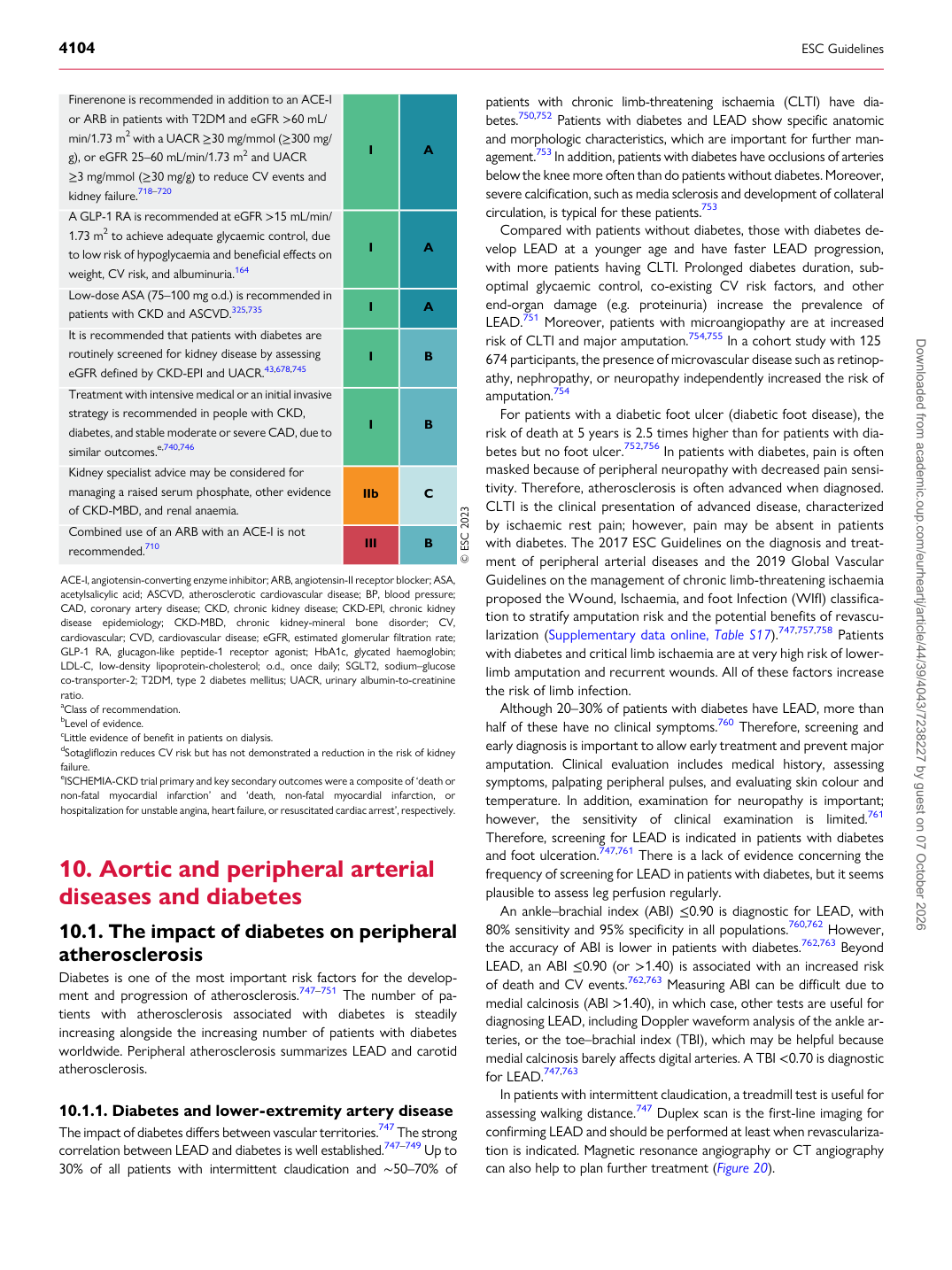
Finerenone is recommended in addition to an ACE-I or ARB in patients with T2DM and eGFR >60 mL/ min/1.73 m2 with a UACR ≥30 mg/mmol (≥300 mg/ g), or eGFR 25–60 mL/min/1.73 m2 and UACR ≥3 mg/mmol (≥30 mg/g) to reduce CV events and kidney failure.718–720 I A A GLP-1 RA is recommended at eGFR >15 mL/min/ 1.73 m2 to achieve adequate glycaemic control, due to low risk of hypoglycaemia and beneficial effects on weight, CV risk, and albuminuria.164 I A Low-dose ASA (75–100 mg o.d.) is recommended in patients with CKD and ASCVD.325,735 I A It is recommended that patients with diabetes are routinely screened for kidney disease by assessing eGFR defined by CKD-EPI and UACR.43,678,745 I B Treatment with intensive medical or an initial invasive strategy is recommended in people with CKD, diabetes, and stable moderate or severe CAD, due to similar outcomes.e,740,746 I B Kidney specialist advice may be considered for managing a raised serum phosphate, other evidence of CKD-MBD, and renal anaemia. IIb C Combined use of an ARB with an ACE-I is not recommended.710 III B © ESC 2023 ACE-I, angiotensin-converting enzyme inhibitor; ARB, angiotensin-II receptor blocker; ASA, acetylsalicylic acid; ASCVD, atherosclerotic cardiovascular disease; BP, blood pressure; CAD, coronary artery disease; CKD, chronic kidney disease; CKD-EPI, chronic kidney disease epidemiology; CKD-MBD, chronic kidney-mineral bone disorder; CV, cardiovascular; CVD, cardiovascular disease; eGFR, estimated glomerular filtration rate; GLP-1 RA, glucagon-like peptide-1 receptor agonist; HbA1c, glycated haemoglobin; LDL-C, low-density lipoprotein-cholesterol; o.d., once daily; SGLT2, sodium–glucose co-transporter-2; T2DM, type 2 diabetes mellitus; UACR, urinary albumin-to-creatinine ratio. aClass of recommendation. bLevel of evidence. cLittle evidence of benefit in patients on dialysis. dSotagliflozin reduces CV risk but has not demonstrated a reduction in the risk of kidney failure. eISCHEMIA-CKD trial primary and key secondary outcomes were a composite of ‘death or non-fatal myocardial infarction’ and ‘death, non-fatal myocardial infarction, or hospitalization for unstable angina, heart failure, or resuscitated cardiac arrest’, respectively. Downloaded from academic.oup.com/eurheartj/article/44/39/4043/7238227 by guest on 07 October 2026