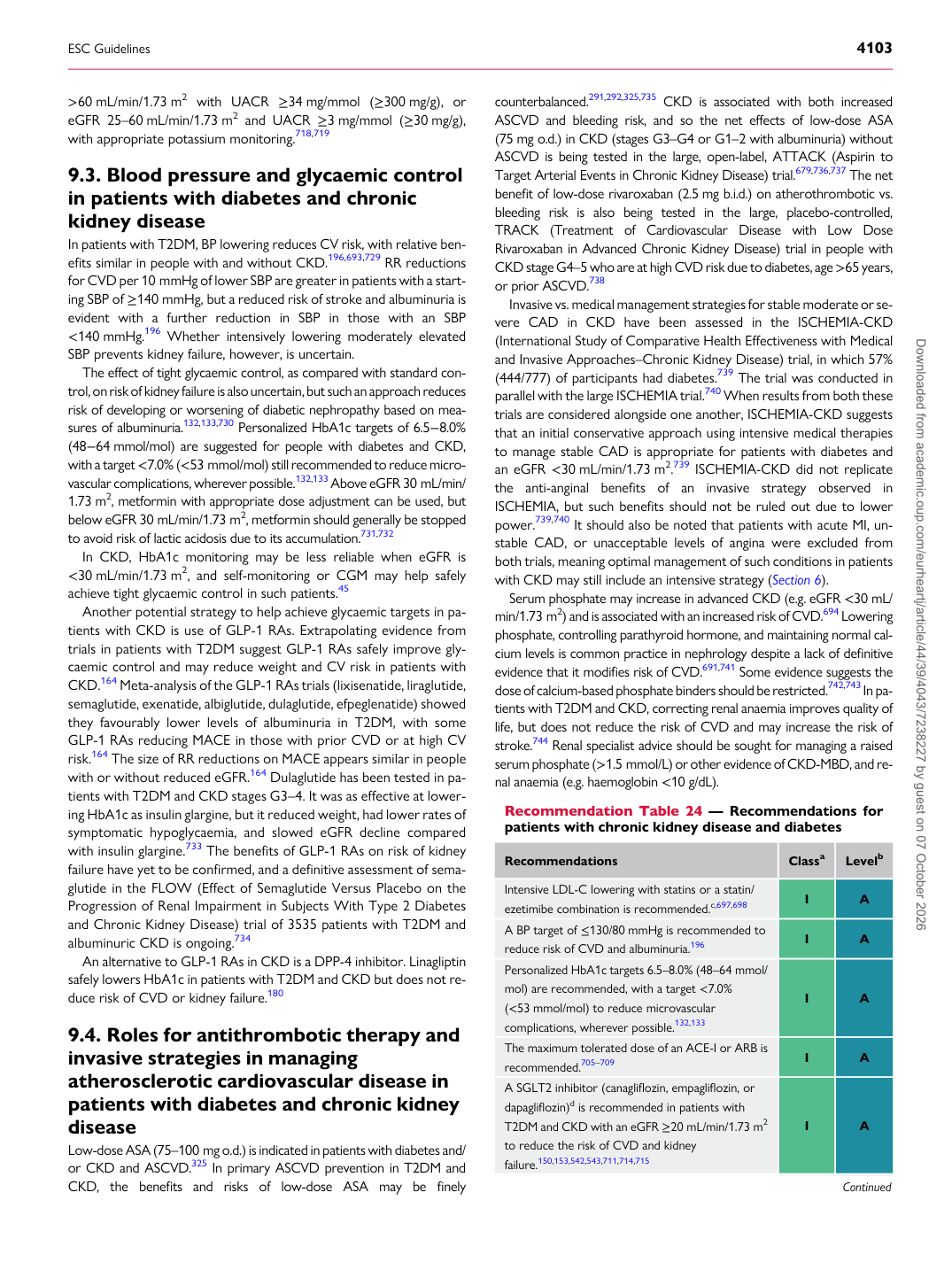
p.61 抽出テキスト
>60 mL/min/1.73 m2 with UACR ≥34 mg/mmol (≥300 mg/g), or eGFR 25–60 mL/min/1.73 m2 and UACR ≥3 mg/mmol (≥30 mg/g), with appropriate potassium monitoring.718,719

9.3 Blood pressure and glycaemic control

in patients with diabetes and chronic kidney disease In patients with T2DM, BP lowering reduces CV risk, with relative benefits similar in people with and without CKD.196,693,729 RR reductions for CVD per 10 mmHg of lower SBP are greater in patients with a starting SBP of ≥140 mmHg, but a reduced risk of stroke and albuminuria is evident with a further reduction in SBP in those with an SBP <140 mmHg.196 Whether intensively lowering moderately elevated SBP prevents kidney failure, however, is uncertain. The effect of tight glycaemic control, as compared with standard control, on risk of kidney failure is also uncertain, but such an approach reduces risk of developing or worsening of diabetic nephropathy based on measures of albuminuria.132,133,730 Personalized HbA1c targets of 6.5−8.0% (48−64 mmol/mol) are suggested for people with diabetes and CKD, with a target <7.0% (<53 mmol/mol) still recommended to reduce microvascular complications, wherever possible.132,133 Above eGFR 30 mL/min/ 1.73 m2, metformin with appropriate dose adjustment can be used, but below eGFR 30 mL/min/1.73 m2, metformin should generally be stopped to avoid risk of lactic acidosis due to its accumulation.731,732 In CKD, HbA1c monitoring may be less reliable when eGFR is <30 mL/min/1.73 m2, and self-monitoring or CGM may help safely achieve tight glycaemic control in such patients.45 Another potential strategy to help achieve glycaemic targets in patients with CKD is use of GLP-1 RAs. Extrapolating evidence from trials in patients with T2DM suggest GLP-1 RAs safely improve glycaemic control and may reduce weight and CV risk in patients with CKD.164 Meta-analysis of the GLP-1 RAs trials (lixisenatide, liraglutide, semaglutide, exenatide, albiglutide, dulaglutide, efpeglenatide) showed they favourably lower levels of albuminuria in T2DM, with some GLP-1 RAs reducing MACE in those with prior CVD or at high CV risk.164 The size of RR reductions on MACE appears similar in people with or without reduced eGFR.164 Dulaglutide has been tested in patients with T2DM and CKD stages G3–4. It was as effective at lowering HbA1c as insulin glargine, but it reduced weight, had lower rates of symptomatic hypoglycaemia, and slowed eGFR decline compared with insulin glargine.733 The benefits of GLP-1 RAs on risk of kidney failure have yet to be confirmed, and a definitive assessment of semaglutide in the FLOW (Effect of Semaglutide Versus Placebo on the Progression of Renal Impairment in Subjects With Type 2 Diabetes and Chronic Kidney Disease) trial of 3535 patients with T2DM and albuminuric CKD is ongoing.734 An alternative to GLP-1 RAs in CKD is a DPP-4 inhibitor. Linagliptin safely lowers HbA1c in patients with T2DM and CKD but does not reduce risk of CVD or kidney failure.180

9.4 Roles for antithrombotic therapy and

invasive strategies in managing atherosclerotic cardiovascular disease in patients with diabetes and chronic kidney disease Low-dose ASA (75–100 mg o.d.) is indicated in patients with diabetes and/ or CKD and ASCVD.325 In primary ASCVD prevention in T2DM and CKD, the benefits and risks of low-dose ASA may be finely counterbalanced.291,292,325,735 CKD is associated with both increased ASCVD and bleeding risk, and so the net effects of low-dose ASA (75 mg o.d.) in CKD (stages G3–G4 or G1–2 with albuminuria) without ASCVD is being tested in the large, open-label, ATTACK (Aspirin to Target Arterial Events in Chronic Kidney Disease) trial.679,736,737 The net benefit of low-dose rivaroxaban (2.5 mg b.i.d.) on atherothrombotic vs. bleeding risk is also being tested in the large, placebo-controlled, TRACK (Treatment of Cardiovascular Disease with Low Dose Rivaroxaban in Advanced Chronic Kidney Disease) trial in people with CKD stage G4–5 who are at high CVD risk due to diabetes, age >65 years, or prior ASCVD.738

Invasive vs. medical management strategies for stable moderate or severe CAD in CKD have been assessed in the ISCHEMIA-CKD (International Study of Comparative Health Effectiveness with Medical and Invasive Approaches–Chronic Kidney Disease) trial, in which 57% (444/777) of participants had diabetes.739 The trial was conducted in parallel with the large ISCHEMIA trial.740 When results from both these trials are considered alongside one another, ISCHEMIA-CKD suggests that an initial conservative approach using intensive medical therapies to manage stable CAD is appropriate for patients with diabetes and an eGFR <30 mL/min/1.73 m2.739 ISCHEMIA-CKD did not replicate the anti-anginal benefits of an invasive strategy observed in ISCHEMIA, but such benefits should not be ruled out due to lower power.739,740 It should also be noted that patients with acute MI, unstable CAD, or unacceptable levels of angina were excluded from both trials, meaning optimal management of such conditions in patients with CKD may still include an intensive strategy (Section 6). Serum phosphate may increase in advanced CKD (e.g. eGFR <30 mL/ min/1.73 m2) and is associated with an increased risk of CVD.694 Lowering phosphate, controlling parathyroid hormone, and maintaining normal calcium levels is common practice in nephrology despite a lack of definitive evidence that it modifies risk of CVD.691,741 Some evidence suggests the dose of calcium-based phosphate binders should be restricted.742,743 In patients with T2DM and CKD, correcting renal anaemia improves quality of life, but does not reduce the risk of CVD and may increase the risk of stroke.744 Renal specialist advice should be sought for managing a raised serum phosphate (>1.5 mmol/L) or other evidence of CKD-MBD, and renal anaemia (e.g. haemoglobin <10 g/dL).

Recommendation Table 24 — Recommendations for patients with chronic kidney disease and diabetes

Recommendations Classa Levelb

Intensive LDL-C lowering with statins or a statin/ ezetimibe combination is recommended.c,697,698 I A A BP target of ≤130/80 mmHg is recommended to reduce risk of CVD and albuminuria.196 I A Personalized HbA1c targets 6.5–8.0% (48–64 mmol/ mol) are recommended, with a target <7.0% (<53 mmol/mol) to reduce microvascular complications, wherever possible.132,133 I A The maximum tolerated dose of an ACE-I or ARB is recommended.705–709 I A A SGLT2 inhibitor (canagliflozin, empagliflozin, or dapagliflozin)d is recommended in patients with T2DM and CKD with an eGFR ≥20 mL/min/1.73 m2 to reduce the risk of CVD and kidney failure.150,153,542,543,711,714,715 I A

Continued

ESC Guidelines                                                                                                                                                                                          4103

Downloaded from academic.oup.com/eurheartj/article/44/39/4043/7238227 by guest on 07 October 2026