p.57 抽出テキスト
diabetes (adjusted HR 2.90; 95% CI, 1.89–4.46).646 Men at all ages have a higher risk of SCD than women, but in the presence of diabetes, the risk of SCD is higher in both men and women.575,615,644–646,648 Both hyperglycaemia and hypoglycaemia are independently associated with increased risk of ventricular arrhythmias.649 Insulin-induced hypoglycaemia has been associated with nocturnal death (also called ‘dead-in-bed syndrome’) in T1DM, and arrhythmic deaths were reported in several T2DM trials.187,576,650–654 Diabetic kidney disease might also play a role in the arrhythmia-associated mechanism of sudden death in this setting.655 Hypoglycaemia-associated arrhythmias are difficult to document, but observational studies using CGM and Holter monitoring in small T2DM cohorts showed that hypoglycaemic episodes were common, often asymptomatic, and associated with various arrhythmias.656,657 Compared with daytime hypoglycaemia, nocturnal episodes were more common and associated with a greater risk of bradycardia or atrial ectopy, while ventricular arrhythmias were equally common.656,657 The use of antiarrhythmic drugs should follow the general principles and precautions related to pharmacological treatment of cardiac arrhythmias.600,658 In patients with diabetes and an ICD, there is an increased risk of death in those who have appropriate therapy compared to those who do not.659 In contrast, patients with diabetes may have a lower risk of inappropriate therapy or ICD shock, since they may be more sedentary with consequently less frequent exercise-induced sinus tachycardia and also lower incidence of lead fracture.600,658,659 Observational studies have reported significant corrected QT (QTc) interval prolongation possibly associated with microvascular complications, atypical patterns of microvolt T-wave alternans, altered heart rate variability, or heart rate turbulence in patients with diabetes, but none of these tests should routinely be used to stratify the risk of ventricular arrhythmias or SCD in clinical practice.658,660–668 There may also be a direct effect of both hyper- and hypoglycaemia on QTc interval.669–671 The mechanisms by which hyperglycaemia may produce ventricular instability may be increased sympathetic activity, increased cytosolic calcium content in myocytes, or both.672 The risk of cardiac events is usually related to the underlying heart disease rather than ventricular premature beats.669–671 There is no diabetes-specific protocol for SCD screening, but all patients diagnosed with diabetes should undergo regular evaluation for CV risk factors or structural heart disease.48,576,658 Patients with diabetes and symptoms suggestive of cardiac arrhythmias (e.g. palpitations, pre-syncope, or syncope) should undergo further detailed diagnostic assessment.576 Patients with diabetes and frequent premature ventricular beats, episodes of non-sustained ventricular tachycardia, or symptoms suggestive of HF should be examined for the presence of an underlying structural heart disease and their eligibility for an ICD should be assessed; this is a general principle in managing patients with HF, irrespective of diabetes status.658 In case of sustained ventricular arrhythmias, diagnosing underlying structural heart disease with imaging techniques and coronary angiography is usually needed if no obvious trigger factors, such as electrolyte imbalance, can be identified.48,576,658 Although cardiac arrhythmias were not specifically investigated in either the LEADER or the EMPA-REG OUTCOME trials, an antiarrhythmic effect of these drugs (perhaps mediated by glucagon-release stimulation or increased blood ketone bodies, which may have sympathico-suppressive effects) has been hypothesized to contribute to the reduced risk of CV death.71,72 In the DAPA-HF trial, dapagliflozin reduced the risk of the composite outcome of serious ventricular arrhythmia, resuscitated cardiac arrest, or sudden death by 21% in patients with HFrEF, compared with placebo.673 The benefit was mainly observed >9 months post-randomization, suggesting that the beneficial effects of dapagliflozin require time to develop and may involve cellular mechanisms that slow the progression of HFrEF.674 However, a recent meta-analysis indicated that SGLT2 inhibition was not associated with an overall lower risk of SCD or ventricular arrhythmias in patients with T2DM and/or HF and/or CKD, although the point estimates suggested potential benefits.675

9 Chronic kidney disease and

diabetes

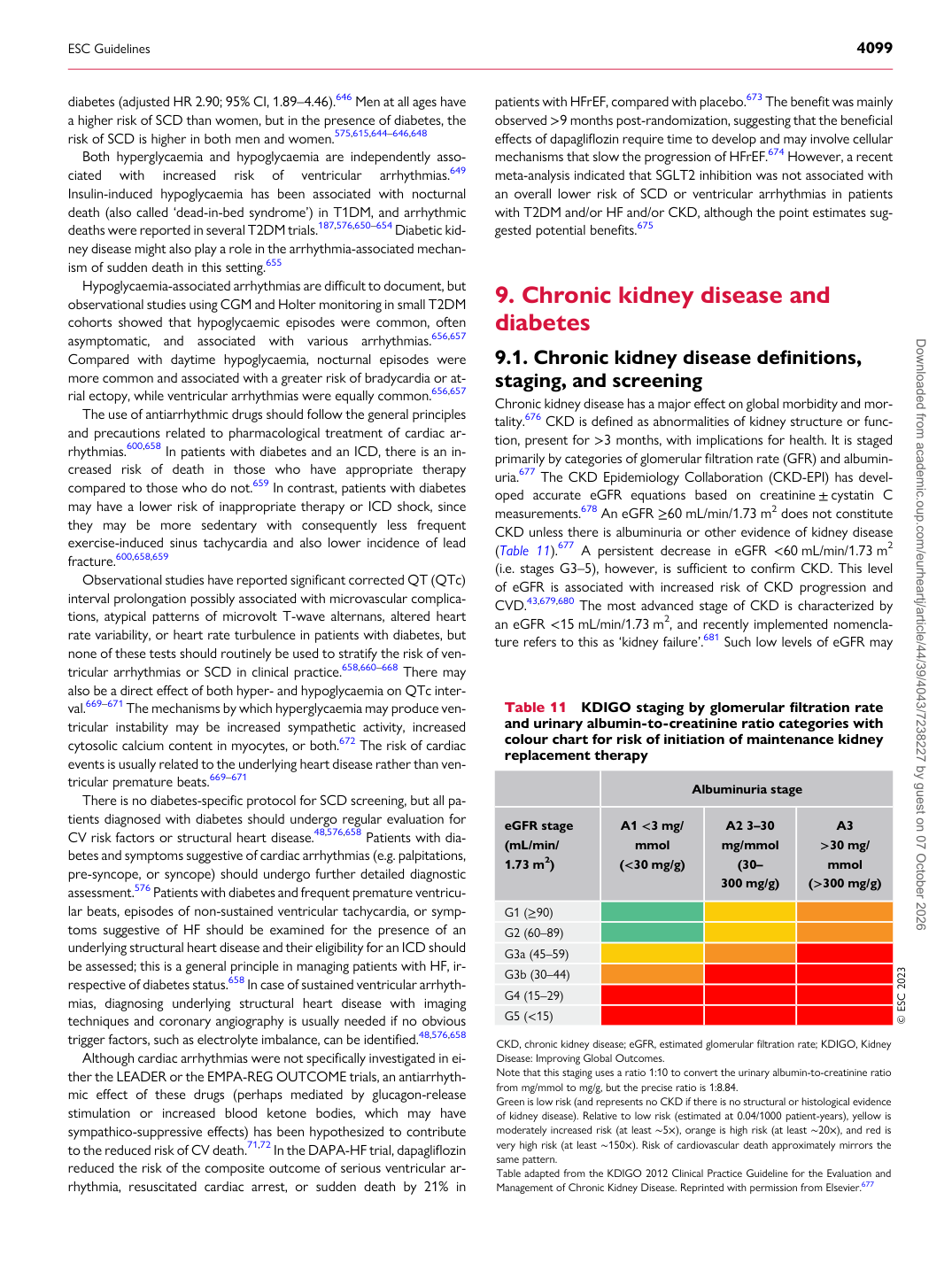
9.1. Chronic kidney disease definitions, staging, and screening Chronic kidney disease has a major effect on global morbidity and mortality.676 CKD is defined as abnormalities of kidney structure or function, present for >3 months, with implications for health. It is staged primarily by categories of glomerular filtration rate (GFR) and albuminuria.677 The CKD Epidemiology Collaboration (CKD-EPI) has developed accurate eGFR equations based on creatinine ± cystatin C measurements.678 An eGFR ≥60 mL/min/1.73 m2 does not constitute CKD unless there is albuminuria or other evidence of kidney disease (Table 11).677 A persistent decrease in eGFR <60 mL/min/1.73 m2 (i.e. stages G3–5), however, is sufficient to confirm CKD. This level of eGFR is associated with increased risk of CKD progression and CVD.43,679,680 The most advanced stage of CKD is characterized by an eGFR <15 mL/min/1.73 m2, and recently implemented nomenclature refers to this as ‘kidney failure’.681 Such low levels of eGFR may

Table 11 KDIGO staging by glomerular filtration rate and urinary albumin-to-creatinine ratio categories with colour chart for risk of initiation of maintenance kidney replacement therapy

Albuminuria stage

eGFR stage (mL/min/

1.73 m2) A1 <3 mg/

mmol (<30 mg/g) A2 3–30

mg/mmol (30– 300 mg/g) A3

>30 mg/ mmol (>300 mg/g)

G1 (≥90) G2 (60–89) G3a (45–59) G3b (30–44) G4 (15–29) G5 (<15) © ESC 2023

CKD, chronic kidney disease; eGFR, estimated glomerular filtration rate; KDIGO, Kidney Disease: Improving Global Outcomes. Note that this staging uses a ratio 1:10 to convert the urinary albumin-to-creatinine ratio from mg/mmol to mg/g, but the precise ratio is 1:8.84. Green is low risk (and represents no CKD if there is no structural or histological evidence of kidney disease). Relative to low risk (estimated at 0.04/1000 patient-years), yellow is moderately increased risk (at least ∼5×), orange is high risk (at least ∼20×), and red is very high risk (at least ∼150×). Risk of cardiovascular death approximately mirrors the same pattern. Table adapted from the KDIGO 2012 Clinical Practice Guideline for the Evaluation and Management of Chronic Kidney Disease. Reprinted with permission from Elsevier.677

ESC Guidelines                                                                                                                                                                                          4099

Downloaded from academic.oup.com/eurheartj/article/44/39/4043/7238227 by guest on 07 October 2026