p.56 抽出テキスト
be well documented using surface-lead ECG (≥30 s showing heart rhythm with no discernible repeating P waves and irregular R–R intervals when atrioventricular conduction is not impaired; Figure 17).600,614 In patients with diabetes and established AF, controlling the ventricular rate is recommended to decrease symptoms and prevent AF-related complications, while asymptomatic patients mainly need thromboembolic prevention. In those with persistent symptoms despite adequate rate control, or in those with LV dysfunction attributable to poorly controlled high ventricular rate, rhythm-control strategies should be attempted, including cardioversion, antiarrhythmic drug use, and catheter ablation, which is the general management in this setting whether diabetes is present or not.600,615–617 For details on managing AF, please refer to the 2020 ESC/EACTS Guidelines for the diagnosis and management of atrial fibrillation and recent European Heart Rhythm Association scientific documents.577,600,613

8.1.3 Preventing stroke in patients with atrial

fibrillation and diabetes Stratifying AF stroke risk with diabetes should use the established CHA2DS2-VASc (Congestive HF, Hypertension, Age ≥75 years [2 points], Diabetes mellitus, Stroke/transient ischaemic attack [2 points], Vascular disease, Age [65–74 years], Sex category [female]) score; following stratification, stroke prevention (i.e. OAC) should be started in patients with >1 risk factor.600,618 The score is likely higher in patients with diabetes due to the common association with other risk factors for stroke, such as arterial hypertension, age over 65 or 75 years, associated vascular disease, or HF. Several studies found that diabetes independently predicted stroke in patients with AF.619 However, diabetes may not be a significant risk factor for stroke in the elderly.620 The Stroke in AF Working Group attributed a RR of 1.7 (95% CI, 1.4– 2.0) for stroke in patients with AF and diabetes, as well as an absolute stroke risk of 2–3.5% per year for non-anticoagulated patients in the same population.621 Diabetes is probably not the most potent independent risk factor for stroke in AF compared with the other items in the CHA2DS2-VASc score, but it is included in this risk-stratification tool, giving a point alongside most other items.600,618,622–624 The increased risk of stroke associated with AF and diabetes is similar in T1DM and T2DM except perhaps a slightly increased risk in T2DM compared with T1DM in patients <65 years of age. The risk of stroke in patients with diabetes and AF may increase with longer diabetes duration, increasing levels of HbA1c, and more diabetes-related comorbidities, such as nephropathy and retinopathy.625,626 As an OAC is being initiated, a clinical bleeding risk score, such as the HAS-BLED (Hypertension, Abnormal renal/liver function, Stroke, Bleeding history or predisposition, Labile international normalized ratio, Elderly [>65 years], Drugs/alcohol concomitantly) score, should be used to identify patients at risk of bleeding, and importantly, to address the potentially reversible bleeding risk factors (that should be considered in all patients, irrespective of HAS-BLED score).600 Due to the increased risk of several CV adverse events in patients with diabetes, a similar RR reduction with OACs generally translates into greater ARR in the diabetes population.577 The beneficial efficacy and safety of NOACs compared with warfarin seem conserved in patients with AF and diabetes, irrespective of their baseline stroke risk or the presence of other CV risk factors.577,627–629 8.2 Ventricular arrhythmias and risk of

sudden cardiac death and diabetes Compared with the general population, patients with diabetes have an increased risk of both SCD and non-SCD.575,615,644–646 In a meta-analysis of 14 studies involving 346 356 participants and 5647 SCD cases, the risk of SCD was two-fold higher in patients with diabetes compared with patients without diabetes (adjusted HR 2.25; 95% CI, 1.70–2.97).647 However, patients with diabetes also exhibited a nearly three-fold greater risk of non-SCD than patients without

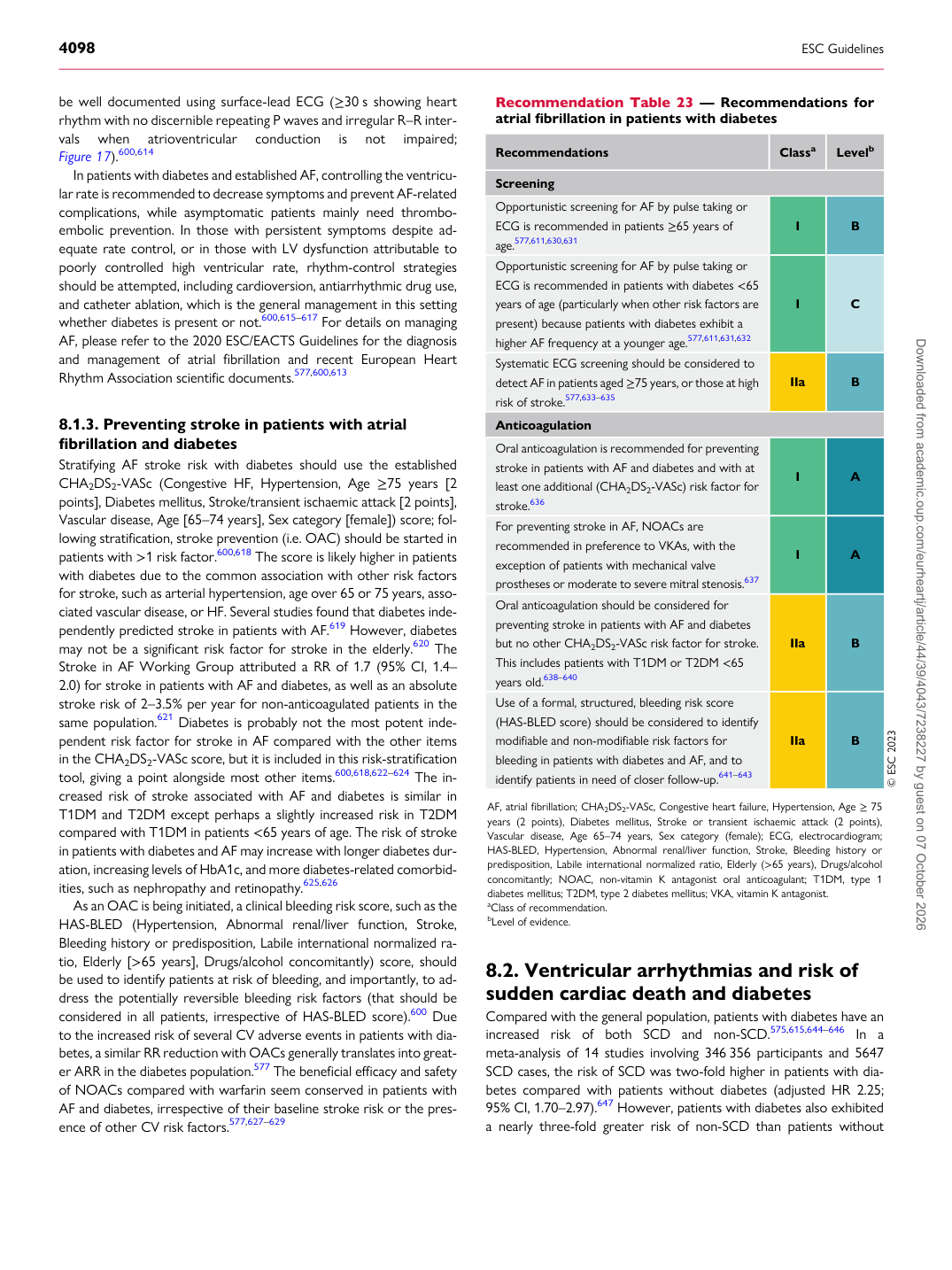
Recommendation Table 23 — Recommendations for atrial fibrillation in patients with diabetes

Recommendations Classa Levelb

Screening Opportunistic screening for AF by pulse taking or ECG is recommended in patients ≥65 years of age.577,611,630,631 I B Opportunistic screening for AF by pulse taking or ECG is recommended in patients with diabetes <65 years of age (particularly when other risk factors are present) because patients with diabetes exhibit a higher AF frequency at a younger age.577,611,631,632 I C Systematic ECG screening should be considered to detect AF in patients aged ≥75 years, or those at high risk of stroke.577,633–635 IIa B Anticoagulation Oral anticoagulation is recommended for preventing stroke in patients with AF and diabetes and with at least one additional (CHA2DS2-VASc) risk factor for stroke.636 I A For preventing stroke in AF, NOACs are recommended in preference to VKAs, with the exception of patients with mechanical valve prostheses or moderate to severe mitral stenosis.637 I A Oral anticoagulation should be considered for preventing stroke in patients with AF and diabetes but no other CHA2DS2-VASc risk factor for stroke. This includes patients with T1DM or T2DM <65 years old.638–640 IIa B Use of a formal, structured, bleeding risk score (HAS-BLED score) should be considered to identify modifiable and non-modifiable risk factors for bleeding in patients with diabetes and AF, and to identify patients in need of closer follow-up.641–643 IIa B © ESC 2023

AF, atrial fibrillation; CHA2DS2-VASc, Congestive heart failure, Hypertension, Age ≥ 75 years (2 points), Diabetes mellitus, Stroke or transient ischaemic attack (2 points), Vascular disease, Age 65–74 years, Sex category (female); ECG, electrocardiogram; HAS-BLED, Hypertension, Abnormal renal/liver function, Stroke, Bleeding history or predisposition, Labile international normalized ratio, Elderly (>65 years), Drugs/alcohol concomitantly; NOAC, non-vitamin K antagonist oral anticoagulant; T1DM, type 1 diabetes mellitus; T2DM, type 2 diabetes mellitus; VKA, vitamin K antagonist. aClass of recommendation. bLevel of evidence. Downloaded from academic.oup.com/eurheartj/article/44/39/4043/7238227 by guest on 07 October 2026