p.48 抽出テキスト
7.4.1.6 Ivabradine

Ivabradine slows heart rate by inhibiting the If channel in the sinus node and is therefore only effective in patients in sinus rhythm. Ivabradine reduced the combined endpoint of CV death or HF hospitalization irrespective of diabetes status.516

7.4.1.7 Hydralazine and isosorbide dinitrate

There is no evidence to support the use of this fixed-dose combination therapy in all patients with HFrEF, but rather limited to self-identified Black patients as per product labelling. An RCT in self-identified Black patients with HFrEF showed that adding the combination of hydralazine and isosorbide dinitrate to conventional therapy (ACE-I, beta-blocker, MRA) reduced mortality and HF hospitalization in patients in NYHA class III–IV.517 The beneficial effects were consistent in patients with or without diabetes.518

7.4.1.8 Digoxin

Digoxin may reduce the risk of HF hospitalization in patients with HFrEF treated with ACE-Is, irrespective of diabetes status.519

7.4.1.9 Diuretics

Despite a lack of evidence for the efficacy of either thiazide or loop diuretics in reducing CV outcomes in patients with HF, diuretics prevent and treat symptoms and signs of fluid congestion in patients with HF.520 Importantly, a judicious use of diuretic therapy including alternating dosing over time is warranted.521

7.4.1.10 Device therapy and surgery

Device therapies (implantable cardioverter defibrillator [ICD], cardiac resynchronization therapy [CRT], and CRT with an implantable defibrillator [CRT-D]) have similar efficacies and risks in patients with HFrEF with or without diabetes.522–525 These therapies should be considered according to treatment guidelines in the HFrEF population. Heart transplantation could be considered in end-stage HF, but a large, prospective study of transplanted patients indicated a decreased likelihood of 10-year survival in those with diabetes.526

7.4.2 Treatment of heart failure with mildly reduced

ejection fraction As in other forms of HF, diuretics should be used to control congestion.520 Results from retrospective analyses of RCTs in patients with

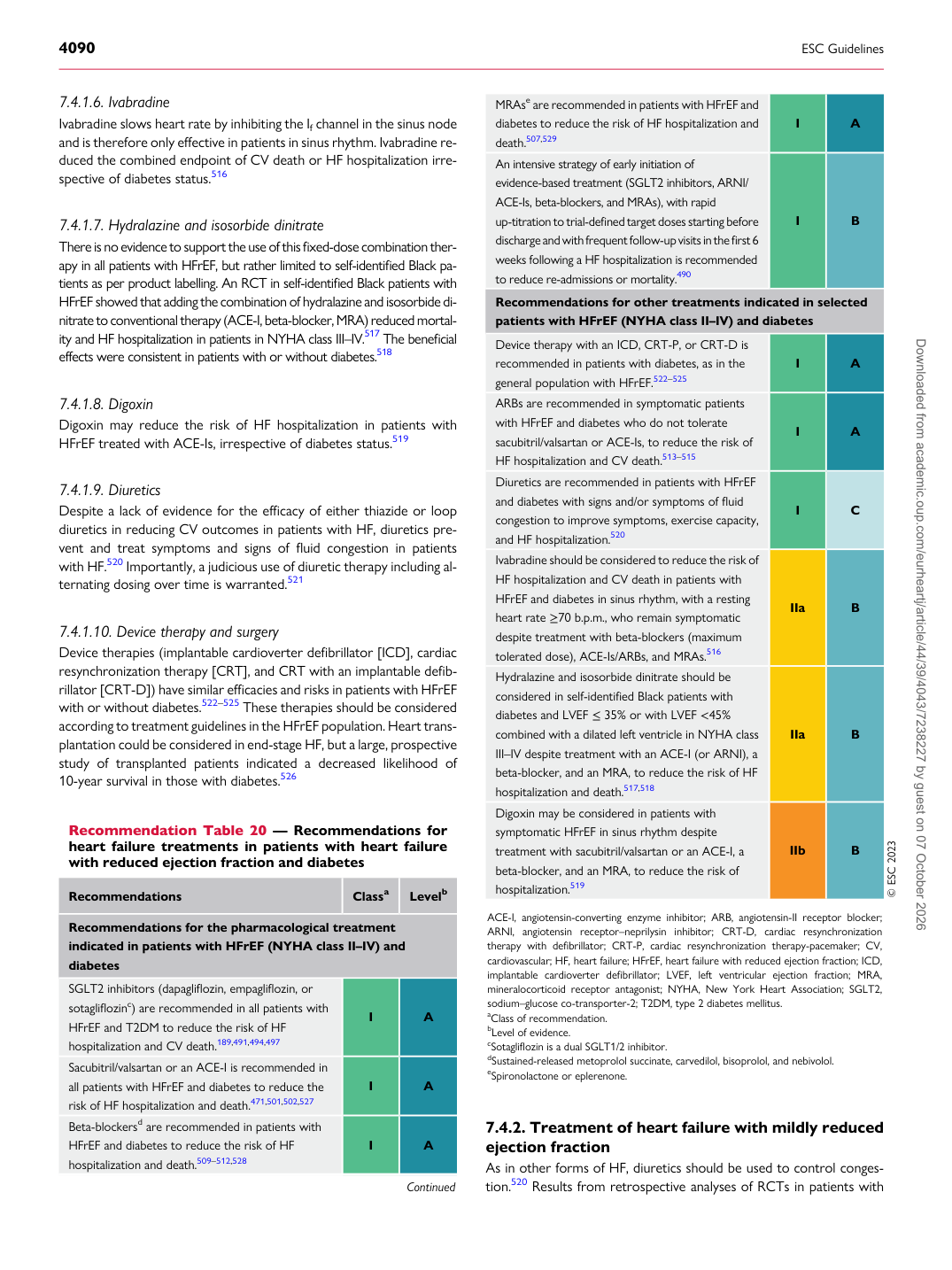
Recommendation Table 20 — Recommendations for heart failure treatments in patients with heart failure with reduced ejection fraction and diabetes

Recommendations Classa Levelb

Recommendations for the pharmacological treatment indicated in patients with HFrEF (NYHA class II–IV) and diabetes SGLT2 inhibitors (dapagliflozin, empagliflozin, or sotagliflozinc) are recommended in all patients with HFrEF and T2DM to reduce the risk of HF hospitalization and CV death.189,491,494,497 I A Sacubitril/valsartan or an ACE-I is recommended in all patients with HFrEF and diabetes to reduce the risk of HF hospitalization and death.471,501,502,527 I A Beta-blockersd are recommended in patients with HFrEF and diabetes to reduce the risk of HF hospitalization and death.509–512,528 I A

Continued MRAse are recommended in patients with HFrEF and

diabetes to reduce the risk of HF hospitalization and death.507,529 I A An intensive strategy of early initiation of evidence-based treatment (SGLT2 inhibitors, ARNI/ ACE-Is, beta-blockers, and MRAs), with rapid up-titration to trial-defined target doses starting before discharge and with frequent follow-up visits in the first 6 weeks following a HF hospitalization is recommended to reduce re-admissions or mortality.490 I B Recommendations for other treatments indicated in selected patients with HFrEF (NYHA class II–IV) and diabetes Device therapy with an ICD, CRT-P, or CRT-D is recommended in patients with diabetes, as in the general population with HFrEF.522–525 I A ARBs are recommended in symptomatic patients with HFrEF and diabetes who do not tolerate sacubitril/valsartan or ACE-Is, to reduce the risk of HF hospitalization and CV death.513–515 I A Diuretics are recommended in patients with HFrEF and diabetes with signs and/or symptoms of fluid congestion to improve symptoms, exercise capacity, and HF hospitalization.520 I C Ivabradine should be considered to reduce the risk of HF hospitalization and CV death in patients with HFrEF and diabetes in sinus rhythm, with a resting heart rate ≥70 b.p.m., who remain symptomatic despite treatment with beta-blockers (maximum tolerated dose), ACE-Is/ARBs, and MRAs.516 IIa B Hydralazine and isosorbide dinitrate should be considered in self-identified Black patients with diabetes and LVEF ≤ 35% or with LVEF <45% combined with a dilated left ventricle in NYHA class III–IV despite treatment with an ACE-I (or ARNI), a beta-blocker, and an MRA, to reduce the risk of HF hospitalization and death.517,518 IIa B Digoxin may be considered in patients with symptomatic HFrEF in sinus rhythm despite treatment with sacubitril/valsartan or an ACE-I, a beta-blocker, and an MRA, to reduce the risk of hospitalization.519 IIb B © ESC 2023

ACE-I, angiotensin-converting enzyme inhibitor; ARB, angiotensin-II receptor blocker; ARNI, angiotensin receptor–neprilysin inhibitor; CRT-D, cardiac resynchronization therapy with defibrillator; CRT-P, cardiac resynchronization therapy-pacemaker; CV, cardiovascular; HF, heart failure; HFrEF, heart failure with reduced ejection fraction; ICD, implantable cardioverter defibrillator; LVEF, left ventricular ejection fraction; MRA, mineralocorticoid receptor antagonist; NYHA, New York Heart Association; SGLT2, sodium–glucose co-transporter-2; T2DM, type 2 diabetes mellitus. aClass of recommendation. bLevel of evidence. cSotagliflozin is a dual SGLT1/2 inhibitor. dSustained-released metoprolol succinate, carvedilol, bisoprolol, and nebivolol. eSpironolactone or eplerenone. Downloaded from academic.oup.com/eurheartj/article/44/39/4043/7238227 by guest on 07 October 2026