p.46 抽出テキスト
displaced apical impulse) is recommended. For more details, see the 2021 ESC Guidelines for the diagnosis and treatment of acute and chronic heart failure.445

If one or more of the symptoms or signs above is present, HF can be suspected, and the following diagnostic tests are recommended: • Measurement of natriuretic peptides is recommended, if available. Values below the following cut-offs make the diagnosis of HF unlikely and other diagnoses should be considered:483–485

○B-type natriuretic peptide (BNP) <35 pg/mL (threshold in AF: <105 pg/mL). ○NT-proBNP <125 pg/mL (threshold in AF: <365 pg/mL).

However, natriuretic peptide concentrations may be disproportionately low in patients with obesity or in women, and disproportionately high in patients with advanced CKD, advanced age, or AF.486,487 Still, elevated concentrations support the diagnosis of HF and may guide further cardiac investigation.488

• ECG is recommended to detect abnormalities such as AF, signs of LV hypertrophy, Q waves, or widened QRS, each of which may be a sign of HF.489 • Echocardiography is recommended to assess cardiac function including LV function, chamber size, LV hypertrophy, regional wall motion abnormalities (that may suggest CAD), right ventricular function, estimated pulmonary pressure, valvular function, and markers of diastolic dysfunction. Transthoracic echocardiography may be considered to detect HF in patients with diabetes if other risk factors arise. • Chest X-ray is recommended to investigate other causes of dyspnoea (e.g. pulmonary disease). It may provide supportive evidence of HF (e.g. cardiomegaly, pulmonary congestion, pleural effusion). • Routine blood tests (including full blood count, urea, creatinine, and electrolytes, thyroid and liver function, lipids, and iron status (ferritin and transferrin saturation) are recommended to differentiate HF from other conditions, to obtain prognostic information, and to guide potential therapy. Additional diagnostic tests should be considered if other specific diagnoses are suspected (e.g. amyloidosis). • If HF is confirmed, additional diagnostic tests are recommended as summarized in the 2021 ESC Guidelines for the diagnosis and treatment of acute and chronic heart failure.445 7.4 Treatment of heart failure in patients

with diabetes 7.4.1. Treatment of heart failure with reduced ejection fraction Treatment of HFrEF encompasses therapeutic lifestyle modifications, as well as pharmacological and device therapies with benefits confirmed in RCTs, in which 30–40% of patients had diabetes. Treatment effects of medications and devices for HFrEF have been consistently demonstrated to not differ in patients with vs. without diabetes. Importantly, while the RR reductions are consistently similar for those with and without diabetes, given the higher absolute HFrEF clinical risk associated with diabetes, the ARR in patients with diabetes is typically higher, yielding a lower NNT for benefit among patients with diabetes. The cornerstone of treatment for HFrEF is pharmacotherapy alongside lifestyle interventions, which should be implemented before considering device therapy. The recent 2021 ESC Guidelines for the diagnosis and treatment of acute and chronic heart failure recommend starting quadruple therapy (angiotensin receptor–neprilysin inhibitor [ARNI]/ACE-I, MRA, beta-blocker, SGLT2 inhibitor).445 These four foundational treatments should be initiated early, as much of the benefits are seen within 30 days of starting treatment, and adding new drugs yields greater benefits than up-titrating existing drug classes. In the STRONG-HF (Safety, Tolerability and Efficacy of Rapid Optimization, Helped by NT-proBNP testinG, of Heart Failure Therapies) trial, 1078 patients with acute HF, 29% of whom had diabetes at baseline, were assigned to either high-intensity care with uptitration of treatments to 100% of recommended doses within 2 weeks of discharge or to usual care.490 Safety and tolerability were assessed at weeks 1, 2, 3, and 6 by full physical examination and laboratory assessments of NT-proBNP, sodium, potassium, glucose, kidney function, and haemoglobin measures. The study was stopped early due to a greater than expected between-group difference. The primary endpoint, consisting of 180-day re-admission to hospital due to HF or all-cause death, was significantly reduced in the high-intensity group, with a RR reduction of 34% (HR 0.66; 95% CI, 0.50–0.86) with similar incidences of serious adverse events. Of note, no sub-group analysis exists on patients with diabetes. Based on these data, an intensive strategy of early initiation of evidence-based treatment (SGLT2 inhibitors, ARNI/ACE-Is, beta-blockers, and MRAs), with rapid up-titration to trial-defined target doses and frequent follow-up visits in the first 6 weeks following discharge from a HF hospitalization is recommended to reduce re-admissions or mortality. The sequence of therapy initiation should be based on the individual patient phenotype taking into account BP, heart rhythm, and heart rate, as well as kidney function and risk of hyperkalaemia. While the start dose of SGLT2 inhibitors is the same as the target dose, ARNI/ACE-Is, beta-blockers, and MRAs should be started at low dose and up-titrated to the maximum tolerated dose. For more details on HFrEF therapy, please refer to the 2021 ESC Guidelines for the diagnosis and treatment of acute and chronic heart failure.445 The

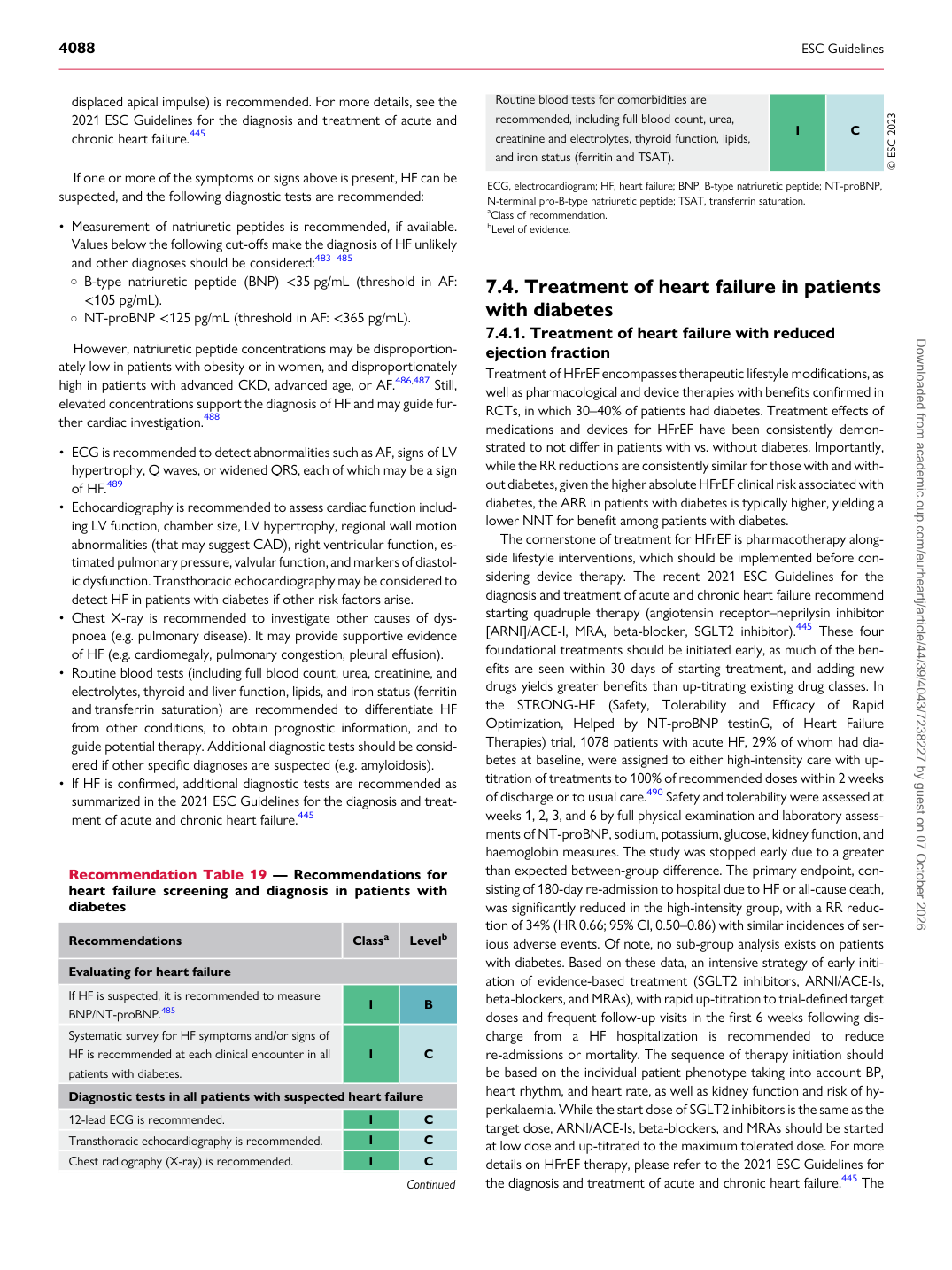
Recommendation Table 19 — Recommendations for heart failure screening and diagnosis in patients with diabetes

Recommendations Classa Levelb

Evaluating for heart failure If HF is suspected, it is recommended to measure BNP/NT-proBNP.485 I B Systematic survey for HF symptoms and/or signs of HF is recommended at each clinical encounter in all patients with diabetes. I C Diagnostic tests in all patients with suspected heart failure 12-lead ECG is recommended. I C Transthoracic echocardiography is recommended. I C Chest radiography (X-ray) is recommended. I C

Continued Routine blood tests for comorbidities are recommended, including full blood count, urea,

creatinine and electrolytes, thyroid function, lipids, and iron status (ferritin and TSAT). I C © ESC 2023 ECG, electrocardiogram; HF, heart failure; BNP, B-type natriuretic peptide; NT-proBNP, N-terminal pro-B-type natriuretic peptide; TSAT, transferrin saturation. aClass of recommendation. bLevel of evidence.

Downloaded from academic.oup.com/eurheartj/article/44/39/4043/7238227 by guest on 07 October 2026